Get Full Government Meeting Transcripts, Videos, & Alerts Forever!
Get email alerts on the Gaming Casino Legislation topic
No spam. Unsubscribe anytime.
House panel hears competing arguments over bill to license Allen County casino
Summary
Lawmakers heard pro-growth testimony from Fort Wayne officials and businesses and sharp opposition from residents, horsemen and the casino industry over House Bill 1038, which would open a new state casino license for Allen County with a $50 million minimum owner's fee. Witnesses debated projected revenue, effects on existing casinos and social harms; no vote was taken.
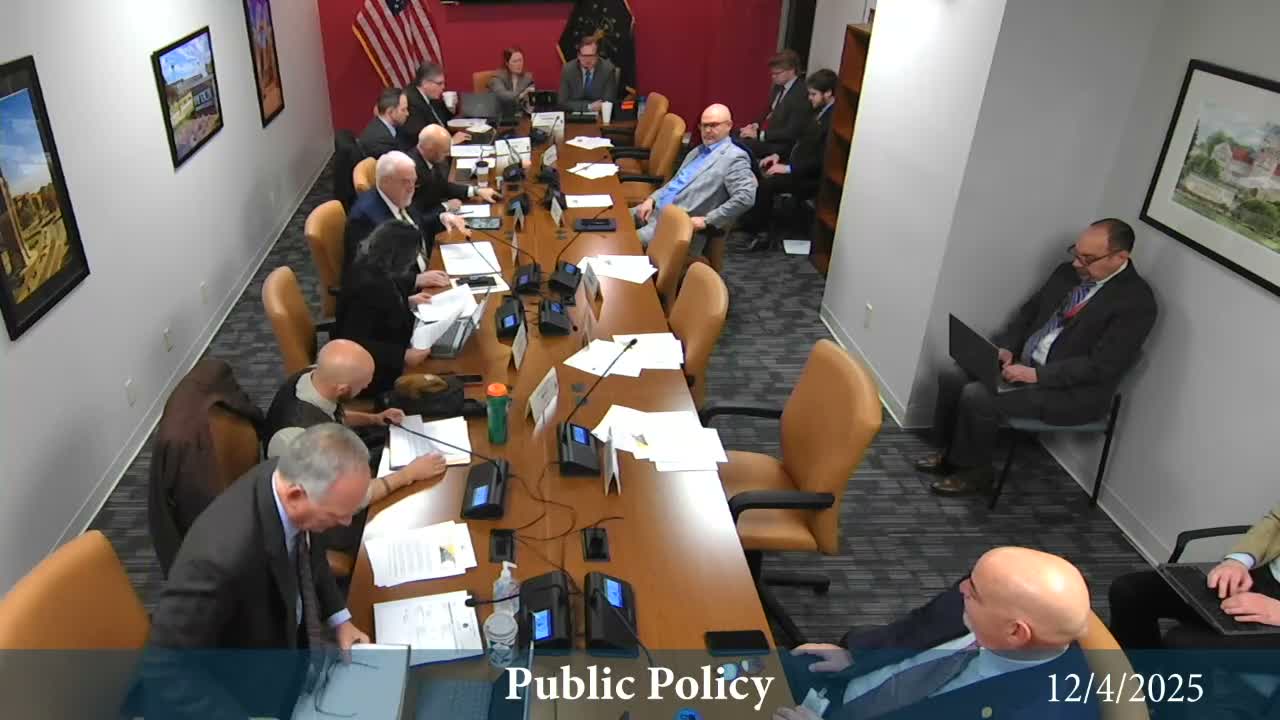
The House Public Policy Committee convened a lengthy hearing on House Bill 1038, which would require the Indiana Gaming Commission to accept applications for an owner's license to operate a new brick-and-mortar casino in Allen County and sets a minimum owner's-license fee of $50,000,000 to be deposited in the state general fund.
Rep. Snow, the bill sponsor, told the committee the proposal is aimed at economic development for Northeast Indiana and said the measure is intended to expand the state's brick-and-mortar casino market rather than relocate an existing license. "This bill expands gaming in Indiana," Rep. Snow said, adding that he wants social-responsibility protections and transparency as the proposal moves forward.
Supporters described significant local economic upside. Tom Kelly, a Fort Wayne businessman involved in the Electric Works redevelopment, cited a preliminary economic analysis that his group provided to legislators and said the project could attract roughly $500 million in private investment. "The repatriated revenue from out of state is projected to be roughly $50,000,000 a year," Kelly said, and he estimated wagering and related tax revenue could approach $90 million annually at stabilization, plus another roughly $13 million in property, food and lodging taxes; he and local leaders also projected roughly 1,024 direct jobs and nearly 976 indirect jobs tied to the development.
Mayor Sharon Tucker of Fort Wayne and Melissa Bieber of Greater Fort Wayne Inc. echoed the economic argument while urging local controls: Tucker said city and county leaders have discussed revenue-sharing arrangements that split proceeds by population and asked that, if a facility is located within Fort Wayne, the city council have a formal role in approvals rather than county officials. "We will make sure that proceeds are split based on population," Tucker said, adding she wants a first-class destination resort and expedited timing if a relocation path is pursued.
Several regional governments, including Steuben County commissioners, asked to be included in consideration as potential host sites and recommended local referenda and additional data collection. Will Howard, president of the Steuben County Board of Commissioners, told the committee his board voted to indicate an openness to discussion and said Steuben County believes it could capture substantial out-of-state visitor spending because of its interstate access.
Industry groups and some existing operators urged caution or opposition. Matt Bell, appearing for the Casino Association of Indiana, said the association opposes adding new licenses because creating new licenses injects uncertainty into capital markets and could discourage future investment. "Speed is what we've heard over and over again. I want to encourage y'all to consider the fact that when you are looking at gaming legislation, speed ought never, never, never, never be the driving concern," Bell said. Several operators said they have not taken a firm position on relocation of an existing license, but they cautioned that unpredictable market changes can hamper long-run investment.
Representatives of the horse-racing industry said a new license or a poorly sited relocation could cannibalize revenue that now supports purses and agribusiness across the state. Brian Elmore of the Indiana Horseman's Benevolent Protective Association said racinos provide an important stream of revenue for racing and that current arrangements give racing 12% of AGR from slots and table games. "If it cannibalizes Shelbyville and Anderson," Elmore warned, "you could lose 40% of funds that go to the horse-racing industry in some scenarios."
Opponents from the Coalition for a Better Allen County emphasized social costs. Kathy Humbarger and Kristen Bissons highlighted studies on problem gambling and said local revitalization in Fort Wayne has occurred without a casino. "If this is all about economics, you don't care about increases in bankruptcies, divorces, substance abuse," Humbarger said, urging the committee to commission a nonpartisan social-impact study.
Operators with underperforming facilities pressed for relocation rather than expansion. Alex Stolyar of Full House Resorts (Rising Star Casino) said his company supports a Northeast Indiana destination resort but prefers relocating an existing license instead of creating a 14th license; he cited the independent Spectrum Gaming Group study and argued relocation could increase state revenue by eliminating an underutilized legacy license while producing a larger, destination investment.
Committee members asked questions about the Spectrum report, how a new license would affect existing properties, referendum and local-approval mechanisms, and whether license-fee proceeds could be escrowed or shelved; Natalie Huffman, general counsel to the Gaming Commission, said she was not aware of any practice allowing a successful bidder to "shelve" a license without implementing it and said she would check statute and practice.
The panel took no vote. Rep. Snow closed by saying the bill is a conversation starter and acknowledged amendments are likely; the chair said the committee plans to continue the process and would accept additional testimony if substantial changes are proposed.
The committee record during the hearing included competing claims about projected tax revenue, job counts, the potential for cannibalization of existing casinos (and resulting impacts to horse-racing purses), and social costs tied to expanded local access to casino gaming. The committee did not take formal action; members said they expected more meetings and potential amendments before any committee vote.