Get Full Government Meeting Transcripts, Videos, & Alerts Forever!
Get email alerts on the Data Centers And Battery Storage topic
No spam. Unsubscribe anytime.
Panel advances bill to add battery storage to energy zones and keeps sales‑tax exemption for data centers with local share
Summary
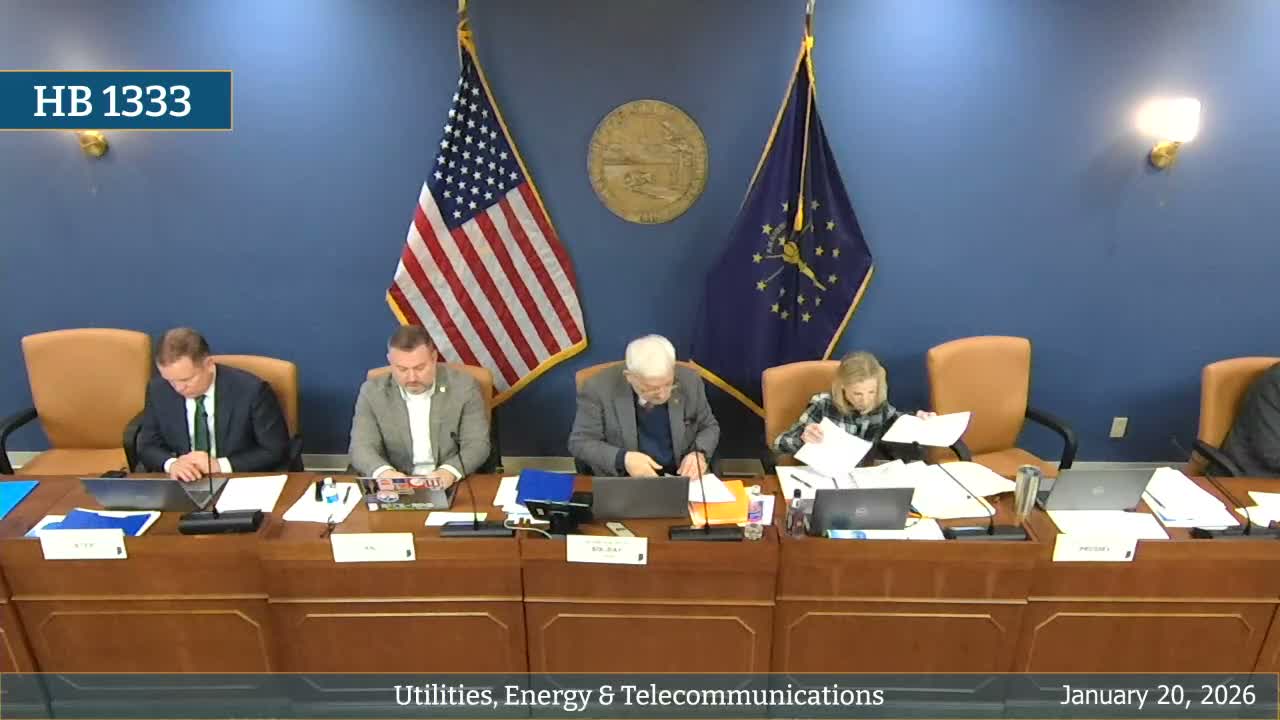
The committee passed House Bill 1333 after amending it to remove controversial OEO language, add battery energy storage systems into designated energy production zones, and keep the state sales‑tax exemption for data‑center equipment while directing 1% of the sales‑tax‑equivalent benefit to local governments; the vote was 9–3.
House Bill 1333, originally framed to encourage local economic development while protecting prime farmland, drew extended debate and public testimony before the House Utilities, Energy and Telecommunications Committee.
Representative Kendall Culp, the bill sponsor, summarized the measure as protecting prime soils (classes 1–3) while making development easier on lower‑quality soils, allowing liability immunity for brownfield redevelopment and explicitly adding battery energy storage systems (BEST) to the energy enterprise zones created in 04/25. Sponsor amendments removed previously proposed on‑site energy off‑take (OEO) language and replaced it with a provision that would give local governments 1% of the sales‑tax‑equivalent benefit that an approved data center would receive through the existing equipment sales‑tax exemption.
That change prompted contrasting testimony. Sam Carpenter, executive director of the Hoosier Environmental Council, opposed the bill as originally drafted and warned of large electricity footprints, water usage and potential PFAS contamination in closed‑loop cooling systems. "Data centers are not normal developments... they require huge amounts of electricity," Carpenter said, and urged retaining robust local review and emergency‑response language.
Industry witnesses and local officials pushed back. Steve Del Bianco (NetChoice) and others said data centers deliver assessed valuation, jobs and property‑tax offsets that can lower local tax burdens; David Bodaroff of the Association of Indiana Counties said the 1% local share creates a clearer partnership and helps communities that welcome these projects.
Committee members wrestled with section 13 language that, as drafted, could allow certain projects on lesser‑quality agricultural soils to be treated as a permitted use without a public hearing. Ranking member Matt Pierce asked staff to work with the sponsor and LSA to clarify the drafting so ordinary local zoning standards are not inadvertently overridden. The sponsor agreed to pursue technical fixes with LSA.
After public testimony and discussion, the committee moved the bill as amended; the transcript records the committee vote at 9–3. Members said they will continue working to tighten the language to preserve local input and avoid unintended preemption of local ordinance requirements.
The amended bill retains the state sales‑tax exemption mechanism for equipment but requires a local benefit equivalent to 1% of the sales‑tax savings; several witnesses suggested that an annual percentage of electricity tax exemption could be a more predictable revenue stream for localities and asked the sponsors to consider that option.