Get Full Government Meeting Transcripts, Videos, & Alerts Forever!
Get email alerts on the Transit Infrastructure topic
No spam. Unsubscribe anytime.
Metro to begin Pasadena construction in April on North Hollywood–Pasadena BRT, officials say
Summary
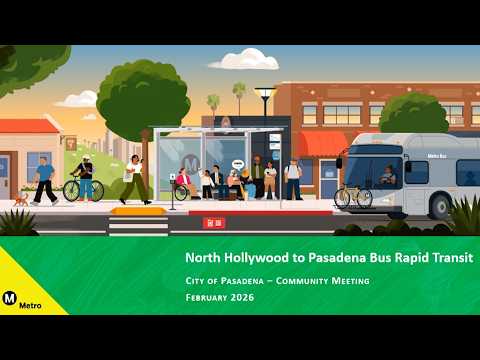
Metro and City of Pasadena officials told residents at a Pasadena City College meeting that the North Hollywood–Pasadena Bus Rapid Transit project will start civil work in Pasadena in April 2026, with four local stations, temporary and some permanent parking impacts and business-support programs to run during construction.
Metro and Pasadena officials said at a community meeting that construction of the North Hollywood–Pasadena Bus Rapid Transit (BRT) segment in Pasadena is scheduled to begin in April 2026, with civil work on station areas expected to be largely complete by the end of the calendar year.
Joaquin Zikas, director of transportation for the City of Pasadena, opened the meeting and said the presentation was intended to give residents and businesses along the route “a better understanding of the project, how we got here, and what the project looks like.”
Metro construction relations manager Matt Evans said the 22‑mile corridor — approved by the Metro Board in April 2022 after environmental review that began in 2019 — will add a premium bus service linking North Hollywood to Pasadena. Evans said the project is funded primarily by Measure M, the 2016 voter‑approved transit measure, and that Metro expects about 30,000 daily riders when the full line opens.
“The goal is to deliver a faster and more reliable ride,” Evans said, and he told attendees Metro projects roughly a 44% travel‑time savings per trip during peak periods compared with current service.
Anthony De Frenza, Metro project manager, previewed the four Pasadena stations and station design changes that will accompany construction: stations at Holly & Arroyo (connecting to Memorial Park Station), Colorado & Los Robles, Colorado & Lake, and a terminus at Pasadena City College (PCC) on Hill Avenue. De Frenza said Metro will use curb bulb‑outs to lengthen stops (from an existing ~150 feet of red curb in some locations to ~180–200 feet) so multiple buses can stage without weaving.
“The bulb out provides more room for the stations and the passengers,” De Frenza said, and noted some permanent parking losses: three parking stalls will be eliminated on the north side of westbound Holly, and one parking space will be removed on the eastbound side for bike‑lane improvements. He added there will be additional temporary parking impacts during construction and some stalls near the PCC terminus will be removed to accommodate layover and charging positions.
De Frenza described the PCC terminus as a longer canopy (about 48 feet) with two on‑site charging stations and rooftop pantograph equipment to give buses a 30–40 mile boost during short layovers. Evans said all BRT buses will be zero‑emission and that corridor‑wide transit signal priority will be used to request shortened reds or extended greens for approaching buses, though local implementation details will vary by city.
On route selection, De Frenza said Metro chose Mentor Avenue for the eastbound connection into PCC because it is one‑way and required fewer street modifications than other options identified in the environmental report.
A resident asked about end‑to‑end travel time; De Frenza said the full corridor is projected to take about 70 minutes from North Hollywood to Pasadena, a substantial reduction compared with existing services. Questions about unforeseen construction costs drew a description of Metro’s construction‑delivery approach: the project is using a CMGC (construction manager/general contractor) method, Metro has negotiated a price for the Pasadena segment, has built contingency into the budget and has done extensive potholing to limit unexpected utility conflicts. Metro expects to set a life‑of‑project (LOP) budget in May.
Evans outlined outreach and mitigation commitments: quarterly corridor‑wide community meetings during design and construction, door‑to‑door notices to residents within a quarter‑mile of active work, multilingual notices in English and Spanish, targeted Nextdoor and council‑district outreach, and a dedicated outreach team for nearby businesses. Aria Adao, who leads Metro’s business engagement and mitigation programs, said businesses within a quarter‑mile of future stations can enroll in the free Eat, Shop, Play program offering monthly marketing webinars, one‑on‑one coaching and promotion through Metro channels; Adao said outreach materials will be distributed to roughly 1,900 nearby businesses and the next webinar was scheduled for Feb. 27.
De Frenza acknowledged interjurisdictional negotiation remains ongoing: he said Metro has coordinated design work with Pasadena, Burbank, Glendale and Los Angeles but noted Burbank’s council has publicly raised concerns about dedicated lanes and that lane designations could change through continued coordination. He added that many core civil improvements and rider benefits can still be delivered if parts of the corridor in some cities operate in mixed flow rather than in permanent dedicated lanes.
Next steps, officials said, include city comment review and permitting in Pasadena (Metro said Pasadena design was submitted and city comments were expected imminently), outreach and community meetings beginning in March, the April 2026 start for civil work at the first two Pasadena locations (Holly & Arroyo and Colorado & Lake), and follow‑up visits to finalize staging plans. Metro said station hardware may not be installed until 2027 to avoid removal for Pasadena’s annual Rose Parade.
Attendees were invited to review station boards after the presentation and speak one‑on‑one with Metro, the contractor and city staff about specific construction staging and traffic‑control plans.
Sources: Community presentation at Pasadena City College; statements by Joaquin Zikas (director of transportation, City of Pasadena), Matt Evans (Metro construction relations manager), Anthony De Frenza (Metro project manager) and Aria Adao (Metro business engagement lead).