Get Full Government Meeting Transcripts, Videos, & Alerts Forever!
Get email alerts on the Tax And Fiscal Policy topic
No spam. Unsubscribe anytime.
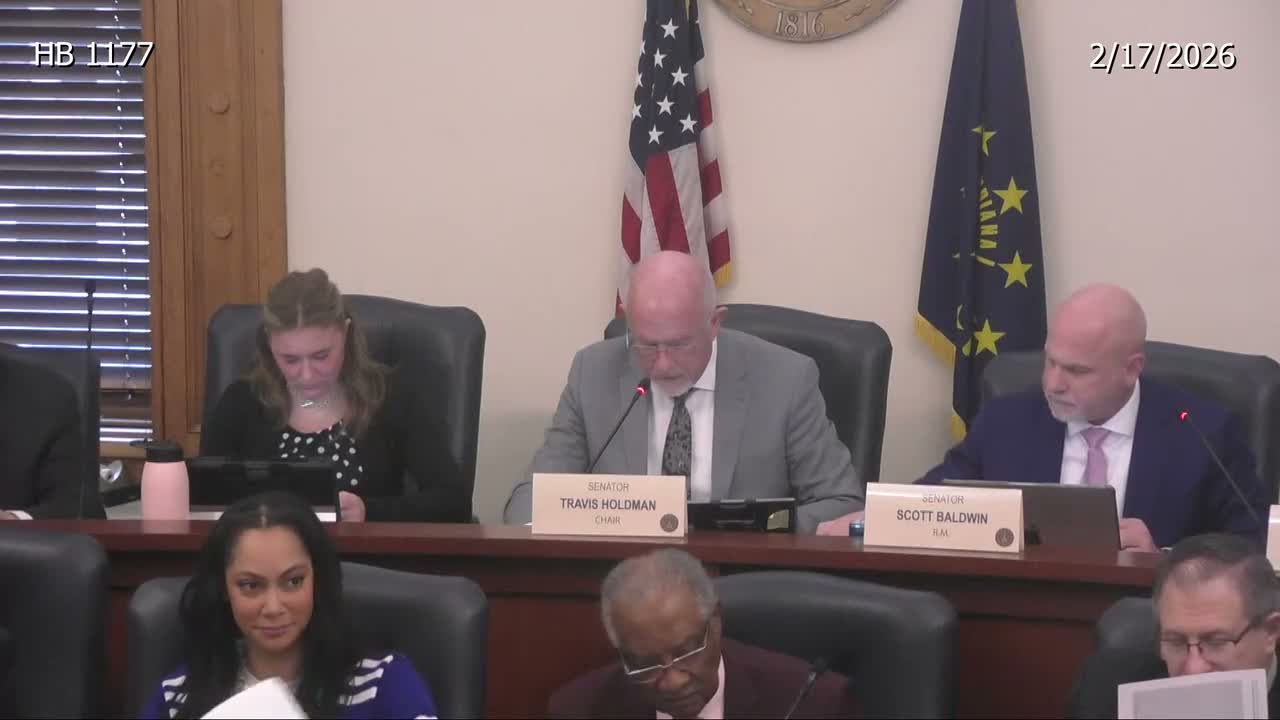
Sen. Baldwin outlines sweeping Amendment 91 to DLGF bill, committee approves it unanimously
Summary
Senator Baldwin presented Amendment 91 to the DLGF bill, a comprehensive package changing local income tax distribution, property-tax rules, TIF treatment, innkeepers and food-and-beverage allocations, municipal-advisor requirements and other fiscal provisions; the committee passed the amendment and moved the bill as amended to the floor by recorded votes of 13-0.
Senator Baldwin presented Amendment 91 to the DLGF bill ("12-10"), describing a comprehensive set of changes covering local income tax distribution, property-tax administration, tax increment finance rules, innkeepers and food-and-beverage tax allocations, municipal-advisor registration and other fiscal provisions. The committee debated the amendment and approved it 13-0, then voted to move the DLGF bill as amended to the floor by the same margin.
The amendment clarifies local income tax (LIT) rules, removes a 7,000-population cap that previously limited large towns and cities from opting into a countywide LIT rate, and requires counties to convene representatives of cities and towns to develop a LIT distribution agreement to be filed with the Department of Local Government Finance (DLGF) by Oct. 1; fire protection and emergency services and nonmunicipal rates are excluded from that distribution requirement. Baldwin said the change is intended to let counties and municipal units tailor distribution plans to local circumstances rather than forcing a single statewide model.
On property tax, the amendment would bar taxpayers from using property-tax credits by carryback, carryforward or refund; it would automatically transfer certain disabled-veteran recipients into a new transformed veteran credit and limit eligibility mechanics for 100% disabled-veteran deductions in specified counties. The amendment also adds a 10% penalty (of the taxpayer's total bill) when a property is found to have improperly claimed a homestead deduction and clarifies assessment procedures for agricultural land, shifting the burden to assessors to prove changes in land-use characteristics if they revise a prior agricultural classification.
Amendment 91 changes TIF (tax increment finance) language to align several statutes with HEA 1641 (2025) and to treat "residential" consistently as homestead property for base assessed-value determinations. It requires original owners of certain non-owner-occupied properties that are excluded from TIF base AV to enter written agreements with the redevelopment commission to ensure payment of taxes attributable to outstanding bonds; those agreements would be treated as liens and disclosed in real-estate sales disclosures. The amendment also preserves original TIFs for districts with multiple TIFs to ensure debt service remains payable, subject to DLGF appeal and approval processes.
Baldwin described changes to food-and-beverage and innkeepers' taxes that authorize a 1% food-and-beverage tax for the Town of Largo (revenues for economic development, parks and recreation) and create expirations (generally 01/01/2049) for several local levies. The amendment reallocates portions of Hamilton County and Allen County innkeepers' tax receipts to other municipalities in the county by population-based distributions, adjusts Hamilton County Tourism Board membership, and requires recipients of such appropriations to have voting representation on the county commission per statute.
The amendment would alter municipal-finance processes: municipal advisors would have to employ individuals who passed the applicable Series 50 or 54 exams, selection would shift from an RFP to an RFQ to be completed by July 1 every three years, municipal-entity contracts longer than three years would expire by 07/01/2026, and failure to register with DLGF would carry a $10,000 fine. Other miscellaneous provisions include expanding permissible uses for excise-tax distributions, increasing the public-works quotation threshold from $150,000 to $300,000, allowing drainage boards to finance projects for up to 10 years instead of five, and authorizing a $40 million augmentation for the Indiana Office of Information Technology (IOT) to pay contractual obligations.
Committee members asked for clarifications and raised concerns during a sustained Q&A. Senator Kidohra praised staff work on the voluminous amendment, asked about the IOT augmentation and supported the amendment. Senator Randolph pressed Baldwin about limits on homeowners-association voting by non-owner occupants and whether eliminating certain funding provisions would affect Gary's convention financing; Baldwin said the amendment preserves local flexibility and does not intend to undercut Lake or Porter County projects. Senator Rogers and Senator Niemeyer questioned the provision shifting industrial (steel-mill) assessments for Lake and Porter counties from the DLGF to county assessors, warning it could reintroduce nonuniform assessments and costly appeals; Baldwin said DLGF guidance and appeals processes remain available and that the intent is to give local officials more control.
After discussion, the committee adopted Amendment 91 on a recorded roll call (13-0). The committee then voted to move the DLGF bill as amended to the floor on the same 13-0 tally. The committee also considered other items later in the meeting before adjourning.
The committee did not vote on the underlying policy details beyond advancing the amended bill; next steps are consideration by the full chamber. The transcript does not specify a next hearing date for further floor action.