Get Full Government Meeting Transcripts, Videos, & Alerts Forever!
Get email alerts on the Land Use Solar topic
No spam. Unsubscribe anytime.
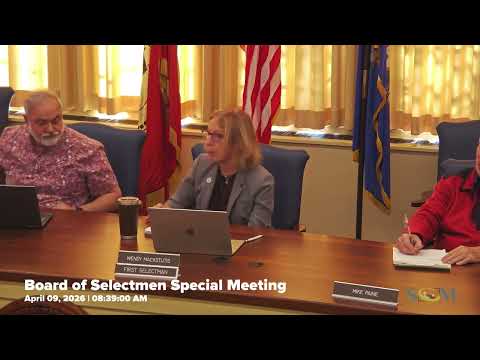
Simsbury board approves $17,475 peer‑review contract and votes to seek party/intervener status in Hot Meadow Street solar siting
Summary
The Simsbury board voted unanimously April 9 to hire Clough Harbor & Associates for an independent third‑party review of the Hot Meadow Street solar application and to file for party or intervener status with the siting council; pre‑filed testimony and exhibits are due April 16 and the evidentiary session is set for April 23.
The Simsbury board on April 9 approved a contract not to exceed $17,475 to hire Clough Harbor & Associates LLP (CHA) to perform an independent third‑party peer review of application CC‑26‑02‑200 (Hot Meadow Street, SL Simsbury LLC) and voted to file for party and/or intervener status in the state siting council proceeding.
The board moved and approved the CHA engagement after S6 read a motion adopting the Inland Wetlands and Watercourses Agency’s recommendation. The motion said the review shall substantially conform to the applicant’s proposal for services dated March 31, 2026, and directed the town manager to execute a contract. The voice vote was recorded as 6 in favor, 0 opposed.
Board members then discussed whether the town should formally seek standing in the siting council matter. S1 noted the town had previously submitted a December 30 letter with conditions and that the applicant and the Conservation Commission had addressed many of the town’s requests. S3 reported that the Conservation Commission had provided recommendations — chiefly about wildlife seed mix, invasive‑species management and questions about a small apiary — and that the commission planned to memorialize its suggestions in a letter. S3 said there had been no formal opposition at conservation.
Several members argued the town should apply for party status (or both party and intervener) to secure broader rights in the proceeding. S5 explained the difference in procedural rights: party status provides fuller participation and an explicit right of appeal under the Uniform Administrative Appeals Act, whereas intervener status provides strong participation rights but more limited appeal options. Board members said applying for party status would not necessarily mean the town intends to appeal; rather, it would preserve leverage in negotiations over siting, setbacks, safety and visual mitigation.
During the discussion members cited project details from the record: the presentation indicated the current proposal would produce about 4.65 megawatts on roughly 17 acres (a reduced footprint from earlier versions), and S1 said the town’s estimated revenue would be about $45,000 per year if approved. Board members compared the site to the larger Tobacco Valley Solar project, which they said is roughly 26.4 MW on about 135 acres, and noted the town successfully negotiated design changes on that earlier project.
Board members pressed for specific mitigation the town could seek if it becomes a party: moving arrays further into the parcel to increase setbacks from the road and river, additional landscape screening, decommissioning bonds and assurances about invasive‑species management. S6 raised concerns about potential RF (radio frequency) interference and audible noise from inverters and said those equipment choices and placement should be part of the town’s review and testimony. Several members said the applicant’s visual renderings provided to the town were inadequate.
Legal and procedural deadlines were emphasized: the evidentiary session is scheduled for April 23 at 2:00 p.m., and pre‑filed testimony and exhibits must be submitted by April 16. S5 and staff offered to assist in drafting the petition and pre‑filed testimony; the board directed the town attorney to file the petition for party/intervener status with input from appropriate people, and directed the town manager to follow up.
The motions to retain CHA for the peer review and to file for party/intervener status both passed by the same 6‑0 voice vote. The board adjourned after the votes.
What happens next: town staff and counsel will prepare the petition and pre‑filed testimony to meet the siting council deadlines; the evidentiary session is set for April 23. The town’s petition, the CHA peer‑review scope and any pre‑filed testimony will be part of the official record in the siting council proceeding.