Get Full Government Meeting Transcripts, Videos, & Alerts Forever!
Get email alerts on the Renewable Energy Jda topic
No spam. Unsubscribe anytime.
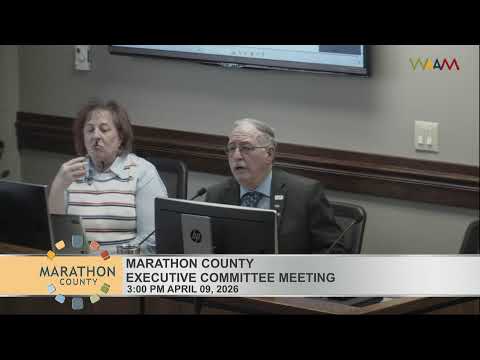
Marathon County executive committee asks staff to draft task-force framework as officials weigh Alliant JDA for Hub City Wind
Summary
After a lengthy public comment period opposing a Joint Developer Agreement (JDA) for the Hub City Wind project, the Marathon County Executive Committee voted to direct administration and counsel to draft framework language for a work group or task force to evaluate negotiations with developers and local protections.
The Marathon County Executive Committee, after receiving multiple public comments urging caution about a potential Joint Developer Agreement (JDA) for the Hub City Wind project, voted to direct county administration and corp counsel to draft proposed language for a work-group or task-force framework to be considered at the board's organizational meeting.
Public commenters raised environmental, property-value and road-damage concerns tied to industrial wind development. Heidi Pesky told the committee, “By 2050, the world will be drowning in 43,000,000 tons of worn out blades,” and asked officials to include decommissioning and disposal provisions in any JDA discussions. Christine C. Hafer cited a Brown County board of health action and noted statutory avenues for remedying highway injury under Wisconsin Statute 86.02. Online commenter Wendy Regalski urged supervisors: “Do not lock Marathon County into a contract that limits your options for decades.”
Committee members and staff spent most of the meeting outlining what a JDA could and could not accomplish and whether early discussions with developers would preserve the county's leverage. Vice Chair Dickinson and others asked why developers were not present; staff said Alliant representatives had been invited but were not at the meeting. Administrator Leonard told the committee that an initial conversation does not obligate the county: “If you get it back and it doesn't meet your needs, you can always say no.”
Supervisor Robinson recommended using the county's metallic-mining ordinance as a model for protections, pointing to mechanisms such as a transportation trust fund for road damage, groundwater funds for impacted wells, and application fees to cover county costs. County counsel warned the group that certain landowner lease terms and private contracts could complicate what a county-led JDA could require, and that developers often seek limits on local intervention in PSC proceedings.
Members debated creating a task force with county board members, town chairs and outside experts. A motion to form a specific task force (four county board members, three town chairs and two experts) was moved and ultimately defeated. The committee then approved a separate motion directing administration and corp counsel to draft language for a framework (rules/charter) that would allow creation of a project-based work group or task force and to present that language at the organizational meeting for consideration.
What happens next: staff and counsel will draft recommended rule language and a proposed charter to allow the board to create a task force if it chooses. The committee heard repeated urgings from residents that any future negotiations prioritize setbacks, decommissioning obligations, mechanisms to reimburse road damage and transparency about how a JDA would interact with private landowner leases and PSC processes.