Get Full Government Meeting Transcripts, Videos, & Alerts Forever!
Get email alerts on the Criminal Evidence Confrontation topic
No spam. Unsubscribe anytime.
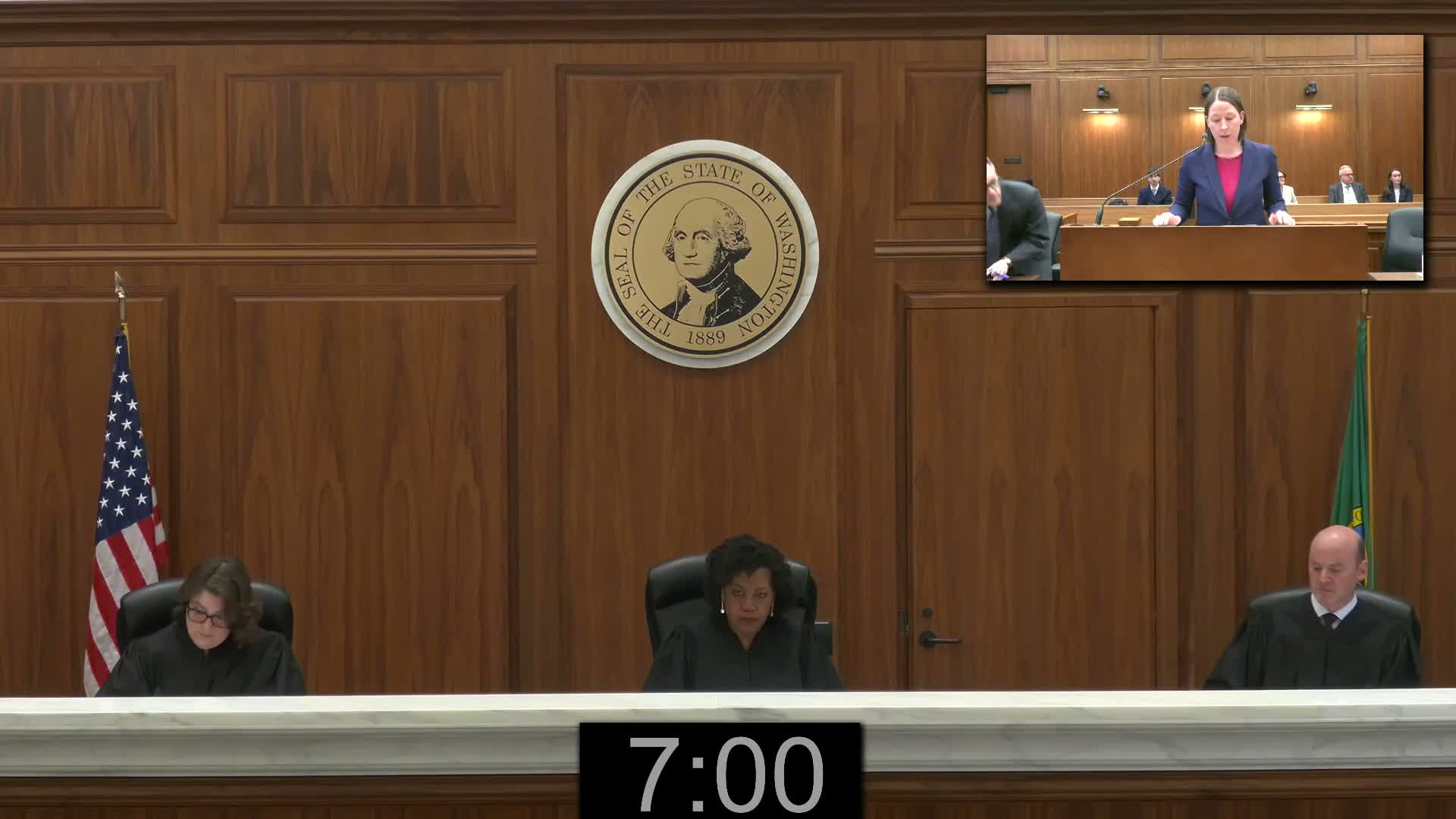
At oral argument in State v. Allen Dean, defense and state spar over excluded evidence and whether confrontation applies to forensic data
Summary
In an appellate argument over Allen Dean's conviction, defense counsel Mary Swift urged admission of woods-incident testimony and shed writings as relevant to an alternative-suspect defense; the State countered that the confrontation clause protects statements but not necessarily machine-generated forensic data, and the panel pressed both sides on authentication and chain-of-custody issues.
Mary Swift, defense counsel for Allen Dean, told a Washington appellate panel that Dean's trial was "marred by multiple constitutional and evidentiary errors" and urged the court to admit excluded defense evidence she says is critical to an alternative-suspect theory.
Swift reserved three minutes for rebuttal and focused her argument on two contested items: a woods incident in which Swift said TJ Peters and an associate (identified in briefing as Eric Corbin) donned gloves and uttered a threat — "do you wanna die like ML" — and graffiti or "shed writings" the defense seeks to admit under an ancient-documents hearsay exception. Swift argued the woods incident and the donning of gloves bear on guilty knowledge and the feasibility of an alternative perpetrator, and she urged that questions about whether others knew ML died by manual strangulation go to weight rather than per se inadmissibility.
The state's attorney, Matthew Pittman, representing the State of Washington, countered that the confrontation clause protects the right to confront speakers of out-of-court statements and that machine-generated data or non-statement evidence presents distinct legal issues. "What the right to confront is recognizing is the speaker of statements that are used against you," Pittman told the panel, arguing the court must distinguish statements from machine outputs and related technical foundations.
Panel members pressed both sides on how defendants can challenge forensic datasets, chain-of-custody, and compliance with relevant Washington rules and statutes when the person who conducted testing is unavailable. Judges asked whether foundation questions (ER 104) and statutory compliance (WACs and RCWs) are appropriately addressed outside confrontation doctrine and how courts should treat human-conduct testing versus fully automated outputs.
Swift acknowledged the state’s propensity concerns but emphasized factual corroboration: she said an associate wore gloves consistent with a theory that the alternative suspect could have avoided leaving forensic traces, and she maintained that shed graffiti witnesses (including testimony referenced to Tony Gonzalez) would authenticate the writings sufficiently for admission. The panel repeatedly questioned who authored the shed writings and when they were made; Swift conceded the authorship and timing were not definitively established but argued authentication standards are low and that testimony could link the writings to the relevant cast of characters.
Pittman invoked case-law lines addressing expert testimony and the right to confront, urging the court to limit confrontation to statements relied on for truth rather than to extend it generally to machine-generated datasets. Swift replied in rebuttal that precedent — which she summarized as holding that "the analyst who performed the testing and wrote the report was the real witness" — supports the view that defendants have the right to challenge the analyst’s work when it is used against them.
The argument featured extended exchange about the practical consequences of different doctrinal approaches: whether requiring every individual who touched or processed samples to testify would upend ordinary courtroom practice, and whether distinctions between automated systems and human-driven forensic processes matter for confrontation. Both sides agreed there is substantial precedent to reconcile; the panel sought guidance on how to balance confrontation protections, hearsay and authentication rules, and ER 104 foundation procedures.
After oral argument the panel thanked counsel and declared the matter submitted. The court then called the next case, Performance Contracting Inc. v. Department of Labor and Industries.