Lifetime Citizen Portal Access — AI Briefings, Alerts & Unlimited Follows
Lake County interim public works director outlines five-year pavement preservation plan and funding challenges
Loading...
Summary
Interim Public Works Director Lars Ewing told the Planning Commission Lake County aims to preserve pavement with a 5-year plan targeting about 30 miles per year (stretch goal 50), relying primarily on gas-tax funds (highway users account and SB1), federal programs and one-time grants while community members pressed for clearer contact points and safety-driven priorities.
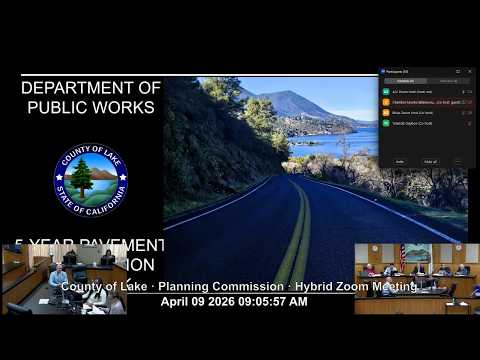
Interim Public Works Director Lars Ewing presented the Planning Commission with a five-year pavement preservation plan and an overview of how Lake County maintains its roads, saying the county seeks to reverse a declining Pavement Condition Index (PCI) that measured 34 in 2022.
Ewing told commissioners the county identifies about 612 miles of county-maintained roads, of which roughly 464 miles are paved and 148 are unpaved. He described three maintenance tiers: reactive/emergency response, routine maintenance (patching, striping, vegetation management) and pavement preservation, commonly implemented as chip seal followed by a fog seal to bind aggregates and extend surface life. "Chip seal is oil and rock — it's like painting a house; it preserves what we have," Ewing said.
Why it matters: Ewing said routine operations and administration consume the bulk of recurring funding (about 70%), leaving SB 1 and federal programs to support pavement preservation and a grant-dependent capital program for bridges and reconstruction. "Over 75% of our funding comes from gas-tax-related sources," he said, naming the Highway Users Tax Account, SB 1 (the Road Repair and Accountability Act) and federal programs such as the Regional Surface Transportation Program (RSTP).
What the plan calls for: The department completed about 38.5 miles of chip seal work in the 2025 program, at a reported project cost near $1.6 million and an average chip-seal cost the presentation cited at roughly $41,420 per mile (for preservation, not reconstruction). The five-year forecast targets about 30 miles per year as a baseline; staff explored a stretch goal of 50 miles per year, which Ewing estimated could cost about $50,000 per mile and average roughly $1.5 million annually (a five-year projection the presentation cited at about $7.8 million, noting cost-escalation assumptions).
Community questions and concerns: Public commenters and commissioners asked how the program accounts for tribal and ecological impacts from roadside spraying, heavy-vehicle damage after wildfire response, private roads and whether repaired roads would be brought to 4290 compliance (the public comments referenced "4290"). Ewing said spray practices are controlled (some areas are excluded and waterways are protected), and he provided the Public Works main number for service requests and concerns: (707) 263-2341, noting that the road superintendent typically handles routed requests.
On heavy vehicles and wildfire impacts, Ewing said FEMA hazard-mitigation grants and other reactive funding have been used for specific wildfire-related repairs, and the county is pursuing local impact-fee options (construction and refuse vehicle impact fees) to offset heavy-truck damage. Regarding private roads, he said countywide service-area mechanisms exist historically but would require follow-up; encroachment permits now include provisions to reduce trench-settlement effects and can require half-width paving or other mitigation.
Safety and prioritization: Margo Kambara, a representative of the Lake County General Plan Advisory Committee, urged the commission to prioritize health-and-safety criteria (fire-safe access, evacuation routes, narrow-grade roads) in addition to PCI-based ranking. Ewing said development review coordinates closely with Community Development, that the county maintains a local road safety plan updated every three years, and that many safety projects are handled as site-specific capital work.
What comes next: Ewing said the five-year plan is a living document; the department intends to post annual road lists and the presentation to the county website as web resources are reorganized. He also asked the commission to consider staffing and contracting options if the county intends to scale preservation toward the 50-mile stretch goal.
Ending: The Planning Commission thanked Ewing for the briefing and invited the public to submit service requests or project inquiries through Public Works for follow-up. The presentation was informational; no formal action or vote was taken.