Lifetime Citizen Portal Access — AI Briefings, Alerts & Unlimited Follows
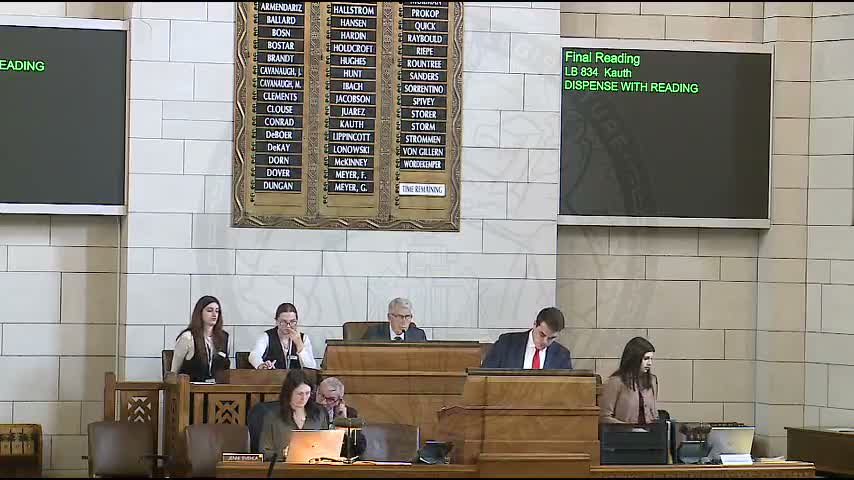
Senators debate 2.5% property‑tax growth cap amendment attached to LB 8 34
Loading...
Summary
Senators spent extensive floor time debating AM 3142, an amendment to LB 8 34 that would impose a 2.5% annual cap plus a ‘real growth’ allowance on property‑tax increases for political subdivisions and require a 60% voter override to exceed the cap. Supporters said caps bring predictability; opponents warned of unfunded mandates and harm to local services.
Senators on the floor debated AM 3142, an amendment offered to LB 8 34 that would impose a uniform property‑tax growth cap for political subdivisions. The amendment — described by sponsor Senator Hansen as a 2.5% cap plus a ‘real growth’ percentage with a biennial averaging rule and a 60% voter override — was the focus of an extended exchange of arguments about local control, public‑safety funding and state responsibility for tax relief.
The sponsor, Senator Hansen, told colleagues the amendment was intended to bring “uniformity to the property tax request process,” moving a previous 2% proposal to 2.5% plus an allowance for real growth and a biennial average that limits a subdivision’s increase to 5% over two years. “This amendment moves a 2% cap … to 2.5% plus a real growth percentage,” Hansen said, adding that community colleges would be excluded and that local subdivisions could exceed the cap only after a public vote receiving 60% approval.
Opponents warned the change would amount to an unfunded mandate. Senator Abel argued the amendment was excessive and premature: “We want LIDS. We want LIDS. We wanna control their spending,” he said, urging caution and noting the recent strain on local budgets from disasters such as wildfires. Abel cited written testimony from the OpenSky Institute, saying the analysis showed hard caps can “harm the operation of local government that rely on property tax revenue.”
Revenue‑committee chair Senator Von Gillard, who said he supported the underlying bill but not the pending amendment, summarized recent state spending on property‑tax relief on the floor: “This is a year where approximately $1,600,000,000 was provided in direct property‑tax relief within the budget. We provided approximately $160,000,000 in homestead exemptions funded entirely by the state, and we funded approximately $2,500,000,000 in school funding.” Von Gillard urged more deliberative work rather than last‑minute structural changes.
Supporters of AM 3142, including Senators Bazin and Brandt, argued caps create predictability and fiscal discipline. Bazin listed commonly cited benefits of caps — predictability for taxpayers, protection against rapid tax increases, and improved affordability — and said the discussion reflected the concerns constituents have raised. Brandt said a modest cap compounded over time could return significant sums to taxpayers and provide relief in local communities.
Senator Mosier questioned the state’s prior actions and asked Senator Clements for numbers on state credits; Clements responded that property‑tax credits totaled about $1.5 billion per year, an increase of $137 million in the current biennium. The exchange highlighted a recurring floor theme: whether additional statutory caps are necessary given recent direct relief paid from the state budget.
Hansen said AM 3142 included compromises intended to make a hard cap workable — including real‑growth allowances, a biennial averaging approach, and a required voter override to exceed the cap for large projects or emergency needs — but acknowledged next steps would require further work on valuation methods and other technical details.
No final vote on AM 3142 was recorded in the transcript; Senator Hansen told colleagues he intended to continue the conversation and that he was “planning on pulling this amendment down the road but I think we need to talk about it first.” The debate was left open as the body recessed, setting the stage for additional conversations or future committee work.