Get Full Government Meeting Transcripts, Videos, & Alerts Forever!
Get email alerts on the Utilities Water Sewer topic
No spam. Unsubscribe anytime.
Portsmouth work session reviews consultant—lueprint to raise fixed charges, add sewer fee and reshape usage tiers
Summary
Consultants recommended raising the water fixed charge, adding a sewer fixed charge, creating a new low-usage tier and increasing ancillary fees and wholesale rates to close projected FY27 fund shortfalls; councilors asked for more modeling on tiering, irrigation impacts and legal defensibility.
Portsmouth—ity Council members reviewed a consultant nalysis on March 2 that recommends overhauling the city—anking for water and sewer services to restore fund health and better align customer charges with the cost of service. The study—alls for higher water fixed charges, the addition of a sewer fixed charge, a new low-usage tier to protect basic indoor affordability, and increases to ancillary fees including capacity surcharges and wholesale rates.
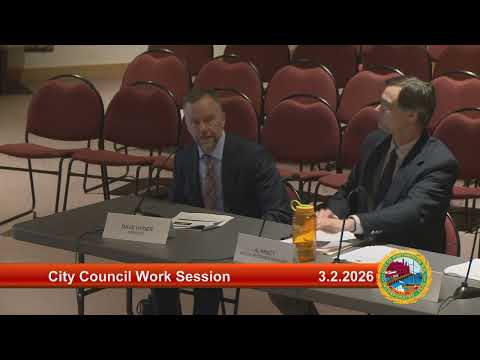
The consultant, David Hyder, recommended a new rate design that would scale fixed charges by meter-equivalent capacity and move the water fixed-charge share of revenues from roughly 7% toward about 16% of water revenue. "Your current fixed charges are not scaled consistently with industry standards," Hyder said, and he urged adding a sewer fixed charge that would start at about $8 for a typical customer to stabilize revenues.
Al Pratt, Portsmouth's water resource manager, told councilors that the study responds to a decade-long shift in customer mix (fewer industrial users, more multi-unit and seasonal residences), rising regulatory costs such as PFAS treatment and several large capital projects. Pratt summarized the capital priorities and noted a PFAS treatment requirement for the Greenland well with a 2029 deadline.
Why it matters: Hyder said the current revenue stream will leave the city well below its target net positions in FY27: roughly $3.7 million short on water and about $3.3 million short on sewer even after the recommended changes. To close those gaps and rebuild reserves, the consultant recommended continued, phased rate increases in the 5'7% range in coming years.
Key elements of the proposal include: - A higher water fixed charge scaled by meter size (to bring fixed revenue to ~16% of water revenues, using AWWA meter-equivalents). - A new sewer fixed charge (initial example roughly $8 for a typical account) because the city currently has no explicit sewer fixed charge. - A reworked usage tier structure that splits the current 0'10-unit band into a lower "essential" tier (0'5 units) priced to cover basic indoor water needs and higher tiers to better capture large-volume users. - Increased ancillary and one-time capacity charges (examples shown: water up to 1" from about $1,400 to $3,300; sewer from about $4,000 to $8,000) and higher wholesale unit rates for Newcastle and Rye to reflect FY27 cost-of-service.
Hyder illustrated customer impacts with examples: a typical residential household using six units now averages about $145—$146 per month; under the consultant's recommended structure that combined water-and-sewer bill would be about $155 per month (roughly a 6.5% increase). For customers with little or no use (seasonal homes), the fixed-charge portion would increase substantially compared with the current $4.95 fixed charge, which has not changed in 24 years.
Councilors pressed for more modeling and legal guidance. Several elected members asked whether the city could shift a greater share of costs onto commercial and large users to lower residential bills. Staff and the consultant cautioned that cost-allocation must be defensible: "You can't be arbitrary and capricious in terms of how we set rates," Hyder said, noting that poorly supported reallocation could invite legal challenge and possible involvement of the state Public Utilities Commission. City staff said they would "sharpen the pencils" and run alternative models that test defensible shifts toward larger users and explore additional high-end tiers.
Irrigation and wholesale customers: Council members also questioned irrigation-meter treatment. Hyder said most irrigation customers remain in the lowest irrigation tier; nevertheless, irrigation places peak demands and therefore costs more to serve. The consultants recommended aligning irrigation rates with cost-of-service and suggested exploring separate residential vs. commercial irrigation rates where appropriate. For wholesale customers, staff said Newcastle has about 298 retail accounts behind its wholesale meter and Rye about 70; proposed wholesale rates would increase unit prices (Newcastle water from ~$3.52 to ~$6.50 per unit in Hyder's example).
Next steps: Staff and consultants recommended several implementation steps: meet with the fee committee to review fixed fees and capacity charges, notify wholesale customers of the proposed wholesale rates and amend the sewer ordinance (currently unclear) to allow a sewer fixed fee. Any formal adoption would come through the budget process; no ordinance or rate changes were approved at the work session.
During public comment the mayor opened the floor; no members of the public spoke. The work session adjourned and the council prepared to convene the regular meeting.
What remains unresolved: councilors asked for more distributional data (counts of customers in higher usage bands) and modeling of alternative tier structures and phasing scenarios, plus written legal analysis to confirm that proposed allocations would be defensible if challenged. Staff committed to produce additional data and to return with refined options before formal adoption via ordinance or budget action.