Lifetime Citizen Portal Access — AI Briefings, Alerts & Unlimited Follows
Seattle Public Utilities briefs council committee on tribal engagement, watershed access
Loading...
Summary
Seattle Public Utilities told the Finance Native Communities and Tribal Governments Committee about its government-to-government engagement with federally recognized tribes, projects including interpretive signage and a South Park water-quality facility, reserved access rights in the Cedar River watershed, and upcoming coordination on the Centennial Accord.
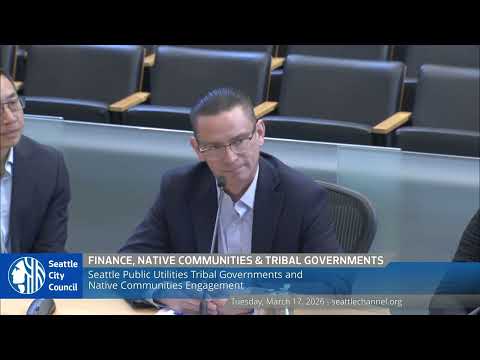
Seattle Public Utilities told a City Council committee on March 17 that it has expanded government-to-government engagement with federally recognized tribes across a range of projects, from interpretive signage and hatchery co-management to watershed access and federal relicensing processes.
At the Finance Native Communities and Tribal Governments Committee, Andrew Lee, general manager and CEO of Seattle Public Utilities, said the utility manages infrastructure that affects cultural and natural resources and has an obligation to consult with tribal nations. “We operate 2 dams that are critical infrastructure to supplying 1,600,000 people in King County,” Lee said, noting the environmental impacts of dams, stormwater and combined sewer overflows and the need for mitigation and collaboration.
Kyle Iron Lightning, SPU’s tribal relations advisor, described recent and planned engagement across projects including interpretive signage at Bitter Lake Reservoir (a 21,000,000‑gallon drinking-water reservoir replacement), updated signage at the Salmon Bay Natural Area near the Ballard Locks, a Thornton Creek culvert strategy to address fish-passage barriers, and preliminary tribal outreach for the South Park Water Quality Facility along the Duwamish River. “When we send letters to tribal leadership from the utility … we wanna make sure that if it’s going to the tribal leader of that particular tribe, that it comes from our general manager,” Kyle said, explaining that GM-signed letters recognize tribal sovereignty and the utility’s decision-maker role.
Kyle also described day-to-day coordination at watershed sites and a working relationship with the Muckleshoot Indian Tribe at the Cedar River sockeye hatchery, including collaboration with state co-managers under a Muckleshoot settlement agreement. He said SPU is engaging tribes early on the Thornton Creek culvert work and has begun sending letters and setting up project meetings with tribal staff.
Committee members pressed SPU on how engagement will be coordinated across citywide programs rather than isolated projects. Lee pointed to prior comprehensive planning—the 2015 CSO long-term control plan—and said SPU and county updates will include tribal engagement. A council member asked SPU to confirm that it will engage tribes on district projects such as the Telarus property and daylighting efforts; Lee said Telarus is in early planning about 2½ months after acquisition and that tribal engagement will be part of future long-range planning.
The committee also discussed the Cedar River watershed’s special status. Lee said the city owns roughly 99.9% of the South End watershed, which enables Seattle to provide an unfiltered water supply but requires strict access controls. Kyle said the Muckleshoot Indian Tribe retains reserved hunting and gathering rights in parts of the watershed under a settlement agreement and that SPU maintains access agreements allowing escorted tribal entry for cultural-resource purposes; tribes notify watershed management and staff document and escort visits to meet regulatory oversight.
Franchesca Murdan, tribal relations director in the Office of Intergovernmental Affairs, described statewide frameworks and training, saying the Centennial Accord and related agreements guide government-to-government relationships. She said the state’s Department of Archaeology and Historic Preservation helps implement protections for cultural and archaeological resources and that some location information is restricted and available only to tribal partners.
SPU officials emphasized institutionalizing engagement by maintaining tribal relations positions and elevating consultation in project planning. The committee received the briefing and scheduled further discussion: SPU will provide more detailed briefings for council offices as projects progress, and the committee chair announced a special meeting March 30 for budget and shelter briefings and a planned April 7 presentation on the Centennial Accord.
The committee adjourned after the briefing; no formal motions or votes were recorded on this item.