Get Full Government Meeting Transcripts, Videos, & Alerts Forever!
Get email alerts on the Tax Policy topic
No spam. Unsubscribe anytime.
Assembly Revenue & Taxation subcommittee refers a slate of tax bills to suspense file after hour-long hearing
Summary
The Assembly Revenue & Taxation Subcommittee heard presentations on a package of tax measures — from a cleanup tax credit for small businesses to proposals limiting investor like-kind exchanges, farm tax credits, extensions for solar property-tax exclusions and several conformity measures — and referred each item to the committee's suspense file for later consideration.
The Assembly Revenue & Taxation Subcommittee met in Sacramento and heard presentations and stakeholder testimony on a dozen tax-related bills before referring each to the committee's suspense file for additional review.
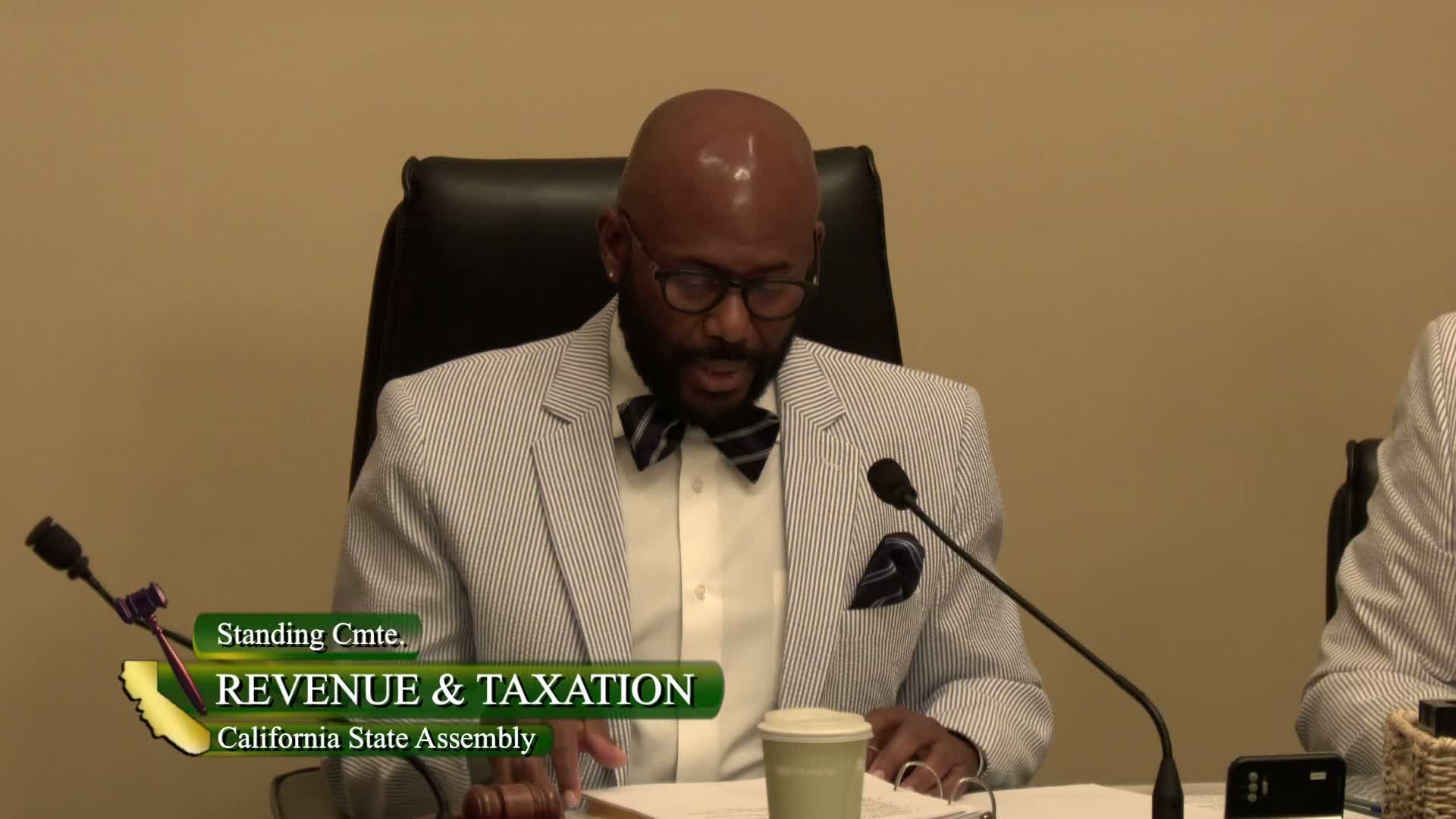
Chair opened the session by reminding participants that bills with revenue impacts over $150,000 are not eligible for immediate votes and will be placed on the suspense file. After a roll call established a quorum, members heard authors and witnesses explain the measures.
Miss Winn, presenting AB 1606, described a five-year, targeted tax credit (2027—2032) of up to $20,000 annually intended to reimburse small commercial-property owners for cleanup costs tied to illegal dumping, encampments and abandoned property. "These are real costs. Business owners are spending thousands of dollars just to keep their properties clean, safe, and open," Miss Winn said. Audrey Rytaycek of Cruise Strategies, speaking for the California Business Properties Association, called the proposal a "targeted practical solution" and asked the committee for an "I" vote. No primary opposition appeared in the room and the chair designated the bill a suspense-file candidate.
On housing and investor activity, Assemblymember Haney presented a measure designed to limit the use of like-kind exchanges by corporations owning large portfolios of single-family homes, arguing that the current tax treatment helps large investors outbid local families. Lenny Goldberg of the California Tax Reform Association and Kevin Stein of Rise Economy testified in support, framing the proposal as closing a loophole that favors big investors. Representatives of the National Rental Home Council opposed the approach, saying it could discourage sales in California and have unintended market effects.
Several bills aimed at expanding access to ownership or reducing costs for particular groups were also discussed. A bill to create a seller repair credit tied to CalHFA-financed buyers (AB 1714) would allow sellers to claim a limited credit equal to 40% of required repairs (capped at $25,000 per taxable year) intended to keep transactions viable for first-time buyers, the author said. The California Association of Realtors and other housing stakeholders voiced conditional support while some tax-policy groups urged caution.
The committee heard multiple agriculture-related measures. One bill (AB 2427) would create a farm tax credit to offset labor, equipment and production costs; sponsors argued the credit helps keep farmland in production, while tax-reform groups asked why ordinary farm operations should receive state tax reductions. Another bill (AB 2192) would extend the existing state sales/use tax exemption for farm machinery to local sales and use taxes and included a $200 million general-fund appropriation to reimburse cities and counties for initial revenue losses, a point the author emphasized when seeking support from local-government representatives.
On energy and affordability, Assemblymember Erwin presented AB 2389 to extend the property-tax exclusion for newly installed solar and storage systems for five years. Environmental groups, solar industry organizations and numerous individual solar owners urged the committee to preserve the exclusion, warning that a new property tax on rooftop systems would discourage adoption and worsen energy- and housing-affordability pressures.
Other measures discussed included AB 2444 (aligning state tax treatment with recent federal changes for ScholarShare 529 accounts and permitting certain rollovers to Roth IRAs), AB 1550 (allowing a state deduction for qualified tips and overtime to align state and federal treatment), and several additional conformity and affordability proposals. Authors frequently said they planned to file amendments while the bills remained in suspense.
After hearing testimony and limited member questions on each item, the committee formally referred the bills on today's agenda to the suspense file for further analysis and potential amendment at a later hearing. The subcommittee adjourned after completing its business.
What happens next: referral to the suspense file means staff will continue to analyze fiscal impacts and authors may submit committee amendments before the measures return to this committee for a future vote or further action.