Lifetime Citizen Portal Access — AI Briefings, Alerts & Unlimited Follows
Committee chair opens Fresno hearing, panels urge sustained state funding and local capacity for Central Valley economic mobility
Loading...
Summary
Panelists at a California State Assembly select committee hearing in Fresno urged sustained state investment, stronger community capacity and stable funding streams to translate federal and philanthropic dollars into higher‑quality jobs and local ownership across the San Joaquin Valley.
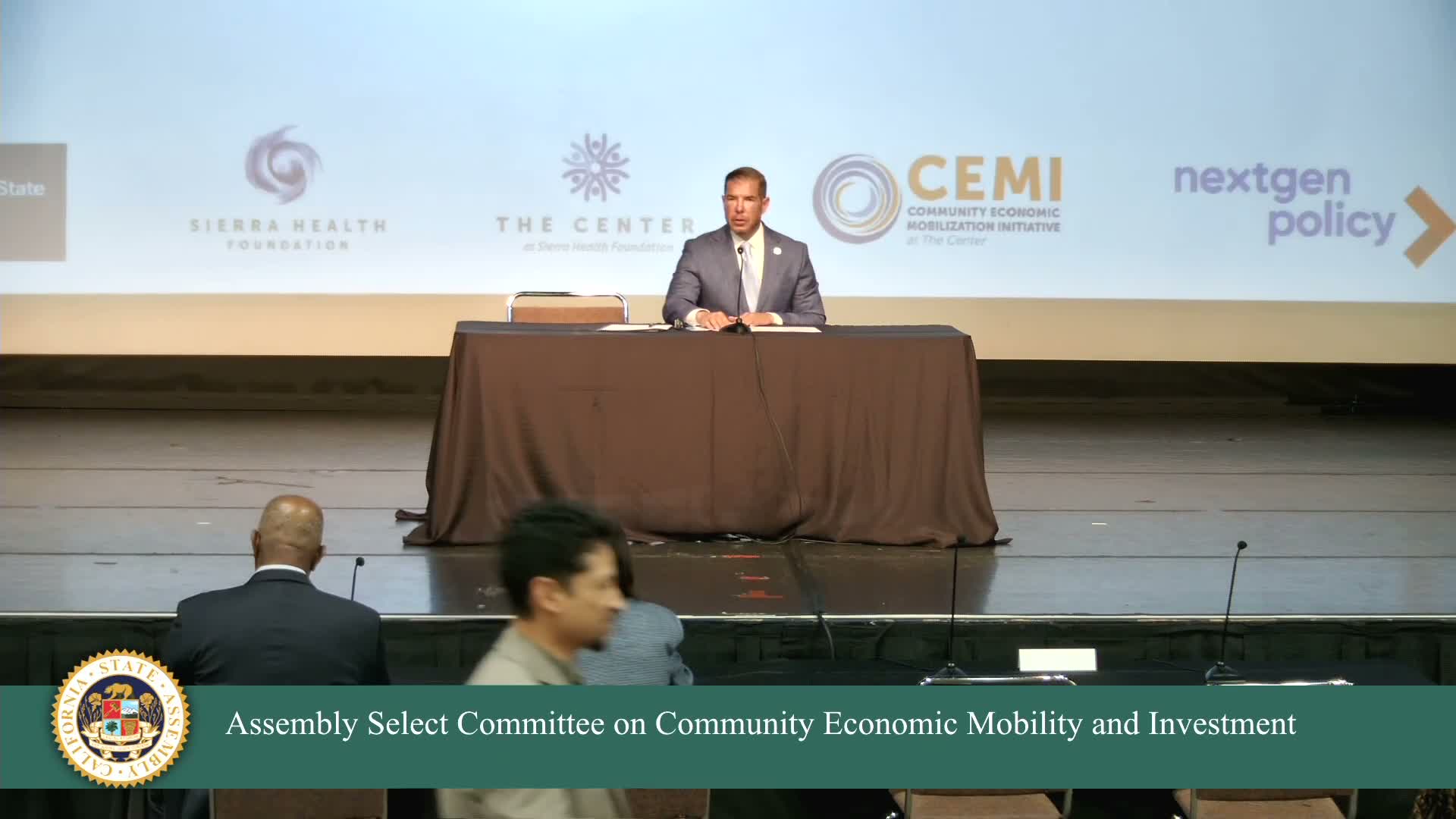
The select committee on economic mobility and investment held an informational hearing at Fresno State to examine how state, federal and philanthropic resources can better support inclusive economic development in the San Joaquin Valley. The committee chair opened the session by summarizing recent local investments — including downtown and infrastructure funding — and framed the hearing as a chance to learn from funders, researchers and community organizations.
Chet Hewitt, president and CEO of the Sierra Health Foundation, described the foundation’s portfolio of health‑focused economic investments — the San Joaquin Valley Health Fund, an impact investment fund and the Community Economic Mobilization Initiative (CME). He said those efforts represent roughly $40,000,000 aimed at expanding financing for microbusinesses, strengthening nonprofit capacity and supporting workforce development, and argued that economic strategies anchored in health outcomes can produce broader gains in community well‑being.
Manuel Pastor, a sociology professor participating remotely, urged attention to inequality as a drag on long‑term job and wage growth and said the Central Valley’s role as a growing share of the state’s children means policies must prioritize job quality, wage floors and community capacity. “Inequality is the Achilles heel of the state,” he said, arguing that technical and power‑building capacity for community‑based organizations is essential for equitable procurement and implementation.
Jessica Kasmir of the James Irvine Foundation outlined the foundation’s place‑based strategy for Inland California, noting a December 2024 board commitment of $220,000,000 through 2031 to support six priority cities. Kasmir said philanthropy can provide flexible funding and technical assistance that complements public dollars, but that foundations alone cannot scale systemic change.
Dr. Edward Flores of UC Merced’s Labor Center described state 'high road' initiatives (SURF/California Jobs First) and introduced the Valley Seed community‑of‑practice, financed in part by Sierra Health Foundation and the Irvine Foundation, which supports worker cooperatives, community benefits agreements and climate‑resilient workforce projects.
Local providers described on‑the‑ground models. Yolanda Randalls, executive director of the West Fresno Family Resource Center, said the Sweet Potato Project — a 36‑week, community‑defined program funded by the California Reducing Disparities Project and the state Department of Public Health — combines agriculture, entrepreneurship and mental‑health supports for youth and reported evaluation gains (average GPA rose from about 1.92 to 3.3, with a reported 90% completion rate). Randalls said current funding for the program is scheduled to expire in June and urged flexible, sustained support.
Addie Carr of Neighborhood Industries described a social‑enterprise model that uses salvage retail to create entry‑level jobs and wraparound services for participants with barriers to employment. Carr noted that earned, unrestricted revenue from thrift operations enabled expansion and added jobs when federal funding declined.
Representing farmer interests, Maria Redull Roscoe of the Community Alliance with Family Farmers emphasized that most Valley growers are small (operations under 100 acres) and said agricultural producers face land, water and capital constraints. She flagged the federal Local Food Purchasing Assistance (LFPA/Farms Together) program — which had moved substantial funding into California — and warned that recent federal contract terminations leave gaps the state will need to address.
Daniela Rodriguez of Immigrants Rising described entrepreneurship supports for immigrant and undocumented entrepreneurs (technical assistance, bilingual resources and the Immigrant BizHub platform). She highlighted a $7.5 million 2025 state budget allocation for a third round of the SEED (Social Entrepreneurs for Economic Development) initiative and said programs that target immigrant entrepreneurs fill capital gaps that traditional lenders do not.
A presenter from VisionView/Bluebird (introduced during Q&A as Lanisha) described land‑access barriers — long private management leaseholds on public land and inactive parcels — and proposed 'community wealth zones,' tenant‑to‑owner grants, and activation timelines to prioritize access for small businesses and community assets.
During Q&A, panelists and community leaders repeatedly raised the problem of short‑term, one‑time grants. Presenters said short funding cycles create staff turnover, complicate data collection and hinder scaling; they urged braided funding strategies and state commitments to sustain proven programs. Panelists also discussed how procurement, technical assistance, and active community participation can influence whether infrastructure or climate‑related investments create good jobs.
Public commenters, including representatives of the Central Valley Community Foundation and the Camino Network, urged the legislature to sustain advocacy and scale local entrepreneurship ecosystems (coaching, capital, connections, climate and culture). The committee chair closed the hearing with thanks to organizers and Fresno State; no votes or formal actions were recorded.
Why it matters: panelists linked workforce quality, community capacity and sustained funding to durable regional prosperity. They urged that state policy and budget decisions focus not only on the volume of investment but on who benefits from it — small farmers, immigrant entrepreneurs, and grassroots organizations — and on ensuring implementation capacity and accountability.
The hearing produced no formal motions or votes; the committee signaled intent to continue hearings and to examine policy options that could extend or replace expiring federal or philanthropic funding.