Lifetime Citizen Portal Access — AI Briefings, Alerts & Unlimited Follows
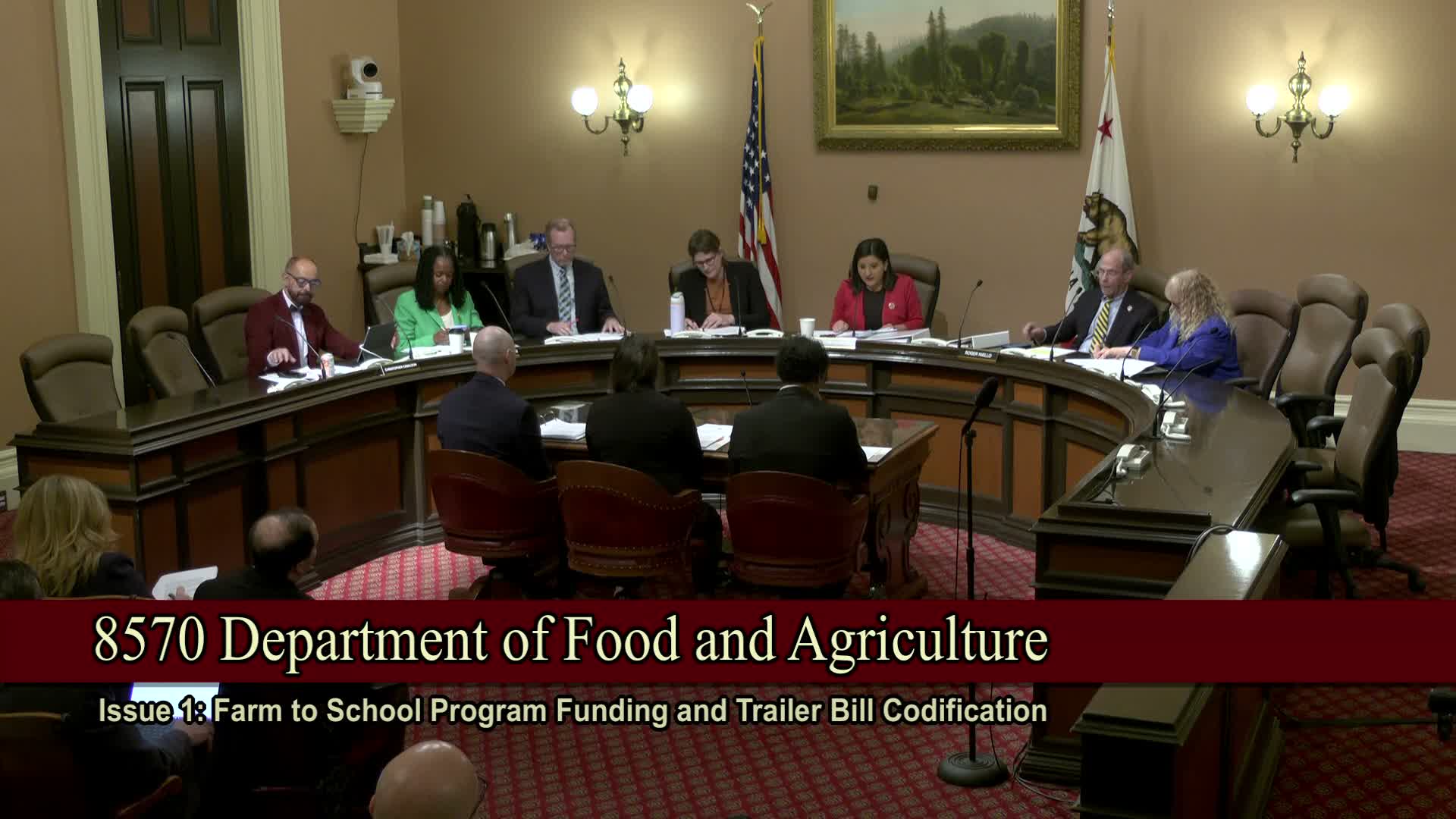
CDFA seeks to codify and fund farm-to-school program amid LAO budget caution
Loading...
Summary
The Department of Food and Agriculture asked the Senate subcommittee to make its Farm to School incubator grant program permanent with $20 million in ongoing grants and funding for evaluation and outreach; the Legislative Analyst’s Office urged caution given the state’s budget limits and suggested alternatives such as Prop 98 counting.
Arma Cozena, deputy secretary for finance and administration at the California Department of Food and Agriculture, told the Senate Budget and Fiscal Review Subcommittee No. 4 that the administration’s FY 26/27 proposal would begin to codify and provide ongoing funding for the Farm to School incubator grant program.
Cozena said the program has reached roughly 49% of California schoolchildren since its launch and that the Governor’s proposal includes $20,000,000 annually for the incubator grants plus $1,300,000 one‑time and $200,000 ongoing for a customer‑relationship management tool and $3,200,000 ongoing to expand climate smart agriculture access. “We support a broad range of functions … and the 26/27 Governor’s budget proposes approximately $685,000,000,” Cozena said in her department overview.
The Legislative Analyst’s Office, represented in the hearing by Bridal Metzger, recommended the Legislature reject the proposal as presented given the state’s current budget condition. “We recommend that the legislature reject this proposal as presented given the state's current budget condition and its limited capacity for supporting additional ongoing commitments,” Metzger said, while noting the program appears to provide benefits to farmers and students.
Committee members asked for more detail on program scoring, regional reach and evaluation metrics. CDFA described plans to codify existing program elements, strengthen interagency coordination with the Department of Education and Department of Social Services, and require biannual third‑party evaluations. CDFA staff said prior evaluations show that for every dollar invested the program generates more than two dollars of value in the supply chain, and that evaluation findings identified regional gaps — CDFA said it would follow up with precise regional breakdowns and evaluation citations.
Several senators raised equity and systems‑change concerns. Senator Cabaldon argued the program’s per‑child funding is modest and said the grants should be framed as a tool to change supply‑chain infrastructure rather than a substitute for Prop 98 school meal funding. The LAO and multiple members pressed CDFA for clearer, comparable performance metrics and for a plan to ensure the program reaches underserved public schools, not primarily charter schools or better‑resourced districts.
Public commenters including farmers, food hubs and nonprofit advocates urged the committee to fund Farm to School and related programs, and multiple speakers requested bridge funding for related initiatives such as the California Nutrition Incentive Program and Local Food Purchase Assistance.
The subcommittee held the item open for follow‑up information, including CDFA’s detailed scoring rubric, regional participation data and the most recent evaluation report.