Get Full Government Meeting Transcripts, Videos, & Alerts Forever!
Get email alerts on the Zoning And Code Changes topic
No spam. Unsubscribe anytime.
Council reviews ordinance updates to align with recent Texas laws, and considers new flag and flagpole standards
Summary
City staff outlined proposed changes to the Comprehensive Zoning Ordinance and Code of Ordinances to reflect House Bill 24 (rezoning protest criteria) and Senate Bill 1567 (definition of family), and proposed new, content-neutral rules for flags and flagpoles including height, quantity, setbacks and permits; council asked for clearer wording and a policy option for expanding courtesy notice radius.
City staff presented proposed amendments to Richardson’s Code of Ordinances and Comprehensive Zoning Ordinance to align local regulations with state law and to add standards for flags and flagpoles.
Andrew (staff member) told the council that House Bill 24 increases the property-owner protest threshold for rezoning requests that allow more residential development from 20% to 60%, but requires only a simple majority vote of council (four of seven) to approve those rezoning requests. "House Bill 24 increased the property owner protest special from 20% to 60% for rezoning requests that allow for more residential development," Andrew said, and noted that other rezoning requests (commercial, industrial) would retain the 20% protest threshold and a supermajority requirement.
On occupancy rules, staff summarized the implications of Senate Bill 1567 for the definition of "family." Andrew said the city must remove limits that restrict occupancy based on blood, marriage, adoption, age or occupation and instead propose a definition such as: "family means any number of persons occupying a single dwelling unit living and cooking together as a single housekeeping unit, including but not limited to those related by blood, marriage, adoption, guardianship or dependency." He noted deed restrictions can remain more restrictive than the statute.
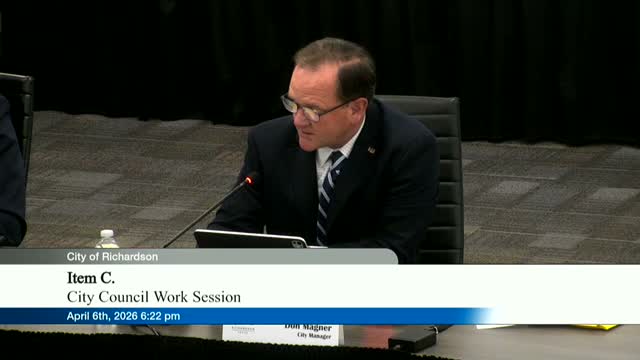
Council members pressed staff for clarity on several practical points. Council Member Barrios suggested the council consider expanding its courtesy notification beyond the statutory 200-foot notice radius; staff advised that the formal protest radius is set by state law but that the council could adopt a policy to extend courtesy notice (Barrios proposed 300 feet as an example). City Manager Don Magner said adopting a policy for a larger courtesy radius would be feasible and recommended setting that outside the code language so it can be adjusted more easily.
On flags, staff proposed content-neutral definitions and limits: up to six flagpoles/flags per platted lot on large nonresidential properties over 10 acres with multiple frontages, up to three for other lots; a maximum flagpole height of 25 feet in residential districts and 40 feet in nonresidential/mixed-use districts; a maximum flag size of 25 square feet in residential districts and 40 square feet in nonresidential districts; and a setback requirement equal to a pole’s height. Staff also proposed requiring permits for flagpoles taller than 25 feet and site-plan approval for many nonresidential cases.
Council members raised design and signage concerns about allowing up to six flagpoles at large sites, asked for exemptions for temporary neighborhood flags (holiday or event displays), and asked that staff consider spacing/separation rules similar to monument-sign standards to avoid a ‘‘wall of flags’’ effect. Andrew said staff will add an exemption for temporary flags and will draft wording on spacing and setbacks. On measurement, staff clarified flagpole height would be measured from grade to the tallest projecting element.
Staff said it will return with revised ordinance language and wordsmithing on the temporary-flag element and spacing. No votes were taken at the meeting; staff aimed to bring revised text back to the council in about a week.