Lifetime Citizen Portal Access — AI Briefings, Alerts & Unlimited Follows
Council pauses Huntington Club remodel after neighbors raise zoning, lighting and operations concerns
Loading...
Summary
After more than two hours of testimony, the City Council continued a contentious appeal of the Huntington Club remodel and proposed bungalows to April 21 to allow the applicant and appellants to negotiate an operating agreement, resolve existing lighting violations and provide details on a proposed lighting entitlement.
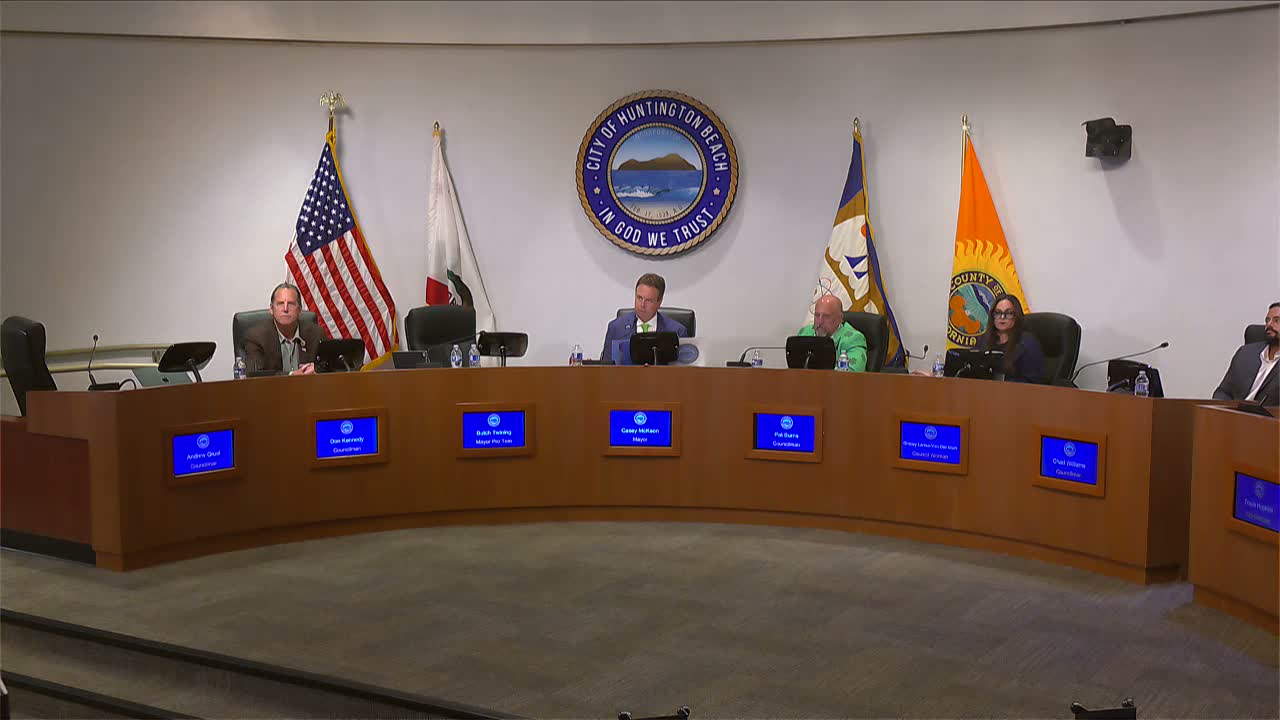
The Huntington Beach City Council on March 17 continued a public hearing on a proposed remodel of the Huntington Club and the addition of four detached bungalows and two lofts, asking the developer and appellants to return April 21 with more detail on operations and lighting. The continuance was unanimous following extensive public testimony from club members, neighbors and the applicant.
The project would replace the current two-story clubhouse and aging pool with a new clubhouse (about 12,000 square feet), add fitness and spa facilities, two loft units and four short-term ‘‘bungalow’’ accommodations for members and guests, and remove three tennis courts. Joanna Cortez, the city’s principal planner, told the council the planning commission approved the project with modified conditions limiting short-term stays to Huntington Club members and directing the applicant to pursue lighting for six currently unlit courts.
Jonathan Bailey, the applicant’s project manager, said the improvements would modernize aging facilities and that the owner expects the bungalows and lofts to be restricted to members and members’ guests. ‘‘We ask that you deny the appeal because our project complies with the open-space recreation zoning, is CEQA exempt and will generate about $479,000 in annual tax revenue for the city,’’ Bailey said.
Opponents including long-time club members and nearby homeowners argued the bungalows amount to lodging that may be inconsistent with the open-space zoning and could increase operational intensity, change how the club functions and reduce public-recreational access. ‘‘This is a meaningful shift in land use and operational intensity — not just a facility improvement,’’ said Cheryl Gates, one of the appellants.
Neighbors also pressed the council on light spill and nuisance from court lighting. James Jensen, who lives directly behind one of the courts, said LED strip lighting had already created nighttime glare into his home. The applicant said the current LED strips were not part of the proposed lighting technology; the submitted lighting application proposes directional fixtures, lower pole heights and blackout screening to limit off-site light.
Council members voiced two recurring concerns: the lack of a signed operating agreement for the bungalows and an unresolved entitlement to light courts that the existing conditional use permit prohibits. Mayor McKeon said he wanted ‘‘assurance we’re not giving entitlements that will be impossible to implement in practice’’ and asked the applicant to meet with the appellants and report back on what can and cannot be agreed.
The council’s continued motion asked the applicant to: meet with the appellants and report the result, present an outline of the expected operating arrangement (either with the current tenant or a third-party manager) that assures guest access is limited to members and guests of members, confirm that any unpermitted lights currently operating are turned off, and update the status and mitigation measures for the lighting entitlement to be considered by the Planning Commission. The item was set for a date certain return on April 21.
If the applicant fails to secure required subsequent entitlements (for example, a separate entitlement amendment to allow lighting of courts currently restricted by an earlier CUP), the council indicated it would consider that status when the project returns. ‘‘We want meaningful progress on the operational framework and a clear path for lighting mitigation before any final discretionary approvals,’’ Mayor McKeon said.
The continuance halts any final council decision but leaves the Planning Commission’s earlier approval intact until the council revisits the item. The April 21 meeting is expected to include progress updates on applicant–appellant negotiations, a plan for the lighting entitlement, and samples of the operating-agreement provisions the council asked to see.