Lifetime Citizen Portal Access — AI Briefings, Alerts & Unlimited Follows
Riverside County board says no to paying outside counsel for sheriff's lawsuits after public comment
Loading...
Summary
After public commenters urged the board to deny requests to cover Sheriff Santiago's legal fees, county counsel told supervisors about Brown Act limits and the board announced a 4'1 closed-session vote not to authorize hiring or paying outside counsel to defend related lawsuits.
The Riverside County Board of Supervisors announced after a closed session that it voted 4'1 not to authorize hiring or paying outside counsel to defend four lawsuits involving the attorney general and the sheriff.
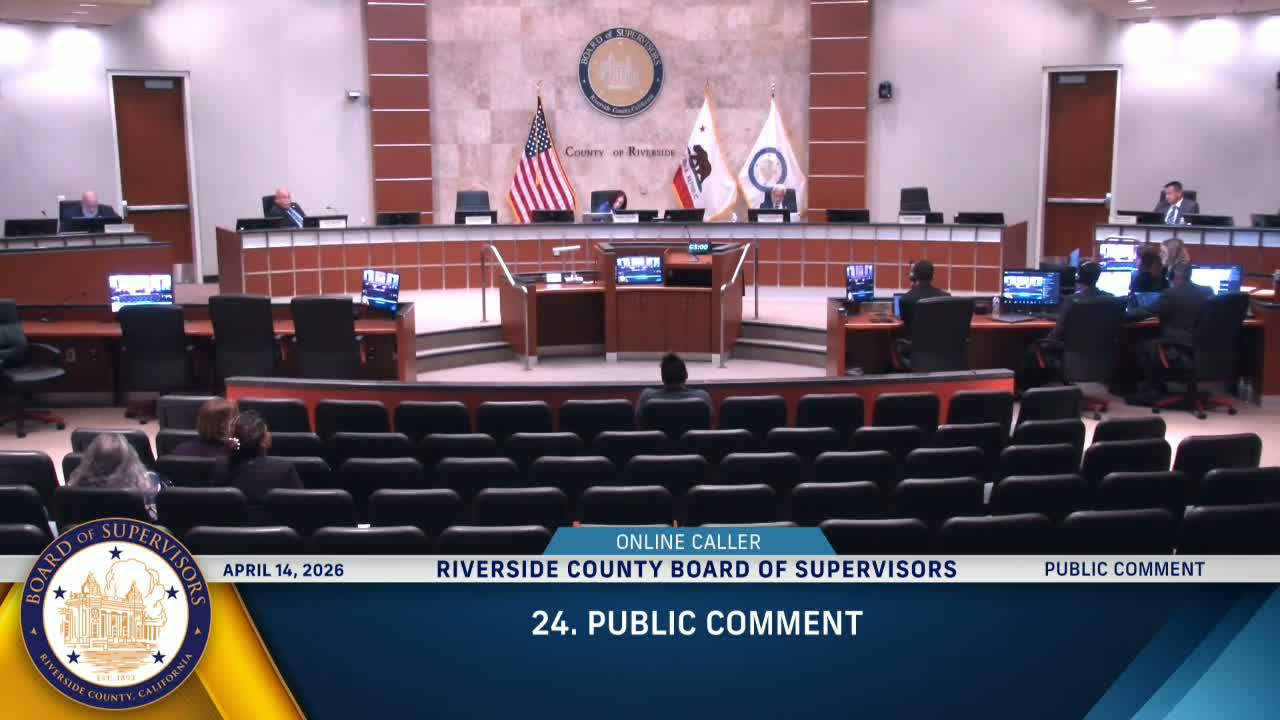
The decision followed a public-comment period in which callers urged supervisors to deny requests from Sheriff Santiago for legal-fee support and called for more transparency about closed sessions. Violet Graham, a resident of Hemet and member of the Riverside Sheriff's Accountability Coalition, told the board: "Taxpayers have already paid over $100,000,000 to settle lawsuits for the sheriff's department. Please do not spend any more on his poor judgment or reward his attempt to use his position as sheriff to campaign for governance." Brad Anderson (identified in the record as "Brad Anderson, City of Ranch and Mirage") asked that the board improve reporting practices, saying: "This board should report out after closed session even if it's a non reportable item." Doris Foreman told supervisors, "The sheriff should be responsible for all legal fees that arise because of this action. The residents and taxpayers should not pay for his poor judgment."
County counsel addressed how the Brown Act governs closed-session handling. Counsel explained that the law generally requires public meetings but "has specific exemptions" for closed sessions where disclosing details could prejudice negotiations or litigation strategy. Counsel said reportable actions are normally disclosed once they are final and gave the example that premature disclosure of negotiation positions could harm the county's ability to negotiate favorable terms.
The board recessed for a short closed session and reconvened as scheduled. County counsel reported that the board had met on four lawsuits involving the attorney general and the sheriff and that the board voted 4'1 not to authorize hiring or paying outside counsel to defend those cases. The meeting record did not identify individual vote choices by name or provide further procedural details about any motion language, mover or second.
The board did not announce additional follow-up steps for those lawsuits at the time it reported out.