Get Full Government Meeting Transcripts, Videos, & Alerts Forever!
Get email alerts on the Urban Canopy Policy topic
No spam. Unsubscribe anytime.
Whittier council authorizes EIR and related legal, PR contracts to remake parkway tree policy after heated public comment
Summary
The City Council voted to fund an environmental impact report and to authorize outside legal and public-relations contracts to replace the Parkway Tree Manual, drawing sustained public opposition and questions about insurance-driven motives.
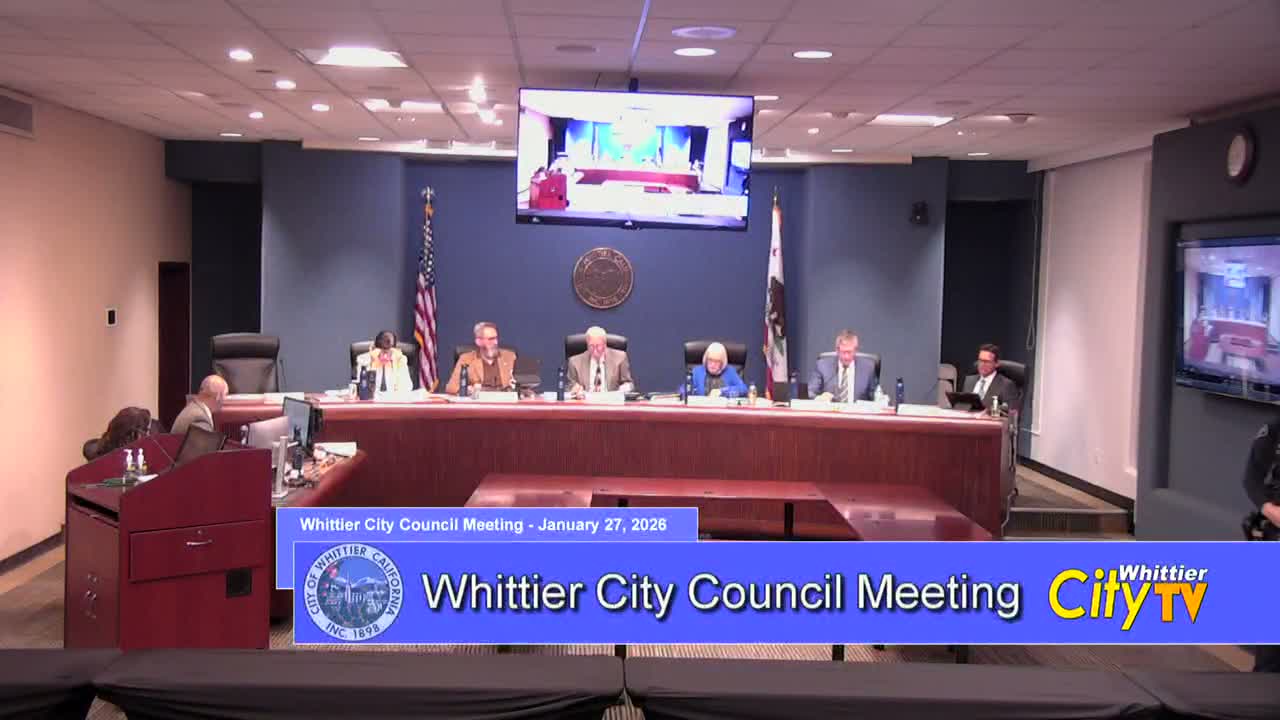
The Whittier City Council on Jan. 27 authorized the city manager to hire consultants to prepare an environmental impact report (EIR) and to retain outside legal and public‑relations help as part of a planned replacement of the Parkway Tree Manual.
City staff said the work is meant to respond to a sharp increase in the city's liability exposure tied to tree-related claims and to produce a new, publicly reviewed policy. The council adopted a resolution (2026-11) to amend the FY2025–26 budget for the professional services needed to prepare the EIR and related support, and approved authorizations for special legal services (Richards, Watson & Grishon, not to exceed $200,000) and public-relations services (Tripepi Smith, not to exceed $50,000). The contract with Michael Baker Inc. for preparation of the EIR was also authorized; the staff report lists the firm and scope but does not specify a total contract ceiling in the council presentation.
The decisions followed more than an hour of public comment focused on the city's emergency actions last fall to suspend parts of the tree ordinance. Residents, conservation groups and neighborhood activists urged the council to pause or reverse the suspension and to avoid spending taxpayer money to dismantle tree protections. "There is no connection between the tree manual and the city's insurance premiums, period," said Helen Raider, executive director of the Whittier Conservancy, during public comment. Mary Gorman Sullins, the conservancy's president, said the suspension and related work "is costing about $620,000 of our taxpayer money." Both urged postponement and more public involvement.
City officials said the city's insurance costs have risen sharply and that tree-related claims are a substantial portion of the city's liability losses. Yolanda, identified in the meeting as the city's HR/risk-management director, told the council the city's premiums were about $512,000 in 2019 and had grown to roughly $5.4 million for the 2025–26 cycle. Staff also cited a Nov. 25 letter from the California Insurance Pool Authority (SEPA), which recommended eliminating the Parkway Tree policy and warned the council that failure to do so could prompt the pool's board to consider terminating the city's participation.
Council members who supported the EIR framed the contracts as safeguards to ensure a rigorous, public review and to limit future legal exposure. Council member Mary Anne Pacheco, who had voted previously against a temporary suspension of the manual, said she backed the EIR because it provides an open, public process and independent legal review. "These reports are very thorough," she said, and the EIR will provide multiple opportunities for public input.
Opponents warned that the EIR and the additional contracts would not justify the immediate policy changes some insurers sought. Residents asked the council to consider alternatives such as better sidewalk maintenance and clarified enforcement before altering tree protections.
The resolution passed on a roll call with the four council members present voting aye; one council member was absent. Staff said the EIR process will include public hearings and opportunities for comment at later meetings.
Next steps: staff will finalize agreements for the EIR and related services and begin the formally noticed public process required by the EIR schedule set by the city.