Get Full Government Meeting Transcripts, Videos, & Alerts Forever!
Get email alerts on the Land Use Cemetery topic
No spam. Unsubscribe anytime.
Riverside County planning commission continues contested Meadowbrook cemetery item after heated debate over water risks
Summary
After hours of public testimony split between water‑quality fears and calls for accessible Muslim burial space, Riverside County planning commissioners voted April 1 to continue review of Conditional Use Permit 230002 so staff and the applicant can respond to technical letters and consider whether an EIR is required.
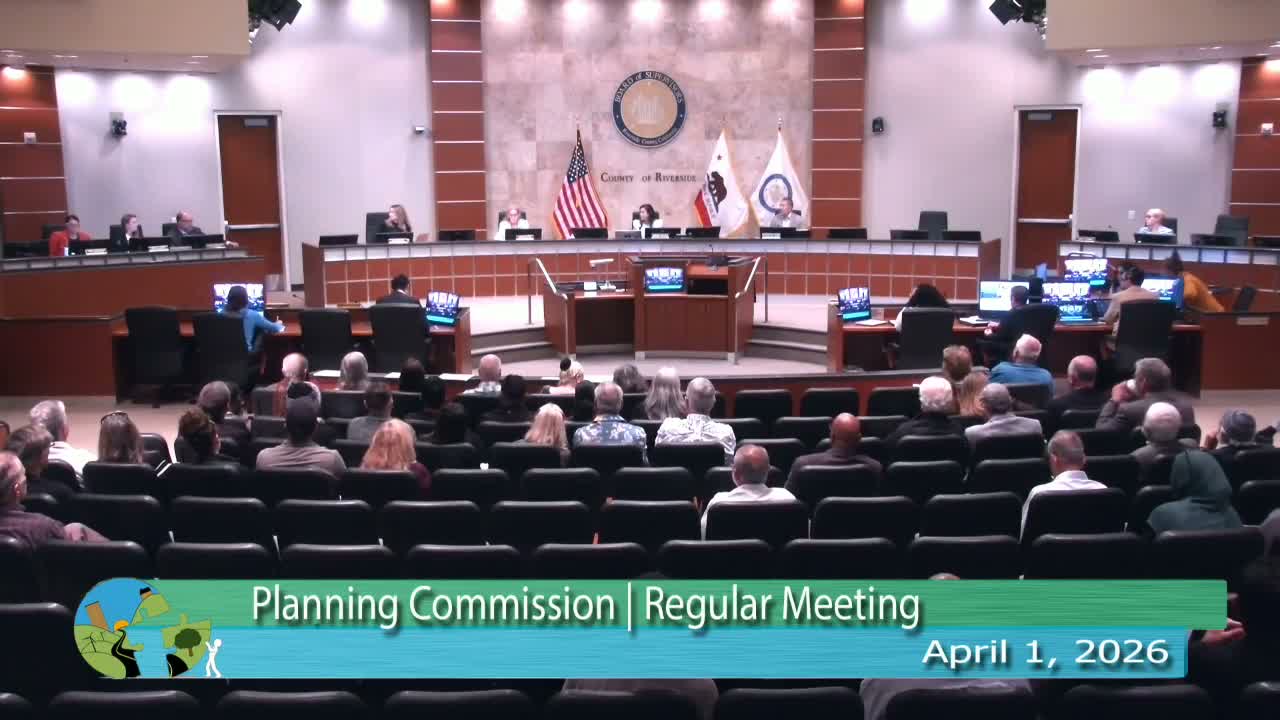
Riverside County planning commissioners voted April 1 to continue action on Conditional Use Permit 230002—a proposed 85‑acre cemetery near Meadowbrook—after a daylong public hearing that drew about 44 registered speakers and sharply divergent testimony over water quality and community need.
John Hildebrand, Riverside County planning director, opened the hearing with a staff presentation describing the site (about 85 acres, roughly 46 acres to be developed and ~38 acres conserved), a phased 15‑year buildout and planned facilities including a chapel, a 7,000‑square‑foot cleansing facility, a caretaker residence and an equipment shed. Hildebrand said staff had prepared a mitigated negative declaration (MND), received “a number of letters” and that the recommendation for the commission was to continue the item off calendar while technical comments are addressed.
Hamid Haq, representing the applicant MMCC, said the nonprofit has run burial operations for more than 35 years and described the project as an affordable, faith‑based cemetery intended to serve the Inland Empire’s growing Muslim community. Selena Kelleher of EPD Solutions detailed operational elements and said the applicant revised its burial method from an open (gravel bed) approach to fully enclosed six‑sided concrete vaults with an additional plastic liner, and that there would be no embalming or caskets in keeping with the applicant’s religious practices.
Public testimony split into two dominant themes. Dozens of residents and elected officials from Canyon Lake and surrounding neighborhoods warned of potential contamination of Canyon Lake and downstream waters, seismic and flood‑related risks, and inadequate site‑specific analysis. Jeremy Smith, mayor of Canyon Lake, told commissioners the site is “1.2 miles from our lake” and urged caution because the lake is a drinking reservoir; Darcy Burke, a 25‑year water professional and Elsinore Valley Municipal Water District director, said the record “fails to meet the evidentiary and regulatory standards required by CEQA, the Safe Drinking Water Act, and California Title 22” and requested a full environmental impact report (EIR).
Opponents repeatedly called for deeper borings, seismic modeling and peer‑reviewed hydrogeologic analysis. Several speakers listed specific concerns about the late addition of sealed vaults and large volumes of imported fill, arguing those changes could alter site hydrology and warranted recirculation or an EIR.
Supporters—many from the Muslim community and several local professionals—said accessible, affordable Islamic‑compliant burial space is scarce in the region. Dr. Dina Halmi of the Islamic Shura Council of Southern California and other religious leaders urged approval, describing burial without cremation or embalming as a faith obligation and saying the applicant had modified practices to address neighbor concerns. Technical supporters with engineering and geotechnical backgrounds told commissioners they reviewed the applicant’s studies and found the analyses adequate for the initial review.
In technical rebuttal, Steve Okubo, the lead engineering geologist for the applicant’s team, said the portion of the site intended for graves is underlain by granitic and metamorphic bedrock “with no pore space,” and therefore there is no regional groundwater table that would support plume migration or liquefaction in the burial areas. Okubo told the commission his team’s borings and logs did not show a shallow, continuous aquifer beneath the grave zones.
Commissioners pressed for additional visuals and data to reconcile competing expert opinions. Requests included cross‑section graphics showing hypothetical contaminant pathways between the cemetery and Canyon Lake, more detail on nearby permitted wells (staff said the closest permitted well on record is approximately 700 feet south of the site), and clarification about notice mailings to affected parcels.
After discussion, the commission voted to continue the item off calendar without a date certain so the applicant and county staff can respond to last‑minute technical comments, revisit the MND materials and confirm notice lists and outreach. The chair said the item will be fully re‑noticed when it returns.
What happened next: The hearing was closed for public comment and the applicant indicated it will review the additional technical letters and provide more detailed responses to water‑quality, geotechnical and hydrologic questions. The commission identified water quality (possible impacts to Canyon Lake and downstream waters) as the primary outstanding issue to be resolved before a final decision.
Why it matters: The project would create local burial capacity for a growing community that currently travels long distances for faith‑based interment, while opponents say the location and recent design changes could pose risks to drinking‑water sources that serve thousands of residents. Commissioners left the record open by continuing the item to ensure technical concerns are addressed before any formal action is taken.
Next step: Staff and the applicant will revisit the technical studies and public notices; the commission will revisit the project at a later date after the county posts updated documents and, if necessary, a notice of EIR scoping or expanded CEQA review.