Lifetime Citizen Portal Access — AI Briefings, Alerts & Unlimited Follows
Neighbors urge safety studies, smaller scale for proposed senior housing at 6230 Claremont
Loading...
Summary
Multiple residents told the Planning Commission in public comment that a proposed eight‑story senior housing project at 6230 Claremont (the 'Red Cross Building') would create life‑safety and traffic hazards, cast large shadows, and improperly rely on a mixed‑use classification; speakers requested fire access guarantees, a traffic safety plan, solar and visual impact studies, and code verification.
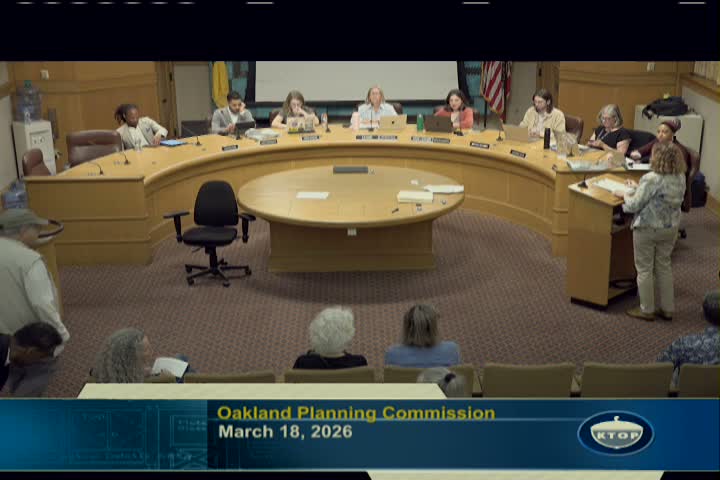
During the meeting’s open forum, five neighborhood speakers urged the Planning Commission and staff to scrutinize a proposed senior housing project at 6230 Claremont Avenue, also referenced as the Red Cross Building.
Allison Hightower, a 35‑year Rockridge resident, said the project proposes an eight‑floor luxury senior residence with only a five‑foot setback from nearby homes on Auburn Avenue. “In an emergency, fire trucks will need 29 feet to accommodate the truck and be able to extend their ladders at a safe angle to reach residents at the higher floors,” Hightower said, and she warned that narrow Auburn Street would make ladder access and evacuation difficult for seniors.
Other commenters echoed safety and scale concerns. Jeremy Evnan said he was not opposed in principle but objected to the building’s height (about 82 feet), large shadow impacts and added traffic on Claremont and Lower Florio; he said neighborhood petitioners had gathered more than 1,000 signatures asking the commission to reduce the project’s scale. Jack Gerson argued the developer’s claim of a “neighborhood center mixed use” classification was inconsistent with the land use element’s description because the project lacks commercial fronting and, he said, the units all have kitchens and therefore do not qualify as rooming units — a technical point he urged staff to verify against the cited land use guidance.
Lynn Harlan said the Claremont/College Avenue corridor already has a documented history of serious pedestrian crashes and fatalities and urged the city to withhold project approval until a comprehensive traffic safety plan and verified emergency access and egress were incorporated into project requirements. Ken Jong asked the applicant to demonstrate, by economic analysis, why additional step‑backs or plane changes were infeasible and requested a formal quantitative solar access (shadow) and visual impact study; he also asked staff to confirm whether density calculations relied on policy guidance rather than City code section 17.33.
Speakers called for specific studies and conditions — emergency access verification, traffic safety mitigation, a solar access study and a visual impact assessment — as prerequisites for design review and any future approvals. The commission did not take action on that project during the meeting; these remarks were delivered during the open forum/public comment portion of the agenda and were recorded for the project’s review process.