Get Full Government Meeting Transcripts, Videos, & Alerts Forever!
Get email alerts on the Parks topic
No spam. Unsubscribe anytime.
Huntington Beach council approves Edison Park Option 2 with community conditions
Summary
The City Council unanimously approved a reconfiguration of Edison Community Park (Option 2), directing staff to proceed with phased design and to incorporate community conditions including upgraded irrigation, a two-for-one tree replacement strategy, and noise‑mitigation for relocated pickleball courts. Estimated full-build costs range from $13.7M–$14.0M; $4.352M is currently budgeted.
The Huntington Beach City Council voted to approve Option 2 of the Edison Community Park conceptual plan and directed staff to advance design and phased construction while incorporating conditions requested by the Edison Park Community Group.
The plan, developed with RJM Design Group and refined after five years of outreach, reconfigures amenities around landfill and oil‑well constraints and aims to restore or replace existing recreational facilities. Staff projected a no‑phasing build at roughly $13.7–$14.0 million; phased work is estimated at approximately $5.8–$7.1 million per major phase plus a smaller Phase C under $1 million. Council meeting materials show $4.352 million currently budgeted in the capital improvement program for the project.
Why it matters: Edison Park is the city’s second‑largest park (about 40 acres). Residents and regular park users argued the park’s aged infrastructure (failing irrigation, cracked courts, drainage issues) and limited accessible play spaces justify a major upgrade. The council approved Option 2 to balance added amenities—pickleball, bocce, new playground, expanded soccer overlays—with protections for park canopy, circulation, and safety.
Staff presentation and community conditions Staff presented technical studies, including an arborist inventory and acoustical modeling. The arborist survey found 234 trees surveyed with 152 classified as healthy; the plan follows the city’s 2:1 replacement standard for removals. Acoustical work modeled worst‑case pickleball noise and concluded levels would fall below city daytime noise thresholds when proposed mitigations are applied.
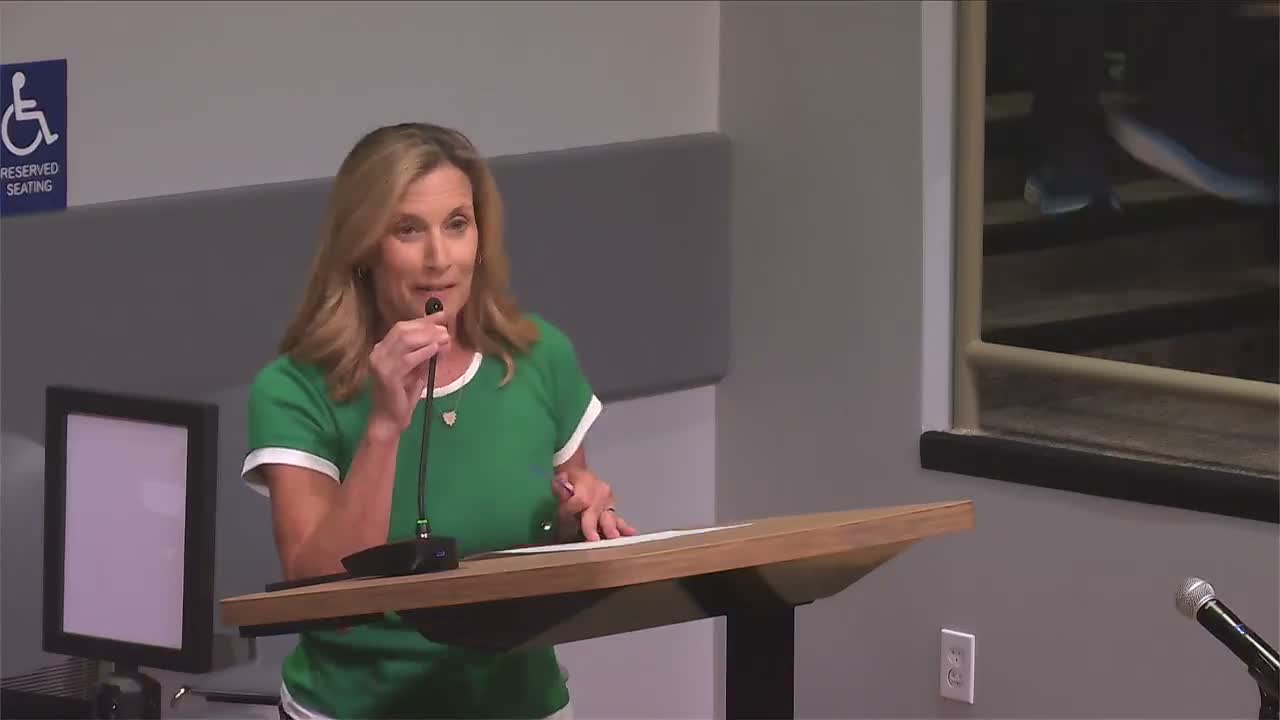
Community speakers pressed for specifics during public comment: retain as many mature trees as feasible, replace removed trees with larger, more mature specimens where budget allows, repair and modernize irrigation systems, coordinate construction timing with nearby projects to reduce traffic impacts, and include sound‑mitigation measures for relocated courts. “I’m just asking that you keep the trees that you can and give us the larger trees that were discussed,” said Nancy Bukos, a longtime resident and member of the Edison Park Community Group.
Council direction and vote Councilmembers discussed phasing, park access during construction, and tree‑by‑tree decisions to be resolved during design. Councilmember Williams moved to approve Option 2 with the community‑group conditions; the motion passed on a recorded roll call (vote recorded as 6–0–1). The vote directs staff to proceed with either a phased or complete development approach and to engage the community in design details, including specific tree selection and placement.
Next steps and funding Staff will prepare detailed engineering and construction documents, refine cost estimates, and return with recommended phasing and financing approaches. Councilmembers noted the potential to use Quimby/park development funds in the FY 26–27 budget process to increase available project funding. If adopted as planned, work will move into design and procurement; phasing could be used to keep key amenities open during construction.
What remains unresolved The final mix of tree removals versus preservation, exact selection of replacement tree species and sizes, and the precise noise‑mitigation measures will be set during the engineering and design phase with continued community input. The council asked staff to involve the Edison Park Community Group and other stakeholders as project documents are developed.
The council approved Option 2 to move the project forward while embedding community conditions intended to preserve park canopy, improve infrastructure, and mitigate neighborhood impacts.