Get Full Government Meeting Transcripts, Videos, & Alerts Forever!
Get email alerts on the Taxes And Fees topic
No spam. Unsubscribe anytime.
National City council directs staff to study variable gross-receipts business license (Model 3) and pursue outreach; Model 2 also to be included in polling
Summary
After an HDL feasibility study showing models that could raise between roughly $300,000 and over $7 million, council directed staff to study Model 3 (variable-rate gross receipts) and conduct outreach and polling that also includes Model 2; council noted legal and ballot deadlines and requested more refined comparisons for businesses and cap/tier data.
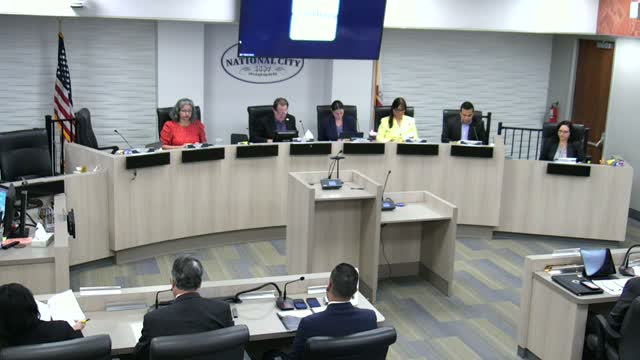
The National City Council reviewed a consultant's feasibility study on changing the city's business license fee structure to a gross receipts model and directed staff to study a variable-rate gross receipts option and begin outreach and polling that also considers a single-rate gross receipts alternative.
Acting Deputy City Manager Martha Juarez introduced a study HDL conducted under a $50,000 contract; Pedro Garcia, the city's community development specialist, summarized that HDL examined the city's registry data, benchmarked peer jurisdictions and modeled three options. Ken Duran of HDL told the council the city has 5,480 registered businesses; the top 100 accounts represent about 57% of reported gross receipts but account for roughly 29% of current city tax revenue because of existing caps and flat-fee tiers.
HDL presented three models: (1) raising existing flat fees (an illustrative 40% increase that HDL estimated would yield about $304,000), (2) a single gross-receipts rate (HDL's slide estimates more than $5 million in additional revenue under that hypothetical), and (3) a tiered variable-rate gross receipts model that HDL estimated could generate over $7 million. Ken Duran and staff emphasized that any change that increases revenue would likely require voter approval and careful ballot language.
Council members pressed HDL and staff on the comparability of peer-city charts (noting that some peer cities show fees "per employee," others "per business" or "gross receipts"), asked for the 2017 ordinance and cap values by business category, and requested category-level reporting so the council could see which businesses currently hit caps. Finance Director Rachel Barreiro explained the city provides gross receipts data to HDL and that the city conducts audits and compliance checks when necessary.
Members also raised equity and economic-impact questions: whether higher fees would be passed through to customers or renters (HDL offered a hypothetical that a $3 per $1,000 rate would translate to about $6 more monthly rent for a $2,000 tenant), whether higher fees risk business leakage to neighboring cities, and how to protect businesses that already pay multiple city or state fees (for example, dealerships or cannabis retailers that already itemize pass-through taxes). Staff said leakage and granular economic impacts would require additional study but said business license fees alone rarely drive a business to relocate.
Given the city's budget gap and a shortened calendar to place measures on November ballots — the clerk said staff would need a staff report by May 26 to get an item before the June 16 meeting and the registrar's deadline is mid-July — several council members urged an expedited outreach and polling schedule. City Attorney noted legal thresholds: if an adopted change would increase revenue it likely constitutes a tax subject to voter approval under local election law.
Council member Bush moved to direct staff to move forward studying Model 3 and begin public outreach, polling and ballot-measure development, with a workshop including the National City Chamber and South County EDC; a colleague seconded. The motion was amended to ensure Model 2 would also be included in outreach and polling. The council voted unanimously to approve the direction and asked staff to return with refined numbers, ordinance language where applicable (including the 2017 ordinance on caps), and results of outreach and polling before any final ballot decision.
The next concrete deadlines staff noted were a staff report due May 26 for the June 16 council meeting and the registrar's mid-July deadline to place an item on the November ballot. Staff cautioned the council that election placement increases costs (an estimated minimum additional $75,000) and limits council communications about the ballot measure once submitted.