Get Full Government Meeting Transcripts, Videos, & Alerts Forever!
Get email alerts on the Community Schools Funding topic
No spam. Unsubscribe anytime.
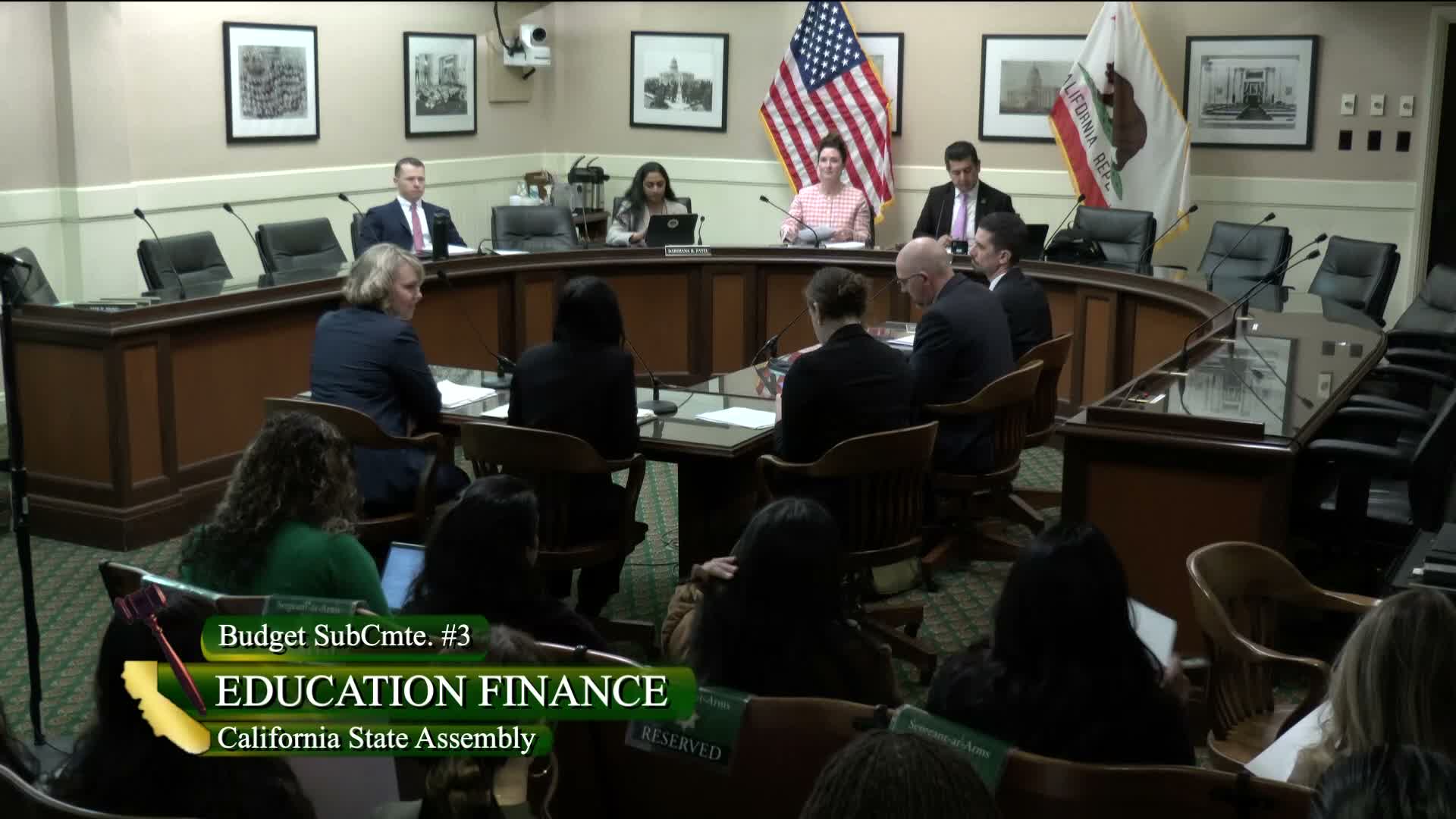
Assembly panel hears debate over $1 billion plan to make community‑schools funding ongoing
Summary
The Assembly Budget Subcommittee examined the governor's proposal to convert one‑time community schools grants into a $1 billion ongoing Proposition 98 apportionment, with administration officials touting scale and LAO analysts warning about state capacity, flexibility, and accountability. Committee members pressed agencies on metrics, technical assistance, and eligibility rules.
Chair David Alvarez opened the Budget Subcommittee No. 3 hearing by framing the day's aim: evaluate whether the governor's January budget can convert an earlier one‑time investment in California Community Schools Partnership Program into an ongoing, statewide system that improves near‑term student outcomes.
The Department of Finance presentation described the administration's plan to provide $1,000,000,000 in ongoing Proposition 98 funding to expand the community schools model to roughly 3,700 additional sites and to sustain existing grantees. Shaday Neri of the Department of Finance said the proposal aligns the apportionment with statewide technical assistance and would target schools with an unduplicated pupil percentage of 65% or higher. "The governor's budget builds on prior investment and proposes $1,000,000,000 ongoing Proposition 98 General Fund to expand the community schools model," Neri said.
The Legislature's analyst, Michael Alferroz of the LAO, recommended a different approach. "We are recommending that the Legislature continue to fund community schools implementation with one‑time grants rather than provide ongoing funding," he told the committee, arguing that an ongoing categorical program could reduce district flexibility, increase administrative burden, and assume the state can reliably scale best practices statewide. The LAO proposed alternatives including continuing limited one‑time cohorts while extending technical assistance and staggering accreditation timelines.
California Department of Education officials urged fidelity to the program's four pillars as the initiative grows. Kimberly Rosenberger (CDE) said roughly 6,091 schools would be eligible under recent data and stressed county offices' role as regional implementation hubs.
Committee members repeatedly returned to implementation details. Alvarez asked how the state translates prior investments into the proposed apportionment: roughly $4.1 billion spent over seven years supported about 2,500 community schools, while the proposal's $1 billion ongoing would aim to serve 3,700 additional schools. Finance and LAO officials clarified that about $125 million would be required to continue the first cohort (458 sites) as implementation grants phase out, with remaining funds intended for new apportionments and a limited TA supplement.
Several panelists urged stronger guardrails in the trailer bill language. Linda Darling Hammond of the Learning Policy Institute summarized research showing cohort gains — "by 2024‑25, the roughly 1,000 schools in the first two cohorts have seen gains in math proficiency rates, 4 percentage points" — and recommended sustained technical assistance, secondary‑school redesign supports, formal school networks, and consideration of a children's cabinet or certification systems to preserve fidelity.
Union and district witnesses stressed readiness and sustained staffing. Celia Medina Owens (Pittsburg Education Association/CTA) and Jason Bavino (San Diego Unified) both urged requirements for shared governance, accountable planning, and roles such as community school coordinators to avoid underfunded expansions. Multiple county office representatives warned that eliminating county coordination grants in 2031 risks fragmenting supports and urged the Legislature to preserve county‑level capacity in the long term.
Public commenters — including dozens of students and parents — largely supported ongoing funding, citing improved access to vision and dental screening, tutoring, mental‑health services, and reductions in chronic absenteeism and suspensions. Several non‑classroom‑based charter providers raised concerns that proposed eligibility language could exclude some existing program recipients and sought clarity.
Alvarez closed by asking agencies to provide detailed May revise materials on expenditures, TA funding, and accreditation timelines. The committee left the issue open for follow‑up, with further hearings expected prior to final budget action.
The committee did not take formal votes during the hearing; members requested written follow‑up and additional budget detail from the administration and the LAO.