Lifetime Citizen Portal Access — AI Briefings, Alerts & Unlimited Follows
Senate subcommittee: May Revision cuts Prop. 98 guarantee by roughly $4.6 billion, rebenches for TK, provides limited fire-related backfill
Loading...
Summary
At a May 2025 hearing, Department of Finance and the Legislative Analyst's Office outlined a lower Proposition 98 guarantee, rebenching for universal transitional kindergarten and a one-time property-tax backfill for fire-impacted districts, while flagging risks from one-time solutions and deferrals.
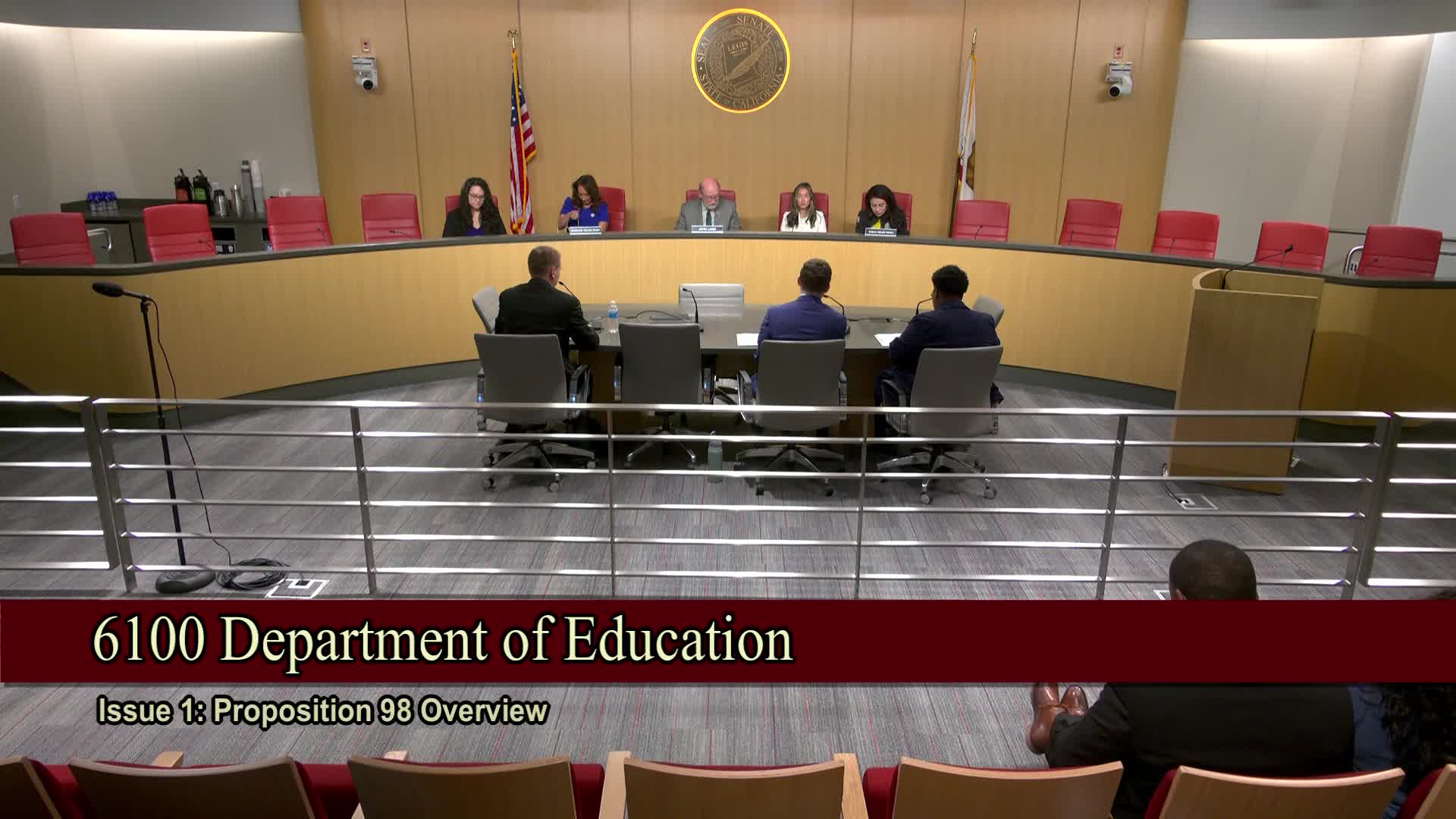
The California State Senate Budget Subcommittee No. 1 on Education heard a presentation Thursday that the May Revision projects a lower Proposition 98 minimum guarantee for K–14 education and proposes targeted adjustments for universal transitional kindergarten and fire-related property-tax losses.
"The May Revision forecast that the Proposition 98 guarantee amount for 2025–26 will be $114,600,000,000, which is $4,300,000,000 less than what was forecast at the governor's budget," Alex Schop, Department of Finance, told the subcommittee. Finance also described a roughly $4.6 billion reduction across the three-year window compared with the governor's budget.
Why it matters: Proposition 98 determines the minimum state funding level for K–12 schools and community colleges. A multibillion-dollar downward revision affects ongoing program funding, one-time spending decisions, and the state's use of deferrals and reserves.
The Department of Finance described two technical "rebenches" in the May Revision. One adjusts the guarantee upward to reflect the continued implementation of universal transitional kindergarten (TK). The other is a one-time rebench in 2024–25 and 2025–26 to increase the guarantee by an amount intended to make up projected property-tax losses attributable to recent Los Angeles fires. The May Revision also includes a one-time Proposition 98 allocation described by Finance as $9,700,000 "to provide property-tax backfills to non-basic aid school districts impacted by the LA fires," covering estimated losses in both 2024–25 and 2025–26.
The May Revision keeps the constitutionally required maintenance of effort and related withdrawals in place. Finance told the committee the May Revision assumes a $540 million deposit to the Public School System Stabilization Account in 2024–25 and a constitutionally required $540 million withdrawal in 2025–26 to fund the Local Control Funding Formula and the student-centered funding formula on a one-time basis.
The Legislative Analyst's Office (LAO) emphasized the scale and the architectural trade-offs. "The most important number to focus on here is the $4.6 billion drop across 2024–25 and 2025–26," Ken Kappan of the LAO said, adding that the May Revision relies on a mix of deferrals, lower reserve deposits and some one-time funds to preserve or expand programs amid weaker revenue estimates.
LAO analysts offered an alternative package that would align ongoing spending with a lower Prop. 98 guarantee and avoid using about $1.6 billion in one-time funds for ongoing activities. The LAO warned that relying on one-time funds and deferrals to pay for recurring costs raises the risk of a structural shortfall when those temporary resources expire.
The May Revision also lists targeted program investments on the K–12 side: an ongoing LCFF augmentation of roughly $2.1 billion (including a 2.3% cost-of-living adjustment), $1.7 billion one-time for a student support and professional-development discretionary block grant, $1.2 billion ongoing to lower the average student-to-adult ratio in TK classrooms (12:1 to 10:1), and $525 million ongoing to implement universal before/after/summer school, among other items described by Finance.
Questions from senators focused on the architecture of the budget: whether paying down deferrals and funding an ongoing COLA in the same package would create a new funding hole in later years, how the state might use the Stabilization Account versus other flexibility, and whether the May Revision had properly considered savings and risks on the community college side where the administration is proposing a partial shift of funds to K–12. Finance and the LAO said the package reflects tradeoffs and warned of substantial uncertainty in revenue forecasts.
The subcommittee did not adopt any formal motions during the hearing. Members said the issues would be part of the coming budget negotiations.
What remains uncertain: revenue sensitivity for 2024–25, the final treatment of the so‑called "split" between K–12 and community colleges (the May Revision proposes shifting $492 million from community colleges toward K–12 in the budget year), and the cumulative impact of deferrals and one‑time solutions on the 2026–27 and later budgets.