Get Full Government Meeting Transcripts, Videos, & Alerts Forever!
Get email alerts on the Dhca Hif Budget topic
No spam. Unsubscribe anytime.
DHCA budget debate zeroes in on eviction-notification staffing, short-term rental revenue correction and a proposed $4 million CIP boost for affordable housing
Summary
DHCA presented a FY27 operating plan and HIF outlook; the committee discussed two bill-tied positions for eviction notifications, an overestimate in short-term rental revenue that required data cleanup, federal grant caps shifting personnel costs to the general fund, and a committee-backed proposal to add $4 million in taxable bonds to the Affordable Housing Acquisition & Preservation CIP to restore prior-year level of effort.
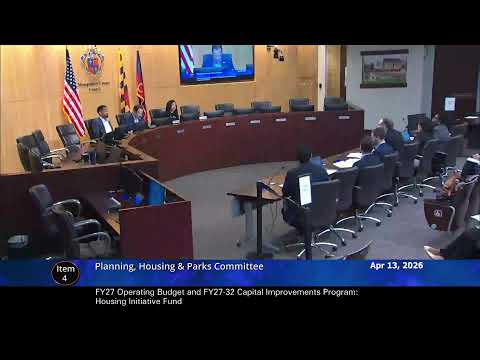
The committee shifted to the Department of Housing and Community Affairs (DHCA) for a detailed review of its FY27 operating budget, the Housing Initiative Fund (HIF), and several CIP amendments.
DHCA told the committee the recommended operating funding across general, grant and HIF funds totals about $77.7 million for FY27, a decrease of roughly $5.9 million from FY26 driven primarily by increased HIF debt service tied to additional taxable bonds programmed in the CIP.
On the operating side, DHCA asked the committee to add two positions to the reconciliation list to implement council bills: a $125,180 position to implement an eviction-notification coordination bill (to receive, verify and share an estimated ~4,600 eviction notices annually with homelessness services and the sheriff) and a $121,320 position to implement pilot amendments tied to bill 225. DHCA said contractors will temporarily cover some duties until positions are approved.
Pophan Salem, DSCA finance division chief, briefed the committee on a recurring budgeting challenge: formula-driven federal grants (CDBG and HOME) have caps on how much of those grant dollars can be used for personnel (CDBG about 20%; HOME about 10%), while county compensation increases push personnel costs beyond what the grants will cover. "When county increases the wage adjustment, however, the federal funding remains constant," Salem said, explaining the general fund must backfill the difference. Committee members asked OMB and finance for a countywide analysis of how many grant-funded positions will need local backfill and requested that analysis quickly.
The committee also examined landlord/short-term rental revenue projections after DHCA reported a technical double-counting error had overstated projected multifamily licensing revenue by about $1.3 million in a prior estimate. DHCA explained that short-term rental universe estimates dropped from earlier contractor and OIG counts (previously reported near 1,400) to about 700 after cleaning the data provided by the vendor (Granicus) and reconciling duplicate entries. Licensing collections were still up year over year (~$500,000), staff said, but the correction means prior revenue projections were optimistic. The department emphasized the enforcement challenge: units go on and off platforms and cleaning the data and weekly follow-up remain labor-intensive.
Chair Friedson stressed the life-and-safety rationale for inspections and licensing, recounting a local fire tragedy to underline the stakes: "Unfortunately, safety standards were not followed ... there was a fire that took the lives of two vibrant, young, beautiful souls," the chair said, urging careful attention to inspection and enforcement responsibilities, particularly in light of a new state law that delegates inspection obligations.
Committee members pressed for clarity on whether DHCA has the core competency and staffing to conduct the inspection responsibilities or whether other county units (permitting, fire marshal) should be involved. DHCA said existing code inspectors can cover inspections required under the new state law and that inspections will support licensing and enforcement.
On affordable housing finance, DHCA described HIF operating impacts of added taxable bonds and a mix of recordation tax and loan-repayment timing that make year-to-year comparisons complex. After staff walked through a crosswalk of FY26 versus FY27 programming (including a $10.1 million loan-repayment that staff programmed into FY26 to close imminent projects and a $64 million taxable-bond program for FY27), the chair proposed and the committee supported recommending a $4 million taxable-bond CIP amendment for FY27 to bring affordable housing support back toward last year’s level of effort. Staff noted any extra debt service would affect the FY28 operating budget and that CIP versus general-fund accounting rules differ for taxable bonds.
Committee members also asked for clearer tables and crosswalks showing how cash and taxable-bond support changed year over year; the chair requested that DHCA, OMB and council staff reconcile the presentation so full council can see consistent figures before final votes.
Next steps: DHCA and OMB will provide requested clarifications (countywide grant-funded staffing analysis, revenue/expenditure crosswalks for HIF/AHAP) and staff will prepare the proposed $4 million CIP amendment for committee and full-council consideration.