Lifetime Citizen Portal Access — AI Briefings, Alerts & Unlimited Follows
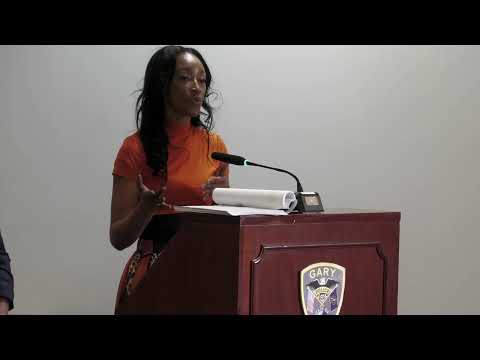
Staff present draft unified development ordinance to Gary Common Council committee
Loading...
Summary
City planning staff presented a draft unified development ordinance to the Gary Common Council's Planning & Development Committee, proposing a simplified R1'R4 residential scale, new commercial and industrial categories, several overlay districts, and a public mapping process.
City planning staff presented a draft unified development ordinance to the Gary Common Council's Planning & Development Committee, describing a full replacement of the city's existing zoning code and the start of a map-update and public outreach process.
The draft, introduced by Corey Sharp and Dr. Sylvia Martin, would replace multiple legacy zoning chapters with a single, table-formatted code that reorganizes residential zones from R1 to R4, creates clearer business categories (B1'B4), preserves a three-tier industrial structure (M1'M3) and adds new specialty districts such as entertainment and "destination." "This is a complete replacement of our existing, zoning ordinances," Corey Sharp said. "At the core, this update is about creating consistency," Dr. Sylvia Martin added.
Why it matters: staff said the rewrite aims to reduce long-standing ambiguity in the 1991 code, make standards easier to apply, and align zoning with how people live and work. Sharp said the new code uses tables for clarity (for example, a minimum building setback is shown in the tables) and that the map update will align district designations with existing land use across the city's roughly 57,489 parcels. The ordinance is intended to guide transitions between low-density residential and higher-intensity commercial and industrial uses rather than to pre-assign future anchors.
Key features described - Residential: replaces a confusing R1'R7 scheme with a simpler R1'R4 progression to protect single-family character while allowing graduated density. - Business: introduces B1'B4 to differentiate neighborhood retail, larger commercial corridors and a new B4 for automotive and specialized commercial uses. - Industrial: keeps M1 (light), M2 (general/warehouse) and M3 (heavy) distinctions and adds buffering and infrastructure guidance. - New districts/overlays: entertainment districts, a flexible "Destination" district (to support anchors such as Indiana University Northwest and hospitals), a new railroad land-use category, airport and wellhead overlays and a clarified floodplain overlay.
Public questions and staff responses During Q&A residents and council members pressed staff on practical effects. A resident identified as Mrs. Kirby said simplicity was welcome but warned that "truth lies on the bridge between theory as words on a page and practice." She asked whether the city would be able to limit the number of short-term rentals in a neighborhood and said she had been told staff research help could cost $50 an hour. Sharp responded that the concern referred to short-term rentals and that "we are regulated by state statute" and therefore the city cannot set a saturation rate; short-term rentals are addressed through special-use criteria and conditions that reflect the state's seven-point standards.
Staff also previewed development standards to come in later sessions (signs, landscaping, parking, fences, lighting, animal standards) and gave one enforcement example: new, table-based rules would allow code enforcement to limit cars parked on automotive sales lots (Sharp cited a hypothetical limit of 20 cars as an example where some lots currently display far higher counts).
Next steps Staff said the Plan Commission has given a favorable recommendation and that the city has begun the public hearing process. The administration will produce a revised zoning map, host neighborhood mapping forums this summer and return to the committee with the ordinance's development standards in a subsequent meeting. The committee scheduled continuation of the item at the council meeting next week.
The committee took no formal vote on the ordinance at the session; staff directed the public to upcoming forums for map input and next procedural steps.