Get Full Government Meeting Transcripts, Videos, & Alerts Forever!
Get email alerts on the State Budget topic
No spam. Unsubscribe anytime.
Senate finance committee advances FY2027 budget with hospital buybacks, teacher pay and targeted grants
Summary
The committee adopted finance‑level amendments to a $58+ billion FY2027 appropriations bill that funds teacher pay commitments, TennCare hospital buybacks, new public‑safety positions, and multiple nonrecurring grant pools; members debated trade‑offs including use of shared savings and projected hemp‑tax revenue.
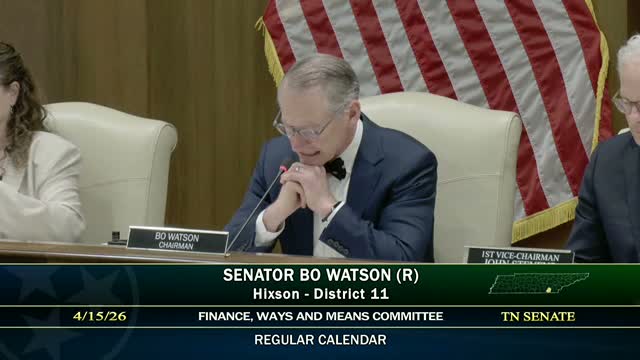
Senate finance leaders presented an amended FY2027 appropriations bill on April 15 that the committee recommended for passage to the committee on the calendar after adopting three finance amendments that reshape the administration’s proposal and add legislative priorities.
Leader Johnson (speaker 11) summarized the administration amendment and said the proposed fiscal 2027 budget totals just over $58 billion, with approximately 52% from general and dedicated state appropriations and the rest from federal sources, fees, tuition and bonds. He highlighted several priorities retained or added in the amended package, including completion of the teacher starting‑salary goal to $50,000, investments in K–12 via the TISA funding formula, increases in public safety staffing, and deposits to the governor’s response and recovery fund.
A later legislative amendment (finance 3) added nonrecurring grant pools: $20 million for volunteer fire departments, $5 million for volunteer rescue squads, $5 million for EMS equipment, $5 million for museum capital improvements, $500,000 for senior centers and $1.5 million for courthouse renovations, among other line items. The amendment also included a legislative effort to fund TennCare hospital buybacks at $137 million using a mix of recovery dollars, wire transfer funds, technology funding reallocation, rural development funds and other sources.
Committee members asked detailed questions about funding sources, including whether buybacks were funded from shared savings (they were not entirely) and the trade‑offs made to preserve a disaster recovery fund. Leader Johnson explained the legislature used $55.8 million from recovery funds, $14 million from a wire transfer fund, $10 million from rural development, and other adjustments to reach the $137 million total for buybacks. He also noted the committee intentionally used recurring elements where possible to partially sustain future buybacks.
Members raised fiscal concerns about relying on projected hemp‑tax revenues and the use of nonrecurring dollars for recurring needs. David Thurman (speaker 12), state budget director, explained that hemp collections were scored as nonrecurring for FY26 because timing affected receipts but were modeled as recurring in FY27 based on the fiscal note; he said timing and legal issues have reduced near‑term collections relative to earlier projections.
Senators also discussed public safety funding allocations for Memphis and the balance between deterrence and prevention programs. The committee adopted the finance amendments and returned the bill as amended; it was recommended for passage to the committee on the calendar.
What’s next: The committee advanced the appropriations bill to the calendar; final budget enactment and implementation depend on full legislative action and any technical corrections during the calendar process.