Lifetime Citizen Portal Access — AI Briefings, Alerts & Unlimited Follows
Superintendent Reykdal: K-12 faces levy-equalization and TK cuts as funding-equity work begins
Loading...
Summary
Superintendent Chris Reykdal told the State Board April 15 that the recent state budget reduced levy equalization by roughly $25 million and cut transitional kindergarten funding by about 25% (around 2,000 slots), and said OSPI will use the funding-equity work group to shape the next biennial budget request.
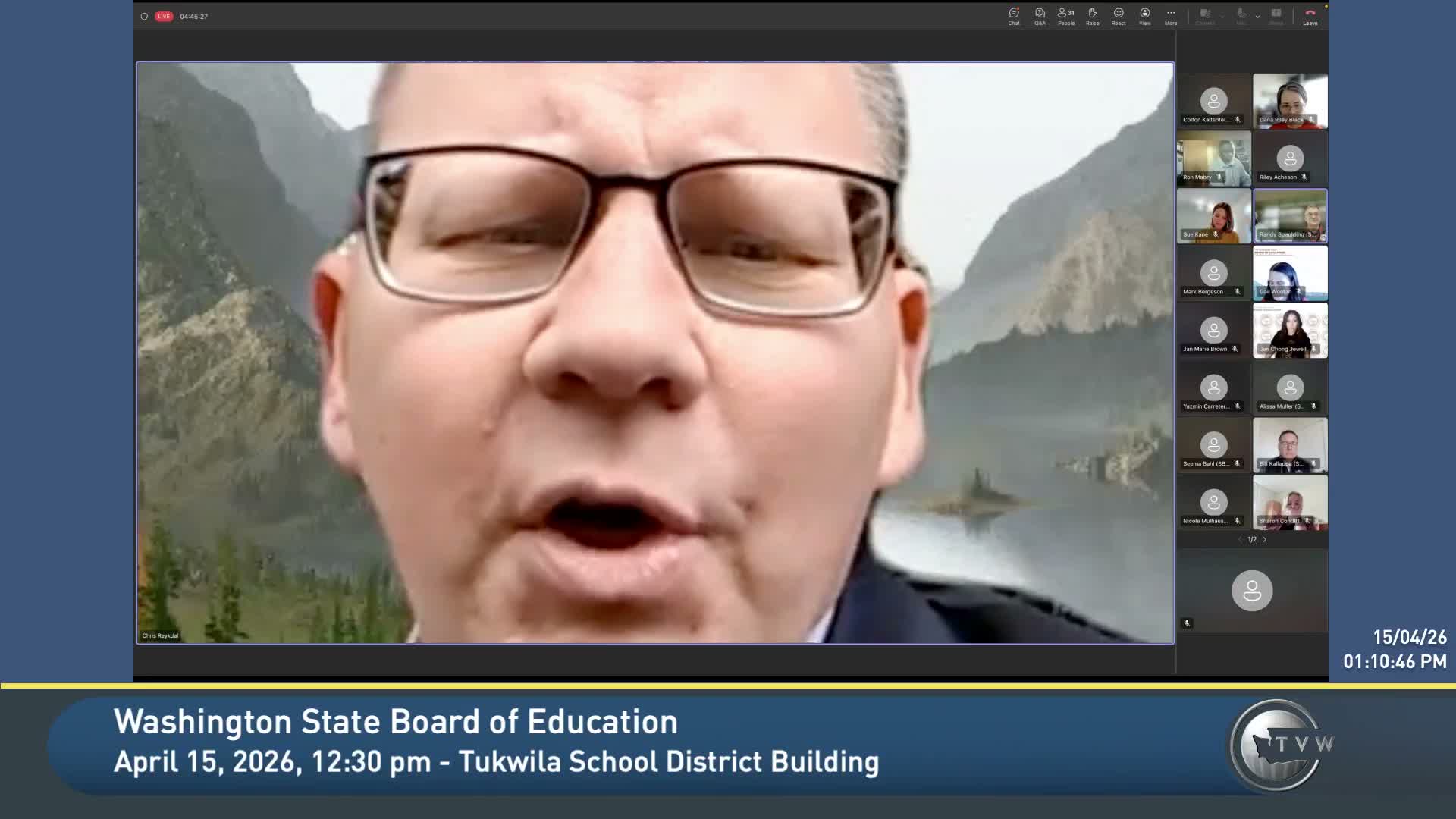
Superintendent Chris Reykdal told the State Board of Education on April 15 that K-12 faces notable reductions in the current budget and that OSPI intends to use the newly reconvened funding-equity work group to drive the agency's next budget request.
Reykdal said the legislature trimmed about $25 million from levy equalization and reduced transitional kindergarten (TK) funding by roughly 25 percent, which equates to about 2,000 slots from a base of a little over 7,000. "About 25,000,000 or so cut out of levy equalization," he said, adding that the TK reduction "was really tough." He also summarized the net fiscal picture for K-12: "the state budget did grow by $2,000,000,000 year over year, but K-12 took an $80,000,000 cut on an annual basis," and noted that roughly $50 million of that $80 million targeted levy equalization and TK.
Reykdal said OSPI will center the funding-equity work group in formulating the agency's comprehensive budget request this fall, aiming for structural changes rather than short supplemental fixes. "Our biggest priority will be to challenge lawmakers to meet the constitutional obligation of basic ed," he told the board, adding that the work group will consider whether a per-student model that recognizes need would be more equitable than the current approach in statute.
Board members pressed Reykdal on rural impacts and implementation details. Doctor King raised concerns that remote and rural districts can cost nearly twice the state average to operate; Reykdal said the state already includes a small-school factor and other minimums but acknowledged a set of districts are not well served by existing regionalization and may require additional adjustments. On the TK cuts, board member Ron Mabry asked whether private-pay options could offset lost slots; Reykdal said districts could pursue a mixed model where some families pay privately to make classrooms viable, but warned that would likely advantage families who can afford private pay and "may make that worse" for equity.
Reykdal and board members also discussed design choices the work group will weigh, from whether to average enrollments over multiple years to blunt volatility to how to cost and prioritize suggestions. Reykdal said OSPI will form a technical advisory group to run regression models and test budget-code implications and that the larger work group will continue to surface big ideas. "We're gonna create the space for that and then report all of that work to the whole group," he said.
The board did not take any formal budget action at the meeting. Reykdal urged board members to share any specific items they want modeled for the governor's request, noting the agency aims to deliver a comprehensive proposal this year ahead of the full biennial session.
Ending: OSPI staff and board members agreed to continue detailed discussion as the funding-equity work group completes technical modeling and returns recommendations to inform the fall budget request.