Get AI Briefings, Transcripts & Alerts on Local & National Government Meetings — Forever.
DBM presents 2027 operating allowance; DLS flags large deficiency appropriations and closeout errors
Loading...
Summary
At an Appropriations Committee hearing, DLS analyst Jacob Cash outlined a $49 million FY27 DBM allowance and identified $758 million in fiscal-25 deficiency appropriations and $3.4 billion in unsubstantiated federal revenue accruals; Secretary Jake Weitzman pledged targeted DPA funds and stronger AFCU oversight to address repeat audit findings.
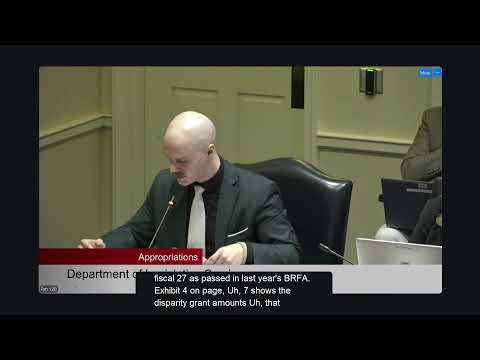
Jacob Cash, policy analyst for the Department of Legislative Services, told the Appropriations Committee that the Department of Budget and Management’s (DBM) proposed 2027 operating allowance is $49,000,000, about $5,000,000 (roughly 11%) higher than FY26, driven largely by central collections activity and related personnel costs.
“The main source of the increase is related to central collections,” Cash said, noting higher placements from agencies, higher banking and postage fees, and five additional positions in the central collections unit (CCU). Cash added that CCU items together account for about $3,500,000 of the increase and that the unit “returned to profitability this past year.”
Cash also summarized a set of DLS concerns arising from fiscal-25 closeout work, telling the committee that DLS identified “serious issues” across seven major state agencies that required $758,000,000 in deficiency appropriations to resolve prior-year shortfalls. He said DLS found $3,400,000,000 in accrued federal revenues that agencies could not sufficiently document, including $2,200,000,000 and $1,600,000,000 in positive and negative entries at the Department of Human Services and $1,350,000,000 in prior-year accruals at the Maryland Department of Transportation that could not be clearly classified as prior or current-year funds.
Those accounting gaps, Cash warned, “may result in unrecovered funds, which could ultimately require the use of state general funds to resolve.” DLS recommended restricting certain funds and rejected a proposed change in the budget reconciliation language that would let DBM stop providing printed budget books—Cash said that change would save about $40,000 annually but recommended striking the contingent reduction and leaving the printing requirement in place.
Jake Weitzman, secretary of the Department of Budget and Management, answered questions and described steps DBM is taking to address DLS concerns. He said DBM has prioritized improving collections and related customer-facing payment options, and reported that “overall, FY25 collections increased by 47%” and that CCU is about 9% ahead of last year’s recoveries through January.
On audit-resolution work, Weitzman said the administration is focusing on practical solutions and described $2,000,000 in dedicated-purpose-account (DPA) funds proposed for recruitment and training of state fiscal leaders and targeted measures to resolve repeat audit findings. “The goal of the DPA funding is straightforward: to implement solutions that resolve audit findings, reduce repeat findings, and prevent further issues from occurring,” he said. He also noted DBM will expand AFCU reporting to provide formal quarterly reports to agency heads and cited a governor’s directive requiring agencies to review audit processes.
Committee members pressed DBM on why deficiency appropriations have grown and on late budget-amendment submissions. A DBM staff member explained that deficiency appropriations are typically requests for additional general-fund authority handled through the annual budget cycle, while budget amendments are generally special or federal-fund adjustments during the fiscal year. Weitzman and staff said reduced vacancy savings (after increased hiring) and unforeseeable events can contribute to deficiencies and that DBM has adopted centralized coordination and follow-up to improve timely submission of budget amendments.
The hearing concluded with members urging DBM to follow up on late submissions and to provide supplemental details where executive privilege permits. The committee then moved to the next budget hearing on the state reserve fund.
What’s next: The Appropriations Committee will continue budget hearings; DBM was asked for follow-up on timely budget amendments, use of DPA funds for audit resolution, and details about CCU placements and collections.