Lifetime Citizen Portal Access — AI Briefings, Alerts & Unlimited Follows
Cook County health officials form Medicaid Impact Work Group and launch getmedicaidfacts.com as federal eligibility changes loom
Loading...
Summary
Cook County Health convened a 60-plus member Medicaid Impact Work Group, unveiled a multilingual toolkit and microsite (getmedicaidfacts.com) to help beneficiaries prepare for HR 1-driven changes (including twice-yearly redeterminations and work requirements), and outlined steps to reduce administrative coverage loss.
Cook County Health officials told the Health and Hospitals Committee on Monday that federal eligibility changes under HR 1 could cause thousands of Illinois residents to lose Medicaid and strain the county’s health safety net, and they unveiled an outreach campaign to reduce avoidable disenrollments.
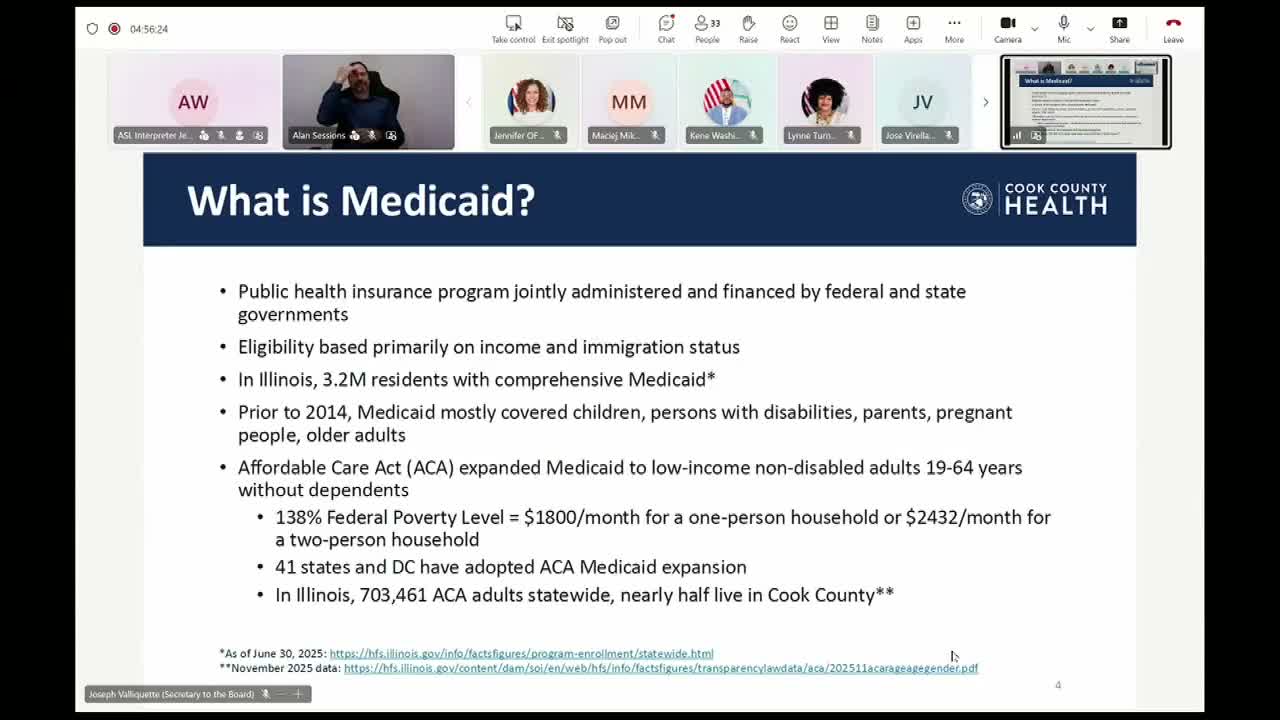
Kathy Chan, director of policy at Cook County Health, said the county is preparing for three major changes tied to HR 1: a narrowed federal definition of "qualified immigrants" that will end Medicaid coverage for many humanitarian immigrants on Oct. 1, 2026; a shift to twice-yearly redeterminations for Affordable Care Act adults starting in January 2027; and a new work or community engagement requirement that beneficiaries will have to document (roughly 80 hours per month, as described by presenters). Chan said those changes create a compressed timeline for state and local systems to implement federal guidance and to notify and help enrollees maintain coverage.
Why it matters: County health leaders warned that administrative barriers — missed mailings, paperwork delays and complicated renewal procedures — have historically driven large numbers of otherwise-eligible people off Medicaid. Cook County Health estimates its retention work has kept redetermination losses near 12 percent in recent months, well below the state average, but officials said the proposed cadence and new requirements increase the risk of coverage churn and greater charity-care costs.
During a presentation, a Cook County Health official summarized system-level trends: the health system’s Medicaid share fell below 50 percent as of February while the uninsured share rose to roughly 25 percent. Charity-care budgeting has also increased; the health system has budgeted about $380 million for charity care this year. Presenters said modeling suggests a broad, multi-year financial and access impact if coverage losses accelerate.
To respond, Cook County Health said it convened the Medicaid Impact Work Group in September and has since enrolled more than 60 organizations — including hospitals, community health centers, health plans, state partners, academic institutions, community organizations and philanthropic groups — to coordinate mitigation strategies. Initial actions include creating and sharing a communications toolkit for community organizations and providers, running frequent enrollment and redetermination events, leveraging data systems and patient portals to flag at-risk enrollees, and pursuing exemptions (including ex parte and medical frailty designations) to reduce unnecessary renewals.
Alex Normington, chief communications and marketing officer for Cook County Health, demonstrated a newly launched microsite, getmedicaidfacts.com, and an unbranded toolkit that the county said can be adopted by partners and translated. Normington said the site and materials are available in English, Spanish, Arabic, Mandarin, Polish and Ukrainian to improve outreach to non-English-speaking communities.
Committee members pressed presenters on coordination with Illinois agencies and marketplaces; Cook County Health said it is working closely with the Illinois Department of Healthcare and Family Services (HFS) and the state marketplace team on messaging and systems, and has asked the state for a county-level estimate of how many of the roughly 10,000 people the state expects to lose immigrant-based coverage live in Cook County.
Several commissioners highlighted the need for targeted outreach in suburban and South Suburban communities and asked whether academic partners and civic volunteers could be mobilized to help with reenrollment work. Presenters said the work group is pursuing a "big tent" approach and encouraged commissioners to share contacts and encourage local partners to use and rebrand the toolkit for their constituencies.
What’s next: Cook County Health signaled a second phase of the work group focused on coordinated care delivery for people who become uninsured and said it plans ongoing virtual and in-person convenings this year. The committee deferred the formal item to committee for continued work and follow-up.
Sources: Presentation to the Cook County Health and Hospitals Committee and Cook County Health officials. Quotes and attributions are limited to speakers who identified themselves during the meeting.