Get Full Government Meeting Transcripts, Videos, & Alerts Forever!
Get email alerts on the Land Use topic
No spam. Unsubscribe anytime.
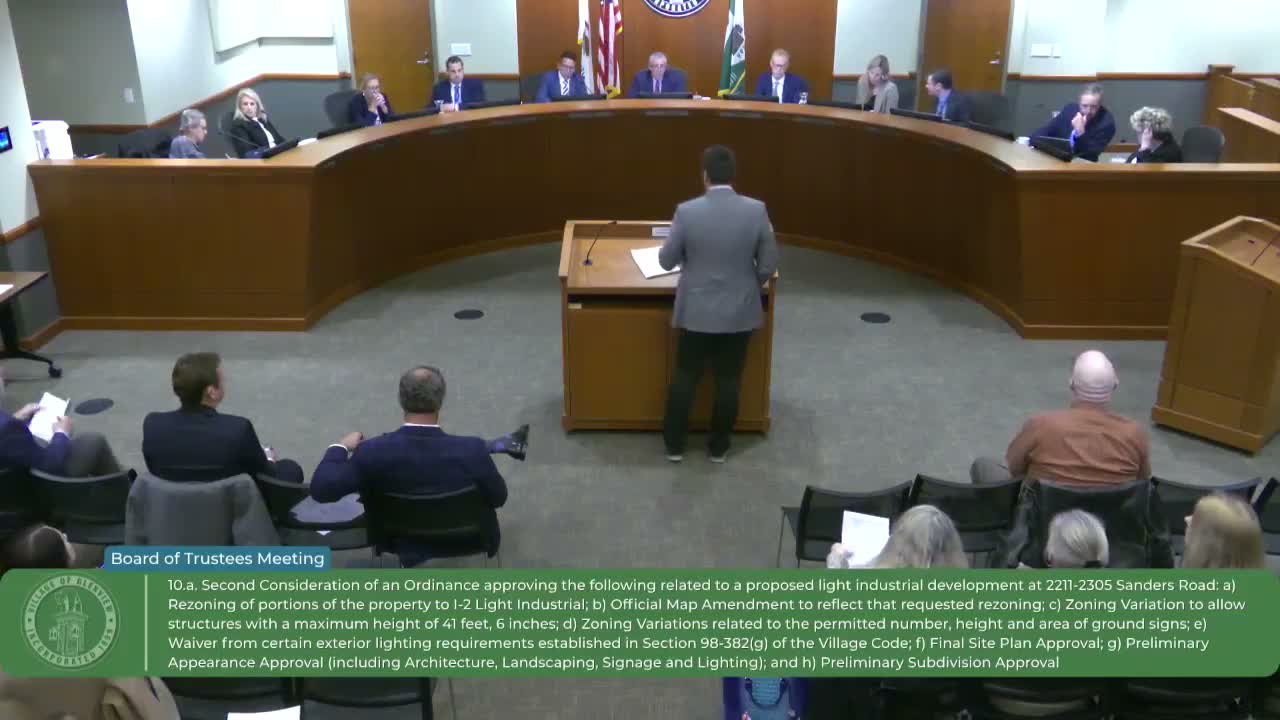
Board approves rezoning and Class 6b support for Sanders Corporate Park after lengthy debate and public objections
Summary
After extensive public comment and trustee questioning about truck traffic, carcinogens and legal compliance with the Willow Road Corridor agreement, the Glenview Board approved rezoning of the Sanders site to I‑2 and a supporting Cook County Class 6b development agreement with added safeguards including a 50,000‑square‑foot occupancy review and tightened ordinance language.
The Glenview Board of Trustees approved on April 7 a rezoning ordinance and related development agreements for Sanders Corporate Park, alongside a resolution supporting the developer’s Cook County Class 6b property tax incentive, after extended public testimony and trustee debate.
Director of Community Development Jeff Brady told the board the 29‑acre site would be rezoned to I‑2 (light industrial) and that the updated ordinance narrows permitted uses with a clarified definition of “clean and light industrial,” appearance controls and enforceable restrictions meant to prevent large-scale logistics operations. Brady also reviewed the Class 6b incentive structure, which reduces assessed valuation for industrial property to 10% for the first 10 years (phasing back toward 25% by year 13), and described a make‑whole provision in the development agreement requiring the applicant to compensate taxing districts if assessments fall below the guaranteed floor.
A representative for the applicant emphasized the redevelopment plan would produce four shallow‑bay buildings designed to attract advanced‑manufacturing, showroom and light‑industrial tenants rather than bulk distribution. The presenter said the project includes site design elements that limit heavy‑truck circulation, no trailer parking or outdoor storage, dock placements screened from Sanders Road and enhanced landscaping; he estimated roughly 200 permanent full‑time jobs and a guaranteed minimum of about $1.1 million annually in property taxes during the 6b period, totaling roughly $15.7 million over 12 years under the build‑with‑6b scenario.
Opponents — organized as an objectors group and represented by counsel — argued the rezoning fails multiple legal (LaSalle) factors, flagged possible inconsistency with the Willow Road Corridor agreement and raised traffic, health and property‑value concerns. Residents and counsel claimed the developer’s materials arrived late, questioned a claimed lot‑coverage percentage and urged the board to delay action and resolve outstanding legal interpretations first.
Trustees questioned staff and the applicant on technical and legal points, including whether the corridor agreement restricts permitted uses, how truck routing would be enforced, whether 53‑foot trailers could physically use Sanders Road northbound, and the potential use of any EPA‑classified carcinogens in future occupiers’ processes. Trustees requested stronger ordinance language and a practical enforcement path for concerns raised.
To address those concerns in real time, the board approved a motion to adopt the rezoning ordinance on second consideration with three friendly amendments: (1) remove the word “could” from a sentence in Section 3 so example uses are framed as examples ("examples include" rather than "could include"), (2) require that any tenant occupying more than 50,000 square feet obtain approval from the Community Development Director before receiving an occupancy permit, and (3) modify Section 3 to explicitly prohibit manufacturing that routinely uses, as part of the primary business function, any EPA‑defined Class I carcinogen. Trustee Cooper moved the motion; Trustee Jones seconded. A roll‑call vote recorded six affirmative votes (Trustees Deboni, Doran, Jones, Sodoti, Bland and Cooper) and the motion carried.
The board also approved a related development agreement and a separate item (10B) on the agenda tied to the project’s procedural steps.
The board majority framed the decision as an effort to reactivate a long‑vacant corporate campus, protect the village’s commercial tax base and secure enforceable commitments from the developer. Opponents said legal ambiguity in the corridor agreement and the absence of confirmed tenants made the approval premature and warned of litigation risk. The developer and staff said the ordinance changes and the make‑whole provision protect taxing districts and that additional site‑level approvals and conditional use reviews would still apply.
Next steps: the ordinance, as amended, passed second consideration at tonight’s meeting. If the development proceeds, site plan and appearance approvals remain through the village’s Development Adjustment Commission and the permit/inspection process; the board and staff said they would monitor compliance and enforcement as the project advances.