Lifetime Citizen Portal Access — AI Briefings, Alerts & Unlimited Follows
Design firms outline budgets, outreach and risk strategies for Neary School feasibility study
Loading...
Summary
Three finalist teams offered contrasting methods: Arrowstreet presented prior MSBA numbers and alternative budget ranges; RGB emphasized forensic assessments and a 'work‑backwards' budgeting approach; Tappe highlighted senior‑staff availability, phasing to keep students in school and outreach tools to build voter support.
Three design teams interviewed by the Southborough Building Committee presented distinct approaches to a feasibility study for the Neary Elementary School.
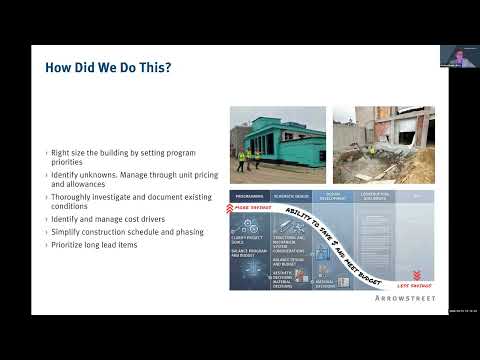
Arrowstreet framed the discussion with the project’s recent history and prior MSBA submission, noting a previously proposed $108,000,000 package that included a $35,000,000 MSBA grant (a net town share of about $73,000,000). Arrowstreet sketched two alternate paths: a reduced scope the firm suggested might be in a $40–50 million neighborhood (a working construction budget estimate of roughly $30–37 million) and a deferred‑maintenance option tracking near $15,000,000. The firm emphasized careful early identification of unknowns (roof deck, masonry, structural issues) and described unit‑priced bid allowances to limit the town’s exposure to hidden conditions.
RGB (presented by David DuPontro and his team) emphasized detailed forensic existing‑conditions work and market‑aware cost estimating. RGB repeatedly described a “work‑backwards” strategy: choose a target budget and then develop and communicate what the town can receive for that sum, supplemented with interactive engagement tools (QR banners or online tax calculators) to collect public feedback. RGB also described in‑house cost estimators and forensic architects to accelerate realistic estimates and reduce design‑to‑bid change orders.
Tappe (Chris Blesen, Jen Littlefield and Cesar Delios) stressed senior‑staff availability, phasing strategies to keep students in place and experience coordinating sensitive site constraints such as wetlands and roof work. Tappe said it routinely builds public outreach packages (graphics, simple tax calculators and storytelling materials) to help residents compare options and understand tax impacts.
All three firms discussed contingency approaches to manage market escalation and how early testing and prioritized scopes can lower overall risk. Committee questions probed how firms would reconcile short‑term choices (e.g., a low‑cost pre‑engineered gym that might last 20–25 years) with long‑term value (a 50‑year MSBA standard), and how to communicate trade‑offs to voters. Several committee members asked firms to provide samples of outreach artifacts (tax calculator, sample mailers, digital assets) so the committee could compare communications methods before contract award.
No votes on specific budgets or scopes were taken; the only formal action that evening advanced a single firm (Tappe) to reference checks and contract negotiation. The committee expects to return to contract details after reference checks and requested the finalist firms’ outreach samples to inform the feasibility study’s communications plan.