Building committee favors a renovation that keeps existing high school, adds about 120,000 sq ft and aims to save embodied carbon
Loading...
Summary
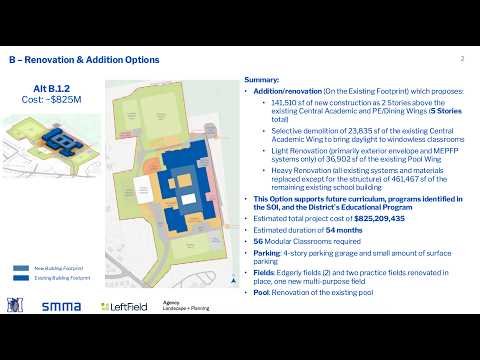
The Medford Public Schools building committee discussed a "B1.2" renovation to retain most of the existing high school, add roughly 120,000 square feet by building two stories over existing wings, and reduce embodied carbon by reusing concrete and other materials.
The Medford Public Schools building committee spent its meeting discussing a "B1.2" renovation option that would keep most of the existing high school structure, add roughly 120,000 square feet by building two stories atop existing wings, and prioritize lowering embodied carbon by reusing materials, committee members heard.
Committee member said community forums showed little enthusiasm for the heavier "B" options that would be highly disruptive, which helped bring modular and retention-focused ideas back into the conversation. "So enter the modular conversation as it were," the committee member said while framing the trade-offs between options that largely preserve the building and those that would replace it.
Presenter urged that embodied carbon was a principal reason some committee members favored retaining the existing structure. "A lot of times we say that, the greenest building that we can build is the one that we don't have to build from scratch," the Presenter said, arguing reusing portions of the current facility reduces the long-term environmental cost of new materials and construction.
The Presenter explained that the B options differ from A options because they allow the project to "keep the existing structure, but completely reconceive the internal workings of the building" while bringing the building up to code and meeting the educational program. The Presenter described the selected B1.2 approach as adding two additional stories over the B Wing and the existing D Wing (where cafeterias and some PE space are located) to create roughly 120,000 square feet of additional space.
Committee member highlighted site-preservation benefits of the approach, saying the option would preserve Edgley Field and existing parking by building vertically rather than expanding the footprint. "This option that we're looking at here would preserve Edgley Fields… it would preserve the parking, like, where it is," the committee member said.
Committee member also outlined programmatic gains from the added space: rightsizing CTE programs that are currently undersized, expanding special education space, and centralizing early childhood offerings now scattered across the district. They said bringing students from Curtis Tufts onto the campus is an objective but noted that geography currently complicates access: "Who have every right to access all of the programming here… whether that's during the school day or in an after school capacity… it's really hard right now for that to be a reality because they are stationed all the way across the city."
The meeting transcript records explanation and discussion of options and priorities but does not record a formal vote or final decision on the project in the segments provided. Next procedural steps were not specified in the transcript.