Get Full Government Meeting Transcripts, Videos, & Alerts Forever!
Get email alerts on the Automated Enforcement topic
No spam. Unsubscribe anytime.
Shoreline approves automated school-zone speed cameras after debate over privacy and fines
Summary
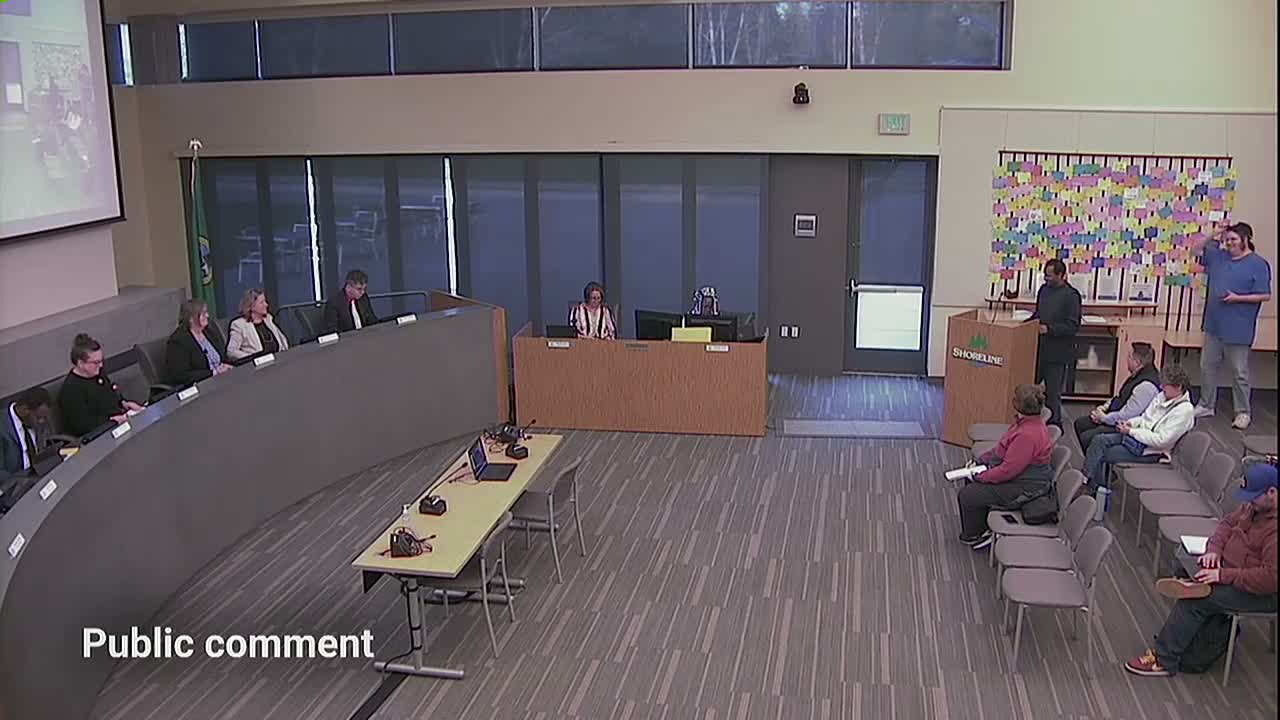
The Shoreline City Council on March 30 approved Ordinance 10-55 authorizing automated traffic-safety cameras in school zones (targeting Meridian Park Elementary) after hours of public comment and council debate; the ordinance was adopted 6–1 after council added a lower low-tier fine and rejected a proposed hours restriction.
The Shoreline City Council on March 30 adopted Ordinance 10-55, authorizing automated traffic-safety cameras in school zones and permitting the city manager to contract with a vendor to operate the program. The ordinance passed 6–1 after council approved an amendment that created a lower fine tier for minor violations.
Council members, staff and residents spent much of the meeting debating trade-offs among pedestrian safety, privacy, equity and program cost. Transportation Manager Kendra Dodinski told the council the proposal targets Meridian Park Elementary due to repeated speeding and rising serious-injury crashes and described the staff recommendation and state reporting requirements. "Proposed ordinance number 10-55 . . . authorizes use of traffic safety cameras for school zone enforcement, which would be used at Meridian Park Elementary if adopted," she said.
Why it matters: supporters said cameras are the most practical enforcement tool where police staffing is limited and engineering fixes are constrained by arterial traffic needs; opponents warned that automated systems collect more scene data than license plates and that vendor-held images are subject to subpoena. "Cameras are not magically able to record only license plates," said Christopher Potter during public comment, arguing the systems take whole-scene photos and may retain extra images. Transportation staff acknowledged that traffic-camera data can be subject to subpoena and that contract provisions and audits are important.
Key provisions and amendments: staff described a tiered penalty framework in which the draft ordinance set a $130 minimum penalty and $260 for drivers exceeding the limit by more than 14 mph. During debate council adopted an amendment that established a lower low-end tier (a $50 ticket tier for drivers 4–9 mph over the posted limit during school-zone hours) while other fine tiers and enforcement rules remain part of the ordinance as written or subject to staff implementation. Council rejected a separate amendment to tightly limit daily operating hours. Staff warned the council a $50 minimum could mean the program would cost the city money unless the budget covered vendor operating costs.
Equity and enforcement: equity concerns animated much of the discussion. Several residents and council members said flat fines disproportionately burden lower-income residents. Council member Scully urged mitigating steps — such as a warning period, mitigation hearings, judicial discretion and neighborhood-targeted education — that would reduce unequal impacts while preserving safety benefits. Transportation staff noted state law requires a public warning period at launch and that judges retain discretion to adjust penalties based on circumstances.
Data, vendor oversight and transparency: multiple speakers asked for contractual language on data retention, auditing rights, and public reporting. Deputy Mayor Pobey urged regular public reporting of tickets issued, revenue collected and safety outcomes to build public trust; staff agreed transparency and reporting would be part of program governance.
Outcome and next steps: with the ordinance adopted as amended, the council authorized staff to negotiate a vendor contract and begin the process required by state law, including a minimum warning period at launch and ongoing reporting. Staff told the council implementation timing could be adjusted to avoid conflict with nearby capital construction on the 170th corridor, but that pausing a vendor contract during construction is feasible. The council also directed staff to return with budget implications if the lower fine tier requires general-fund supplementation to cover operating costs.
The ordinance (SMC ch. 10.21 / Ordinance 10-55) will be implemented under state law reporting requirements and under terms to be negotiated in the vendor contract; staff expects to post launch details and periodic performance reports online.