Get Full Government Meeting Transcripts, Videos, & Alerts Forever!
Get email alerts on the Comprehensive Plan topic
No spam. Unsubscribe anytime.
Port Townsend council, planning commission workshop focuses on code changes to implement comprehensive plan; residents press MFTE and farm protections
Summary
At a joint Port Townsend workshop, staff outlined code and procedural changes to implement the new comprehensive plan — from lot-recognition and nonconforming-lot rules to possible repeal of some PUD provisions — while residents urged adoption of multifamily tax-exemption incentives and stronger protections for small-scale agriculture.
At a joint workshop, the Port Townsend City Council and Planning Commission reviewed proposed code changes aimed at implementing the city’s recently adopted comprehensive plan, including recognizing historic lots, revising nonconforming-lot rules and reconsidering planned unit developments, city staff said.
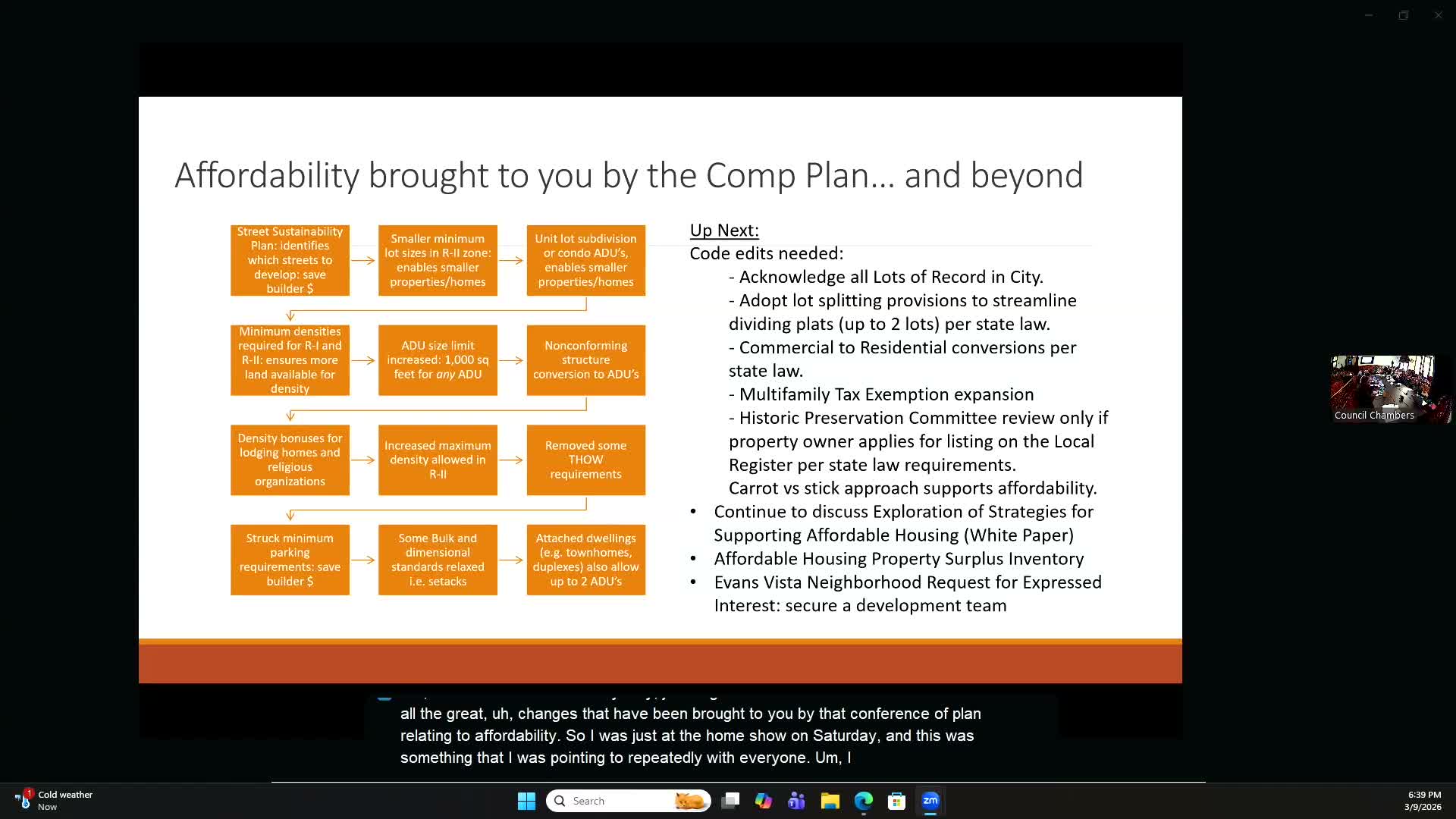
City planning staff framed the session as a technical workshop focused on how to translate plan policy into code. “I guess the takeaway is that we still have exclusionary development codes in Fort Townsend,” the meeting chair said, noting a series of code edits staff expects to bring forward to allow smaller lots, more accessory dwelling units and relaxed setback and parking requirements.
Why it matters: the changes would affect how the city counts buildable lots, how developers and homeowners can reuse or split lots, and which projects qualify for incentives intended to increase housing supply. That affects housing affordability, infrastructure costs and the role of urban agriculture inside city limits.
City staff flagged several concrete constraints. They said the city’s land-capacity analysis used a higher-than-recommended market-reduction factor because many parcels are subject to restrictive covenants or historic allotment-record rules; staff proposed updating the allotment-record code and adding administrative pathways to demonstrate buildability. Staff also warned of limited internal capacity: “We have 2 professional employment vacancies, it’s Peter and myself,” the chair said, and added that consultants and outside work require staff time to manage.
Public commenters urged the council to prioritize affordability and support for local agriculture. Eric Jones, a Port Townsend resident and director of Cowgens Solutions Network, spoke by phone and urged the city to move forward on affordability strategies this year: “There’s a good chance that the multifamily tax exemption might be on there, so I’d really put a plug for that,” he said, asking the council to consider MFTE options and strategies developed in a recently circulated white paper.
A second commenter, Jean Jenkins, told the panel the city’s land-use choices affect farmers: “Do you know that you have about 45 people that have either farms or growing in this town,” she said, and urged the city to recognize growers’ contributions to food security, school programs and the food bank.
Several participants asked procedural and sequencing questions. Staff described the docket process for site-specific amendments — planning commission public hearings followed by council action — and said one written docket submittal had lacked the required format. Staff proposed a working meeting to sort items that are comprehensive-plan amendments from those that are technical code changes, and to vet feasibility with applicants before committing staff resources.
On funding, staff said the city has a federal grant to support an urban-forest and food-conservation ordinance that is funded through September, but cautioned that invoices submitted after that date may be affected by the federal budget process. Participants discussed trade-offs such as whether to advance a large conservation project this year or to prioritize a smaller set of changes given staffing limits.
No formal votes or motions were taken: the chair reminded attendees the session was a workshop and that the planned executive session and workshop would produce no immediate action. City staff said follow-up steps will include the scheduled meeting with the growers, mayor and staff to clarify amendment language and a prioritized sequencing of docket items for council and planning commission review.
The council and planning commission did not adopt code changes at the meeting; staff will return with proposed amendments, timelines and any requested technical edits for public hearing and further deliberation.