Lifetime Citizen Portal Access — AI Briefings, Alerts & Unlimited Follows
Environmental Commission backs Project Connect code changes, adds explicit reimbursement formula
Loading...
Summary
After hearing Austin Transit Partnership and city staff, the Environmental Commission recommended City Council adopt amendments to Title 25 to streamline permitting for light rail, set project‑wide water‑quality rules and allow administrative heritage‑tree review — with an added requirement that any reimbursement for treatment exceeding regulatory requirements be calculated by a defined city formula (Appendix U).
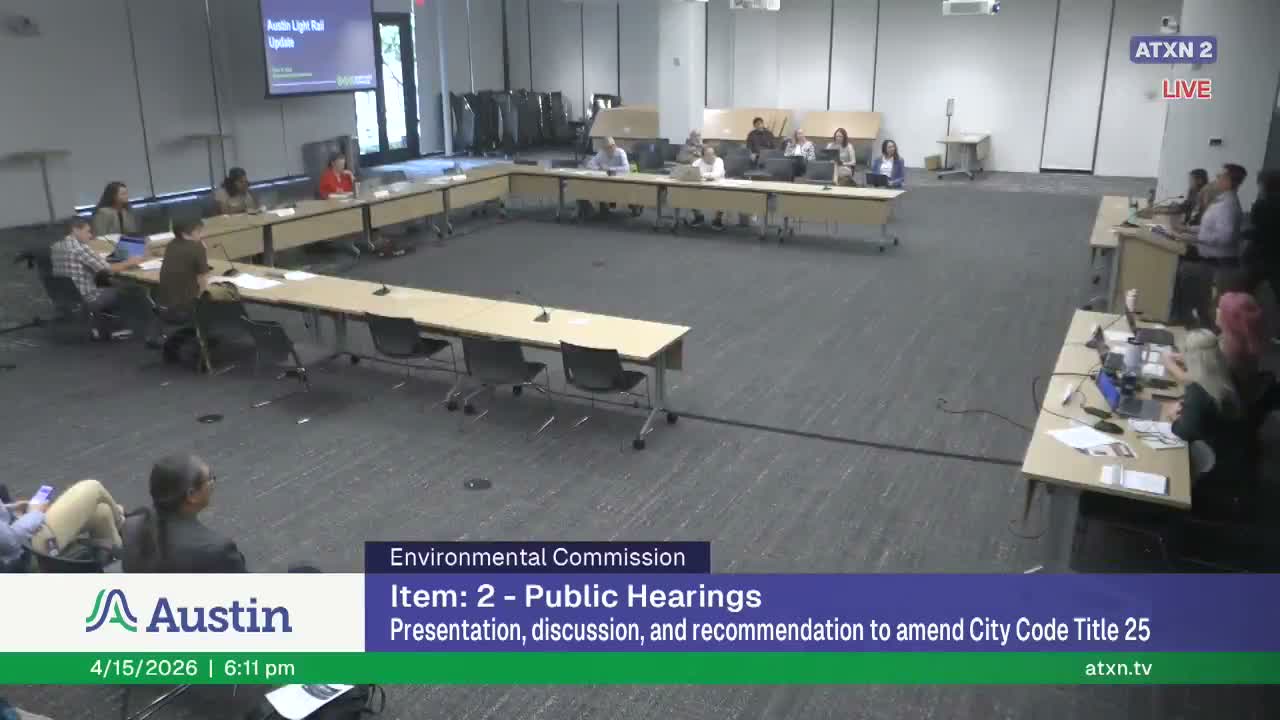
The City of Austin’s Environmental Commission on April 15 recommended that City Council adopt amendments to the land‑development code to support the Project Connect light‑rail program while adding a binding limit on how the city calculates reimbursements for water‑quality work that exceeds regulatory requirements.
Austin Transit Partnership officials told the commission they completed the final environmental impact statement and record of decision in January 2026 and have advanced procurement and early design work. “We completed our environmental impact statement in January 2026,” ATP’s Darren Lozano said, adding the project received a “medium‑high” federal rating and that contractors for design and construction have been selected.
City staff described six components of the proposed ordinance amendment: allowing non‑contiguous site‑plan limits for linear light‑rail construction, rescinding an outdated utility policy, establishing light‑rail streetscape standards, creating a project‑wide water‑quality compliance program, adding administrative review for certain heritage‑tree decisions, and modifying administrative rules to address constrained utility spacing. Watershed Protection liaison Diana Wang said the water‑quality approach treats the alignment as a single project to enable cross‑watershed treatment credits and encourage built treatment over payment‑in‑lieu. “What this would allow is water‑quality treatment compliance across watersheds and across site plans,” Wang said.
Commissioners pressed staff on heritage‑tree protections, administrative waivers and how payment‑in‑lieu and reimbursements would be handled. City arborist Naomi Ruttamel told the commission the ordinance “does not change the Heritage Tree Ordinance. It only speeds up the process,” and that the same mitigation and variance standards will apply, including a 300% mitigation requirement for removed heritage trees unless a tree is dead, diseased or an imminent hazard.
Several commissioners asked how many heritage trees Phase 1 would affect. Staff said an early inventory exists but must be updated when site plans are submitted; the estimate for single‑stem heritage trees within the right‑of‑way is small — “definitely fewer than 50, maybe fewer than 20,” the arborist said, subject to field verification.
A central point of debate concerned language allowing the director of Watershed Protection to reimburse public entities for water‑quality treatment built above regulatory requirements. Commissioners sought an explicit calculation method and an upper bound for any reimbursement. Staff and the environmental officer said the Environmental Criteria Manual’s Appendix U provides the payment methodology; commissioners successfully moved to add amendment language tying reimbursements to a defined city formula (Appendix U) and to limit reimbursement calculations to that formula.
Secretary Qureshi moved the commission’s recommendation (Recommendation 20260415‑002) and Commissioner Sullivan seconded. After discussion and the amendment adding the Appendix U formula reference, the commission voted to approve the recommendation; the motion passed with nine members voting in favor and one abstention. The recommendation will be transmitted to City Council; staff noted subsequent scheduled briefings (codes & ordinances joint committee April 28, planning commission and council consideration May 21) as the ordinance proceeds through the rule adoption process.
Why it matters: The ordinance package is intended to remove procedural obstacles to designing and permitting a large, linear light‑rail project without changing substantive protections in the code. Commissioners framed their approval around balancing the project’s scale and schedule against the public interest in protecting heritage trees, water quality and parkland — and they required clearer budgeting rules when the city reimburses extra mitigation work.
Next steps: Staff will forward the commission’s recommendation and the amendment language to City Council as part of the ongoing rules and ordinance adoption process; the commission also asked city staff and ATP to return to brief the body on tree preservation strategies and site‑level impacts as design details are finalized.