Lifetime Citizen Portal Access — AI Briefings, Alerts & Unlimited Follows
Yarmouth planners raise legal and enforcement questions about state's "seasonal communities" designation
Loading...
Summary
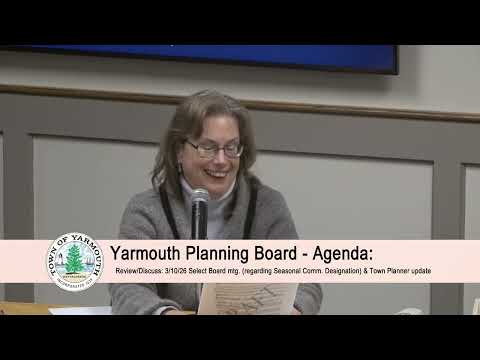
Planner Cathy Williams told the board the state presentation left open key questions about undersized lots, whether new units must be capped at 200'100'50% AMI, permanence of year-round restrictions, and whether the term "regulate" could be read to prohibit movable tiny homes; members asked for written legal clarifications.
Yarmouth planners spent a large portion of the March 18 meeting discussing the state'backed "seasonal communities" designation and what it would mean for local zoning, housing affordability requirements and enforcement.
Cathy Williams, the town planner, summarized a March 13 presentation by Matthew Walsh of the Executive Office of Housing and Livable Communities and said the presentation left multiple unanswered legal and practical questions. Williams said the draft materials did not include a date in the definition of "undersized lots," which raised concern among town planners and several municipal attorneys about whether the designation could apply to future lots. "The actual definition doesn't give a date," Williams said, adding that planners advised specifying a 'prior to' date in the local bylaw to avoid uncertainty.
Williams also said the new designation appears to require that an undersized lot developed under the program be built as an "attainable year-round" housing unit with sales and rental limits tied to AMI. "If you have an undersized lot and you build an attainable home on it when you sell it, you're not going to get the current market rate," Williams said, noting the program contemplates affordability levels up to 200'100'50 percent AMI for sale and rental calculations. The board discussed whether owner or renter qualification rules would follow the current affordable-housing lottery process (Williams said details on qualifications were not available and that the program's enrollment/qualification process was not yet clarified).
Members asked about the permanency of year-round restrictions. Williams said the statute currently treats an unspecified term as a 30-year restriction by default but that towns could set a longer term "if we wanted to"; she said state guidance was working on modifications to allow permanence. Board members also pressed whether the term "regulate," used in the state materials, could be read to permit a local prohibition on movable tiny homes. Williams said she would seek written clarification: "I think that's gonna just be a case where we need to get that clarified and get that in writing," she said.
The board discussed enforcement questions, including how to confirm a tiny home is occupied as a primary residence for the required 10 months per year. Members described scenarios (for example, temporary RV use during house reconstruction) that could complicate enforcement and said local enforcement would likely fall to the building department.
Williams told the board that some capital investment funds exist for designated communities (she cited $2 million for FY26 and $2 million for FY27 in the current materials) but added there is no guarantee of recurring funding. She also said being designated can award extra points in certain grant programs. The board asked staff to compile written questions for state officials and to circulate any forthcoming FAQs and model bylaw templates from the Cape Cod Commission.
The board agreed to continue discussion and to seek written legal guidance before drafting local bylaw language or taking a final recommendation to Town Meeting.