Lifetime Citizen Portal Access — AI Briefings, Alerts & Unlimited Follows
WDFW scientist outlines international salmon monitoring, enforcement work with NPAFC
Loading...
Summary
Dr. Mara Zimmerman told the Fish Committee that the North Pacific Anadromous Fish Commission (NPAFC) coordinates a 100-year dataset, marking exchanges and enforcement cooperation across five countries, noting IUU fishing has declined but uncertainties remain; staff highlighted recent research estimating Gulf of Alaska standing stocks and large-scale hatchery releases.
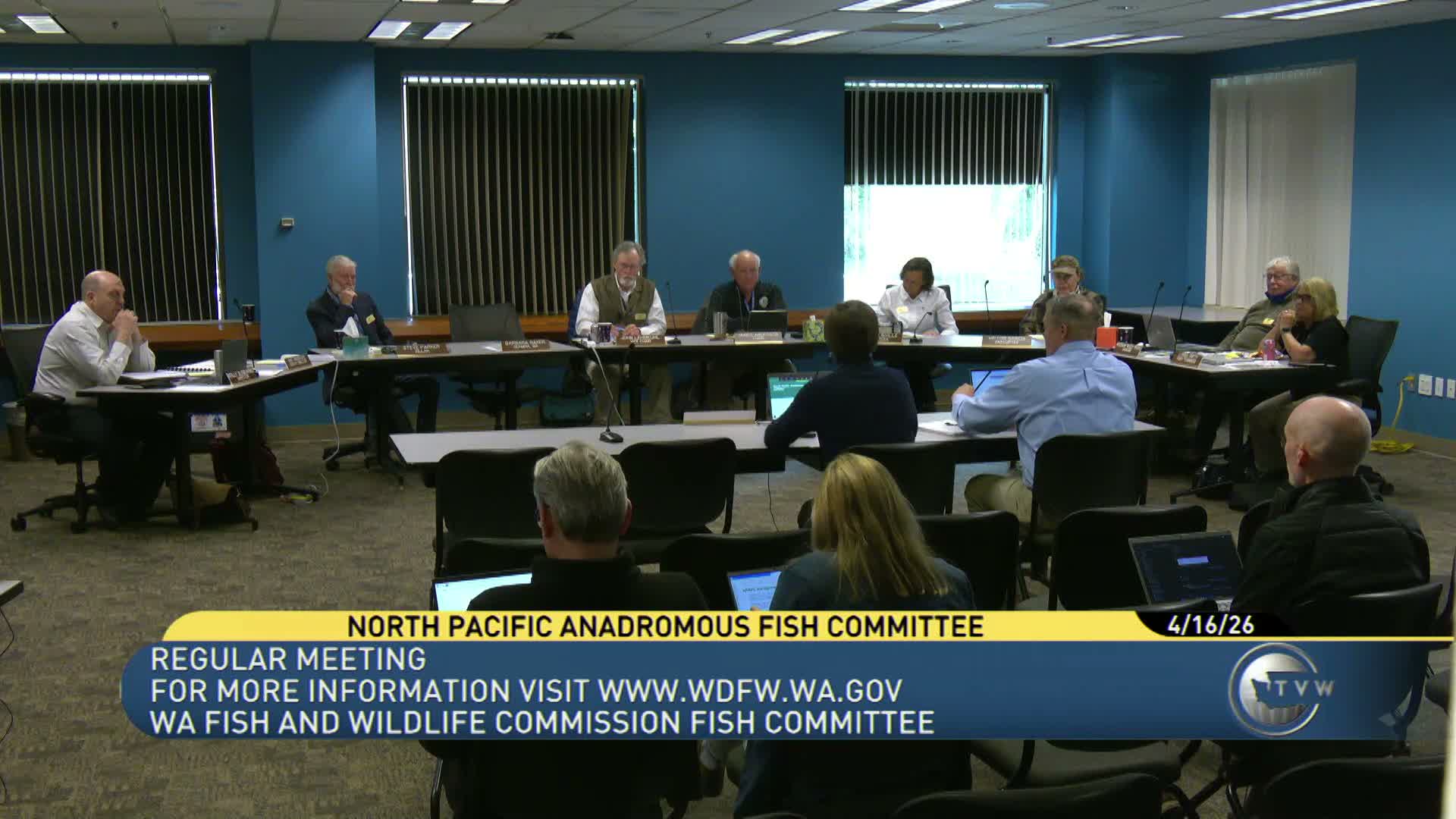
Dr. Mara Zimmerman, lead of the fish science division, briefed the Washington Fish and Wildlife Commission Fish Committee on April 16 about the North Pacific Anadromous Fish Commission (NPAFC), saying the international forum coordinates conservation, scientific exchanges and cooperative enforcement across Canada, Japan, the Republic of Korea, the Russian Federation and the United States. "There is an agreed upon allocation and that allocation is 0," Zimmerman said, describing the convention’s prohibition on directed fishing for anadromous stocks in international waters.
Zimmerman summarized long-term data and research the commission shares among member countries, including a compiled 100-year commercial-catch time series showing dominant catches of pink, chum and sockeye salmon, and a hatchery-release time series she said averages about 5,000,000,000 hatchery fish in recent years. She highlighted coordinated international marking and genetic work used to identify the origin of intercepted fish, noting that in 2025 there were 453 distinct otolith mark patterns entered into a shared otolith-mark database.
The presentation also reviewed recent coordinated research (2019–2022 'International Year of the Salmon') that expanded understanding of offshore and winter salmon ecology. Zimmerman cited a first-ever estimate of standing stock in the Gulf of Alaska of about 55,000,000 immature and adult salmon and said that research documented Washington-origin coho using portions of the Gulf of Alaska previously thought outside their range. "We think of our Chinook salmon management and coho salmon management as very important to our rivers and our fisheries, but if we look broader within the North Pacific we are really talking about an ecosystem dominated by pink, chum and sockeye," Zimmerman said.
Committee members pressed Zimmerman on enforcement and bycatch details. Commissioner John Lemkewil asked for a definition of "directed fishing;" Zimmerman replied that directed fishing involves intentionally targeting salmon or steelhead with gear and location specifics, contrasting it with incidental catch in fisheries such as tuna or squid. Commissioner Steve Parker asked whether domestic fisheries such as pollock or whiting have Chinook bycatch; Zimmerman said those fisheries are in U.S. waters, reported to NOAA Fisheries, and that staff can provide recent bycatch figures on request.
Zimmerman told the committee that enforcement-committee reports show fewer intercepted illegal-directed-fishing vessels over time — suggesting a decline in some forms of IUU activity — but she cautioned that the North Pacific is vast and that unknowns remain. She urged continued investment in enforcement–science coordination and international data exchanges, including the Basin Scale Events and Coastal Impacts (BECI) initiative to consolidate environmental monitoring data across the North Pacific.
The briefing concluded with commissioners thanking staff; Zimmerman offered to return with more detailed data if the committee requested it. No formal action was taken on the NPAFC briefing during the session.