Lifetime Citizen Portal Access — AI Briefings, Alerts & Unlimited Follows
Senate Resources Committee reviews 6¢ per‑MCF alternative volumetric tax and project economics for Alaska LNG
Loading...
Summary
On April 16, 2026 the Senate Resources Committee heard Gaffney Klein analysis showing a 6¢ per MCF alternative volumetric tax (AVT) would yield roughly $60 million annually at current project volumes and raise combined government take to about 33%; members pushed back on 1% indexation, asked about 45Q credit effects and requested further modeling of producer returns and DOR assumptions.
The Alaska Senate Resources Committee on April 16 heard economists and consultants evaluate how proposed changes in tax treatment would affect the economics of a proposed Alaska LNG pipeline and terminal under Senate Bills 275 and 280.
Nicholas Fulford, head of LNG and energy transition at consultancy Gaffney Klein, told the committee that at the project's modeled annual production (about 1,000,000,000 MMBtu), a volumetric tax of 6¢ per MCF would generate roughly $60,000,000 a year and that a 10¢ rate would produce about $100,000,000 annually. "So at 6¢ it's 60,000,000, at 10¢ it's 100,000,000," Fulford said, illustrating how modest per‑unit charges scale over decades. He said a 1% nominal annual escalation would erode the tax's real value over a 35‑year project life; his slide estimated nominal cumulative receipts near $2.23 billion and just under $2.0 billion in real terms after 35 years.
Why indexation matters was a focal point of questioning. Sen. Dunbar criticized the proposal's 1% escalation, saying, "I certainly think 1% is too low. It doesn't even remotely keep up with inflation." Fulford replied that many jurisdictions prefer indexation tied to observed inflation measures and that a fixed nominal percentage over decades carries risk; he also noted that staged or periodic step increases might be alternative design options that protect long‑term value while keeping the mechanism auditable.
Committee discussion also probed how the AVT compares to existing property taxation and to other jurisdictions. Fulford showed a comparison with Canadian LNG fiscal regimes and said that the combination of U.S. federal and Alaska state taxes is roughly 28–28.4% under the slide's baseline and that replacing property tax with a 6¢ AVT would move that combined figure to about 33%. "With the 6¢ volumetric tax, that would move that number up to about 33%," Fulford said.
Senators pressed how federal incentives alter the picture. Sen. Dunbar asked whether the 45Q carbon‑capture tax credit had been included; Fulford said it had not been included in the cited government‑take figure and that the 45Q credit would reduce federal tax receipts in early years: "The 45Q would bring that number down," he said.
Department of Revenue chief economist Dan Stickel, appearing on the record, cautioned that delivered price and project economics do not always move in lockstep because projects must purchase fuel gas for operations and liquefaction. "For each molecule of delivered gas into the market, the project actually has to purchase additional gas above and beyond that," Stickel said, explaining one reason small changes in landed price can have outsized impacts on modeled outcomes.
Sen. Myers and others questioned which market index should be used for long‑term price forecasts (Japan/Korea Marker, Gulf Coast/Henry Hub, oil‑indexed contracts). Fulford said LNG pricing is often a hybrid of indices and that the economics the project must meet are driven by the marginal, cheapest global supply; "it could be 50% oil, 50% Henry Hub adjusted," he said, describing common contract structures.
Members also pressed whether state tax changes or upstream producer economics are the better lever to improve project viability. Fulford said the principal levers are capital cost, the tax regime (property tax vs. AVT), and federal support (loan guarantees or credits), and that detailed, scenario‑based modeling is required to quantify tradeoffs. The committee asked Department of Revenue to provide additional producer‑return information in follow‑up.
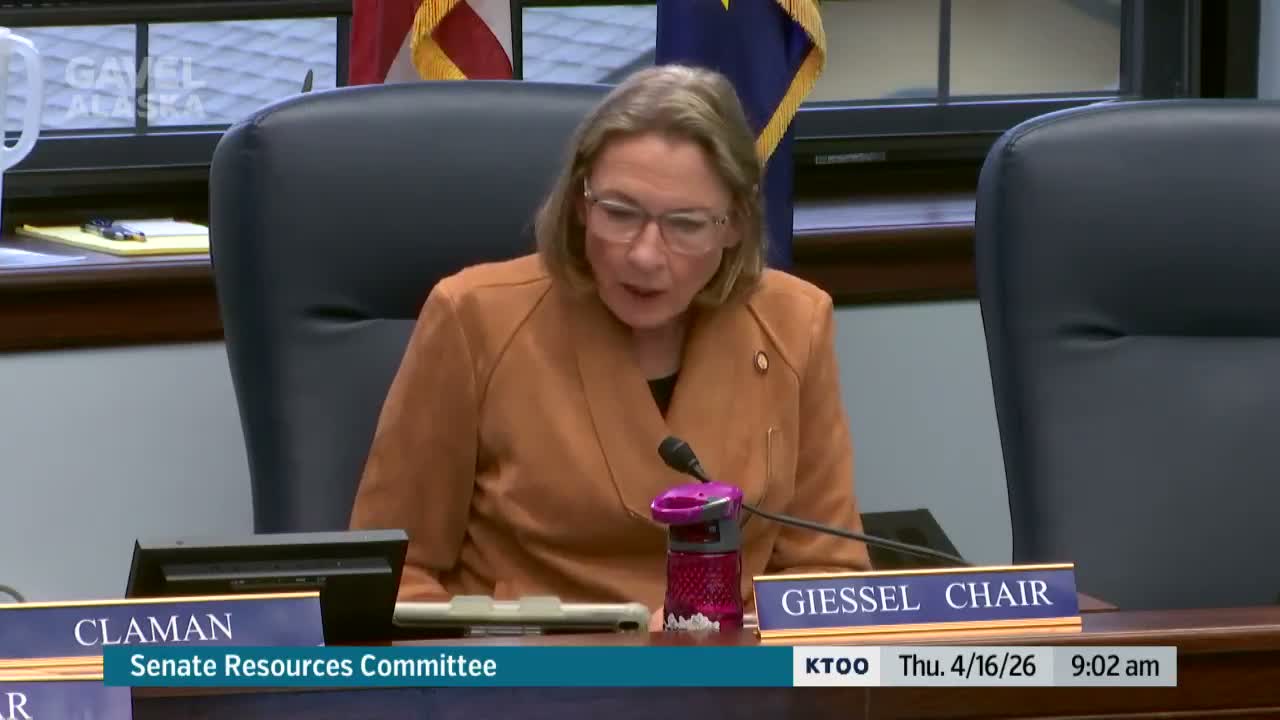
The committee paused its questioning after Fulford completed the slides and scheduled continued consideration; Chair Sen. Giesel said the committee will reconvene April 17 and that the Regulatory Commission of Alaska (RCA) will appear next week to address regulatory questions.
The hearing record also includes a legal clarification read by the chair on municipal taxation: under the state constitution (Article IX, Section 4) and AS 29.45.030(a)(1), property owned by the state or a municipality is exempt from ad valorem property taxes, meaning a spur line owned by a municipal utility would be exempt regardless of whether the AVT framework applies.
Next procedural step: the committee will continue these bills at its next scheduled session and has asked DOR for additional modeling on producer returns and on modeling assumptions that produce differences between DOR and consultant estimates.