Lifetime Citizen Portal Access — AI Briefings, Alerts & Unlimited Follows
Gaffney Klein adviser tells Alaska Senate committee AVT framework needed before setting tax rate
Loading...
Summary
Nicholas Fulford of Gaffney Klein told the Senate Resources Committee that shifting to an ad valorem volumetric tax (AVT) would create fiscal clarity needed to advance an Alaska LNG project, but he cautioned setting a fixed per‑Mcf rate before FEED/FID carries risk and urged an open‑book economic model and reopener provisions.
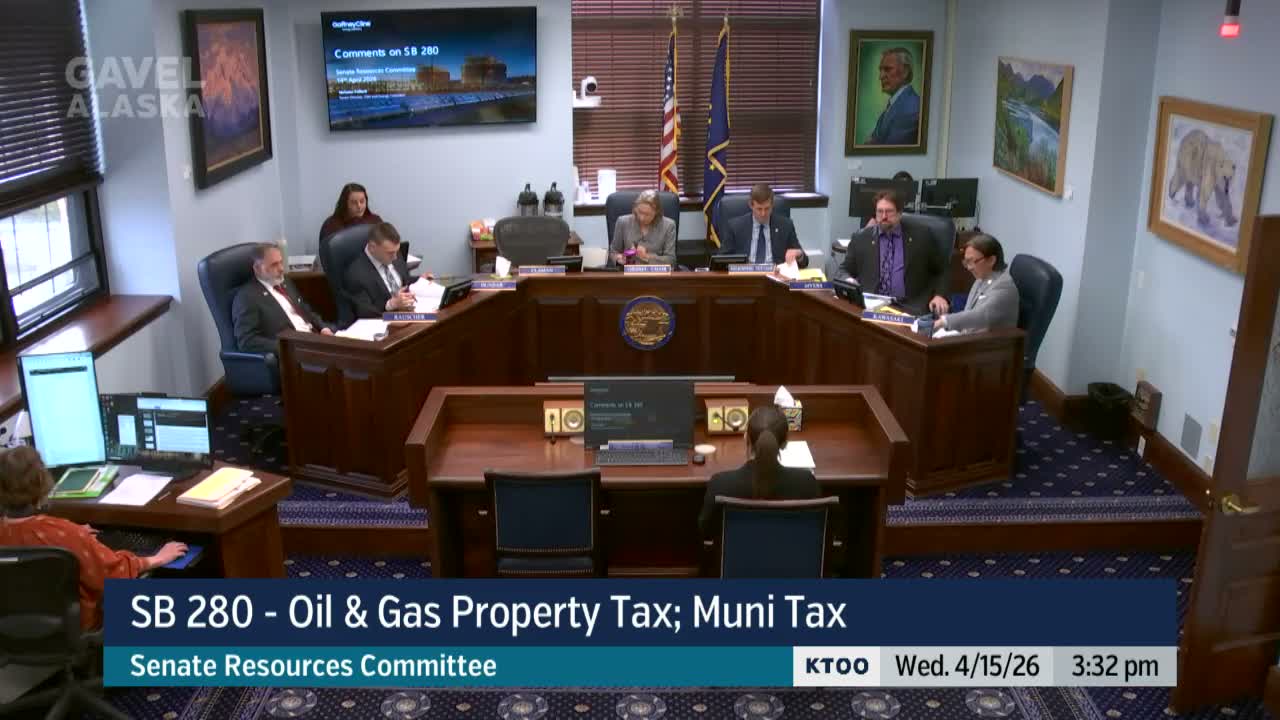
Nicholas Fulford, senior director for LNG and energy transition at consulting firm Gaffney Klein, told the Senate Resources Committee on April 15 that reforming Alaska's property tax mechanism toward an ad valorem volumetric tax (AVT) would supply the fiscal stability developers, buyers and lenders seek to advance a large LNG export project.
Fulford said the committee should think of the issue in two parts: “the way in which the alternative volumetric tax works compared with the existing law, and the level of tax, the 6¢.” He argued the structural move toward an AVT provides a clearer fiscal architecture and a better planning horizon for negotiations with buyers and finance providers.
Why it matters: Fulford said an AVT helps define project economics and financing features that are typically needed before a project reaches FEED (front‑end engineering and design) and a final investment decision (FID). Without that clarity, he said, developers and lenders are hesitant because investors “don’t like change particularly on the tax front.” He urged an open‑book economic model (OBEM) that would allow state stakeholders to test assumptions and recommended mechanisms such as conditions precedent and narrow “reopeners” rather than open‑ended future rate changes.
Context and evidence: Fulford compared Alaska’s situation to other jurisdictions, pointing to examples in Texas, Louisiana, British Columbia and Papua New Guinea. He translated property‑tax concessions elsewhere into cents‑per‑Mcf terms to compare those subsidies with the proposed 6¢ AVT and used an illustrative capital‑cost exercise (a $50,000,000,000 example depreciated over 20 years) to show how taxable value assumptions affect cents‑per‑Mcf equivalents. He warned that tax systems which concentrate burden in early operational years can make Alaska’s front‑loaded property tax appear large compared with jurisdictions that offer multi‑year holidays.
Responses from the committee: Senators pressed Fulford on whether Alaska has the fiscal stability other jurisdictions enjoy and whether the legislature should wait until FEED/FID to set an exact rate. Fulford said the structural question (moving to an AVT) is more urgent than locking the precise rate; setting a rate (for example 6¢/Mcf) could be coupled with a defined framework for limited reexamination as the project’s economics become clearer.
Direct quote: “A formulation of the property tax mechanism towards an AVT would be really an essential step in creating an economic framework for the project with appropriate fiscal controls,” Fulford told the committee.
Unresolved points: Fulford and committee members agreed that capital‑cost uncertainty and key FEED/FID milestones remain the main unknowns; multiple speakers urged more detailed modeling tied to realistic capital estimates and assumptions before permanent rate commitments are made.
Next steps: The committee paused the presentation and scheduled a continuation. Fulford agreed to return for a follow‑up session at 9 a.m. the next day. The committee also plans additional presentations (Regulatory Commission of Alaska and others) and continued public testimony on SB 275 and SB 280.