Get Full Government Meeting Transcripts, Videos, & Alerts Forever!
Get email alerts on the Everglades Restoration topic
No spam. Unsubscribe anytime.
Army announces multibillion-dollar contract to build Everglades A-2 reservoir, partners say work will finish by 2029
Summary
U.S. Army officials said April 13 that a multibillion-dollar contract has been awarded to complete the Everglades Agricultural Area A-2 reservoir foundation, embankment and water-control structures, and federal and state partners said the work is being accelerated to a 2029 completion target. Officials highlighted project scale, funding and expected environmental benefits.
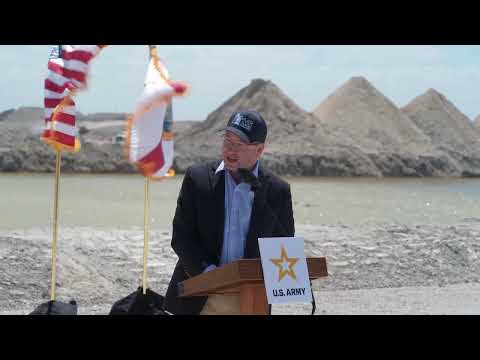
At a site ceremony April 13 at the Everglades Agricultural Area Reservoir Project Site, the U.S. Army announced a multibillion-dollar contract to complete the A-2 reservoir’s foundation, embankment and water-control structures, and federal and state officials said the work will be accelerated to finish by 2029.
Adam Tell, the assistant secretary of the Army for civil works, said the Army “has embarked on an unprecedented multibillion-dollar contract” to complete not only the reservoir foundation but also the embankment and control structures, and credited a joint federal-state effort with collapsing schedule and cost. “This announcement will accelerate the completion of this work by at least 5 years,” Tell said.
Major Jason Kelly, deputy commanding general for civil and emergency operations with the U.S. Army Corps of Engineers, described the A-2 reservoir as a central element of the Central Everglades Planning Project. Kelly said the reservoir footprint is 10,500 acres with 240,000 acre-feet of storage and an operational depth of more than 20 feet, and that supporting features — including an A-2 stormwater treatment area of about 6,500 acres and related canals — are already under contract or construction. Kelly said the broader initiative will deliver roughly 370,000 acre-feet of new water south each year and could reduce damaging discharges to the St. Lucie and Caloosahatchee estuaries by up to 80%.
Florida Governor Ron DeSantis said the state has committed about $8 billion over seven years to Everglades restoration and water-quality work and credited state investment and the partnership with accelerating the schedule. “With these contracts executed, with the money that’s now been dedicated, to bring this completion not in 2034 … but 5 years earlier, 2029,” DeSantis said.
Alexis Lambert, secretary of the Florida Department of Environmental Protection, said the state has taken responsibility for several project components — including pump stations and flow-way work — so federal partners can focus on the reservoir itself. “By aligning our strengths and cutting through barriers, the state of Florida has taken on key components … allowing our federal partners to focus on completing the reservoir, helping accelerate completion by 5 years,” Lambert said.
Speakers and officials at the event emphasized the project’s scale and economic framing. Tell and other speakers characterized the effort as a national infrastructure priority and said the federal-state partnership and recent funding actions reduced projected cost and schedule. Eric Eichenberg, chief executive officer of the Everglades Foundation, described the reservoir as roughly a $4 billion project and said advocacy groups and the congressional delegation have supported the effort since the legislative passage of Senate Bill 10 in 2017.
Officials did not provide a full procurement or contract text at the event; several speakers described contracts for canals and foundation work as already awarded and said the new contract will complete embankment and water-control works. Speakers offered different framings of the project’s political leadership: several credited recent White House and congressional support for increasing federal funding and enabling faster delivery.
Next steps described at the event include ongoing execution of awarded contracts and on-site construction. Officials present said the Army Corps, state agencies and district partners will continue coordinated work toward the stated 2029 completion target; no formal regulatory approvals or permit timelines beyond those described were announced at the ceremony.