Lifetime Citizen Portal Access — AI Briefings, Alerts & Unlimited Follows
Farmers urge St. Joseph County drainage board to delay Amazon site dewatering permit after 2024 flooding complaints
Loading...
Summary
Farmers and residents told the drainage board that dewatering tied to the IEC 3/Amazon site caused flooding and crop damage in 2024 and demanded written data, a letter of intent on crop compensation and independent review; the board voted to table the permit and asked the company to return with clearer data and commitments.
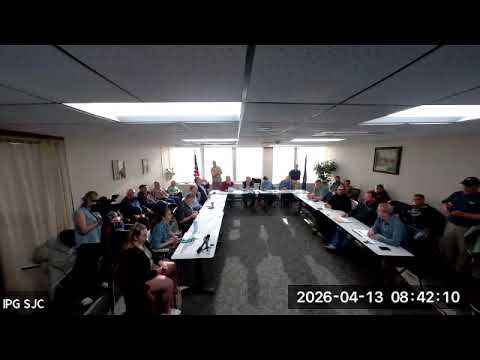
The St. Joseph County Drainage Board on the meeting floor on March 16 heard hours of public concerns and technical testimony about a renewed dewatering permit for work on the IEC 3 parcel tied to Amazon/AWS, and ultimately voted to table the request so the applicant could return with clearer data and a written commitment addressing crop compensation.
Farmers were the meeting’s chief voices. Ryan Bailey, a farmer who gave his address as 30970 Johnson Road, told the board that when contractors pumped the ditch in 2024 “we had our pumps running 24 hours a day, 7 days a week” during the driest months, that he logged roughly 2,800 extra pump hours and that fields suffered lost acreage and poor yields. “If we had to shut them off, the water would have been over top of our fields,” Bailey said, urging the board to prevent a repeat.
Several other landowners echoed Bailey. Bridal Zick of Sears Farms urged the board not to issue the permit until the developer’s team negotiated crop-compensation agreements with affected landowners, saying landowners had supplied historical yield data and received only limited contact from the company since an earlier meeting. Dan Caruso of New Carlisle cited a July 24, 2024 county commissioners’ agreement that set a 24,000,000-gallons-per-day withdrawal cap and warned that adding a proposed 35,000,000-gallons-per-day dewatering operation would risk exceeding local aquifer capacity.
The applicant’s representatives described the planned dewatering as a combination of horizontal wells (used where feasible) and vertical 70-foot wells only where utilities prevent horizontals, saying they dewater only to the depth necessary to install utilities (typically 20–25 feet). Company speakers said they monitor discharge with electronic meters and perimeter piezometers and that monitoring data show no evidence the operations have increased surrounding water tables. One company representative told the board that the reported 546-day duration on the application was a typo and that the intended authorization was roughly a year.
Board members and commenters pushed for readable, documented pumping and monitoring data and for a written letter of intent or commitment from the company addressing crop compensation. Multiple board members said their statutory oversight focused on the ditch’s capacity and permitted discharges — and that the board can require immediate shutoff of dewatering if downstream impacts occur — but they called for a data-driven record before acting on a permit with the level of public concern expressed.
After discussion, a board member moved to table the permit so the applicant could prepare clearer documentation and a proposal that addresses landowner concerns; the motion was seconded and the board carried it by voice vote. Members discussed holding a special meeting and asked the company to produce readable pumping and monitoring data and, if feasible, a written statement of intent about compensation before the next consideration.
The board did not grant or deny the permit at this meeting. Instead, it asked the applicant to return with the requested materials and to coordinate with the drainage board on monitoring and communications to neighboring landowners. Public speakers urged the board to schedule any future discharge to avoid peak planting times and sought independent hydrology review by state agencies or nonbiased experts.