Get Full Government Meeting Transcripts, Videos, & Alerts Forever!
Get email alerts on the Hb 381 topic
No spam. Unsubscribe anytime.
Committee hears revenue modeling showing major municipal losses under proposed LNG tax swap
Summary
The Alaska House Resources Committee on April 15 reviewed Department of Revenue modeling showing House Bill 381 would replace property tax on the Alaska LNG project with a volumetric tax, cutting modeled municipal receipts from roughly $17.3 billion to $3.9 billion over the life of the project and raising questions about timing and local impacts.
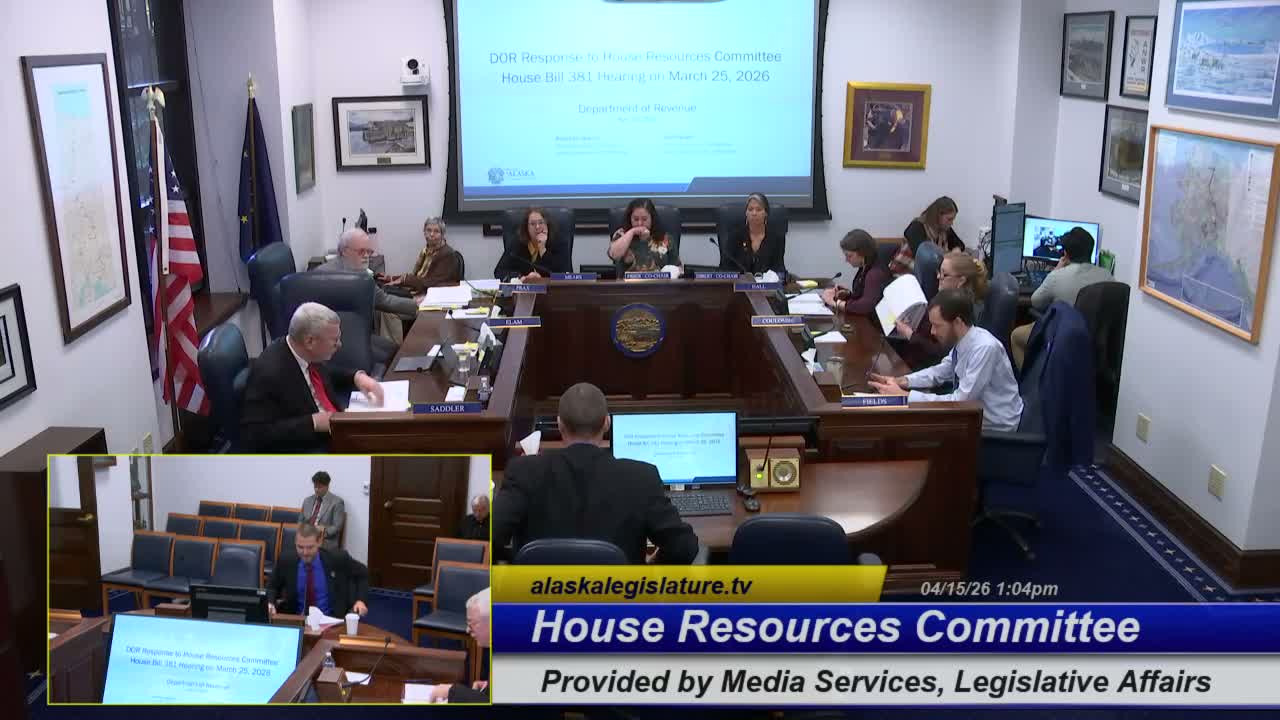
Juneau — The Alaska House Resources Committee heard a Department of Revenue presentation on April 15 that laid out how House Bill 381 would swap property taxes on the Alaska LNG project for an alternative volumetric tax (AVT), and the sizable municipal revenue implications of that change.
Dan Stickel, chief economist for the Department of Revenue, told the committee the bill would exempt “qualified property” from property tax and many municipal levies only if the plant, pipeline and gas‑treatment components were part of the Alaska LNG project. “A stand‑alone LNG import facility would not be exempted under this bill,” Stickel said.
The department’s sensitivity modeling, presented on slide 6, used a baseline capital‑expenditure assumption of about $46.2 billion. Under the baseline (current law) scenario, the five affected municipalities would receive about $17.3 billion in cumulative local property‑tax revenue over the life of the project; with HB 381’s AVT and related exemptions, that modeled local total drops to about $3.9 billion, Stickel said. The department expressed willingness to provide annualized tables and alternative CapEx scenarios on request.
Why it matters: committee members from several regions said those reductions would shift costs and services to local jurisdictions while construction impacts (traffic, worker housing, road wear) arrive sooner. Representative Sadler summarized the concern: “So there’s a pretty big delta there. Why would municipalities agree to this without any kind of compensatory?”
Timing and threshold: under the bill text and the department’s baseline assumptions, the AVT would begin once the project reaches 1 billion cubic feet per day throughput. Stickel said the department’s modeling assumes that threshold will be reached in 2031 and full project capacity by 2033; if throughput stays below the threshold, the bill’s ramp provisions mean municipalities could see no AVT or property tax from the project for up to a decade. “If by any chance the volume did not exceed 1,000,000,000, there would be no tax flowing from this for a decade,” Representative Sadler said.
Members asked for additional analysis: lawmakers pressed the department for further, specific scenarios — annual revenue tables at various throughput levels, AVT escalator alternatives (the bill includes a 1% annual increase), phase‑1‑only models (in‑state pipeline without full export trains), and mill‑rate comparisons. Stickel and other presenters said the department and AGDC consultants would supply supplemental analyses, including modeling of alternate AVT ramps and different mill‑rate equivalents.
Quotable from the presentation: Stickel said, “To be a qualified property under the bill, an LNG plant would need to be part of the Alaska LNG project.” Matt Kissinger, commercial director for AGDC (on the line), said the benchmarking and tax adjustments are aimed at improving the project’s ability to reach a final investment decision in competitive markets.
What was not decided: the committee did not vote on HB 381. Members continued to debate tradeoffs between municipal revenue and project feasibility and asked for written follow‑up. The committee’s amendment deadline for HB 381 was extended to Friday, April 17 at 4:30 p.m., and the bill is scheduled to return to House Resources on that date for further consideration.
Background: the presentation cites assumptions about CapEx and throughput that were developed for the department’s supplemental fiscal analysis; members repeatedly requested scenario breakdowns and documentation from consultants and AGDC to test sensitivity to different cost, throughput and tax‑escalator assumptions.
Next steps: the Department of Revenue committed to providing the requested annualized and phase‑1‑only scenarios and other supplemental materials to the committee before its next scheduled meeting.