Get Full Government Meeting Transcripts, Videos, & Alerts Forever!
Get email alerts on the Oil And Gas Regulation topic
No spam. Unsubscribe anytime.
House panel debates Reiser bill to formalize process for higher-pressure saltwater disposal wells
Summary
Lawmakers, operators and Department of Conservation and Energy officials debated House Bill 706 on April 15, 2026; the bill would set a site-specific process for requests for higher injection pressures. Members split 6–6 on a motion to report the bill, and the author said he will continue talks with the department.
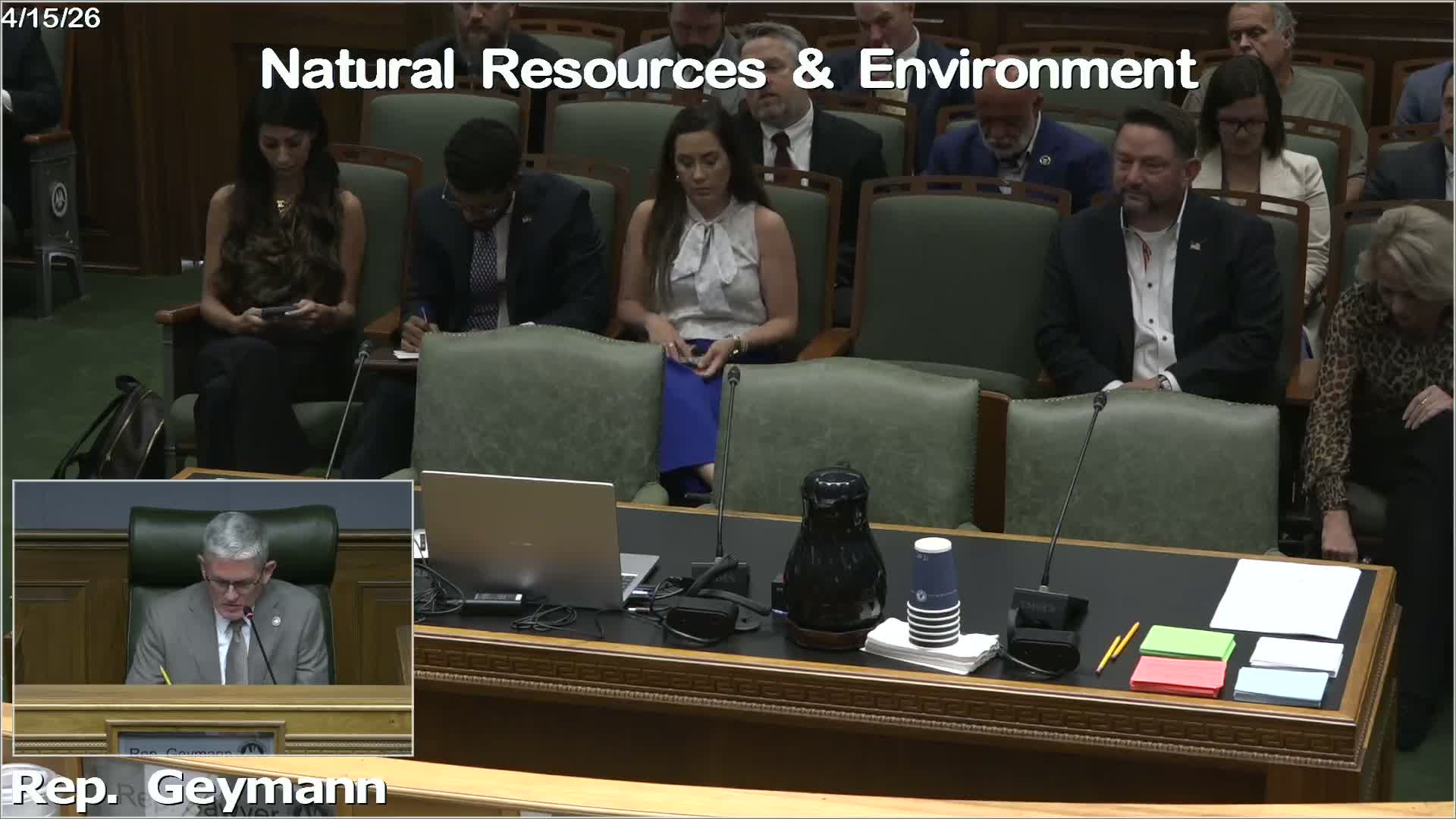
A House Natural Resources Committee hearing on April 15 focused on House Bill 706, authored by Representative Reiser, which would establish a formal, site-specific process for operators seeking higher maximum injection pressures at commercial saltwater disposal wells.
Reiser said the measure is intended to give operators predictable rules so they can make multi‑million dollar investments. ‘‘We’ve lost some major companies because we don’t know what the rules and the regs are,’’ he said, arguing the bill creates a structured method for modeling, testing and permitting exceptions.
Operators told the committee the current process is inconsistent and slow. ‘‘When they revoked that variance, they promised us something else to try to replace it,’’ said Brian Snead, owner of Bulldog Oilfield Services, describing his Frierson, Louisiana, project. Snead said his permit came with a 1,160 psi limit that left the facility economically infeasible compared with a roughly 2,500 psi allowance in Texas for similar wells.
Department of Conservation and Energy (DCE) officials urged caution. Secretary Dustin Davidson read an EPA Region 6 recommendation that the department ‘‘implement enhanced pressure and volume monitoring that includes a thorough review of fault maps and geologic data’’ after a recent cluster of seismic events, and warned that the EPA could remove state primacy if the program strays from federal guidance. Gavin Broussard, head of engineering for DCE’s underground injection control program, said fracture pressure is formation‑dependent and that the department is developing guidance that would permit exceptions when site data (coring, modeling or adjacent testing) demonstrates safety.
Members pressed technical points: whether Eaton’s correlation or other fracture‑gradient methods should be used, the role of coring versus modeling, how to account for legacy wells and how quickly DCE could complete a site review. DCE told the committee the time to evaluate a request depends on the data provided and that the agency is working to publish clearer guidance outlining the criteria for exceptions.
Lawmakers also questioned the fiscal note, which estimates roughly $330,000 per year for three new positions to handle reviews, and asked whether permit or expedited‑review fees could offset costs. DCE said revenue depends on the number of exception requests; committee discussion mentioned an applicant fee of about $750 per hearing in some scenarios.
Representative Ventrella moved the bill favorable as amended. The motion met objection and a roll call produced six yeas and six nays; the committee did not report the bill out that day. Reiser said he would continue discussions with DCE.
The committee’s next steps, as described on the record, are additional talks between the bill’s author and DCE to refine pressure ranges and the review timeline; no floor action was recorded during the hearing.