Get Full Government Meeting Transcripts, Videos, & Alerts Forever!
Get email alerts on the Water Infrastructure topic
No spam. Unsubscribe anytime.
Escalon gets a primer on groundwater wells as city weighs $14M surface-water and $40M wastewater projects
Summary
Public Works briefed the council on four municipal wells, seasonal pumping (peak ~2,000,000 gallons/day), testing and SCADA monitoring; city manager and staff said a $14M surface-water conveyance project and a phased ~$40M wastewater plant will be pursued only when funding—grants, leases or loans—are secured.
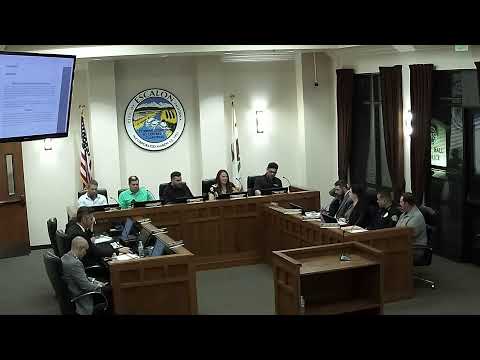
Escalon’s Public Works staff gave the City Council a detailed briefing on the city’s groundwater wells and the long-term infrastructure needs that prompted planning for a $14 million surface-water conveyance project and a multi-phased roughly $40 million wastewater-plant replacement.
"The city of Escalon collects, treats, and distributes safe drinking water from 4 municipal groundwater wells pulling from our local aquifer," Public Works said in the presentation, noting the system serves roughly 2,328 residential and 167 commercial connections and 33–35 miles of water mains. Staff told the council the system pumps about 2,000,000 gallons per day in summer months and as little as about 600,000 gallons per day in winter.
Staff reviewed the individual wells: the newest well (described in the presentation as Well 1A) cost in the low millions to drill and is nearing production; Well 3A (the primary production well, drilled in 1988) produces about 1,400,000 gallons per summer peak; Well 9 and Well 10 provide redundancy and geographic coverage. The presenter highlighted monitoring practices—25 sample stations, Title 22 testing, and a SCADA system that monitors pressure and production—and stressed that regulatory changes (notably tightened arsenic limits) can make previously acceptable sources noncompliant.
City Manager Trevin and staff discussed two capital priorities. Trevin said the city holds a surface-water allocation but lacks a conveyance pipeline; completing conveyance would cost roughly $14 million. On the wastewater side, staff said the plant needs substantial work and described an approach to phase improvements so the city is not required to fund a single large up-front project. Trevin said staff have paused active design/construction until the city can identify funding, and that options under review include grants, leasing the city’s water allocation to other agencies to generate revenue, and phased design to spread costs.
Council members pressed for more detail on life-cycle costs and asked whether new wells guarantee production; staff emphasized drilling discovers production zones but does not create them. On timing and budget, staff said the last full water-rate study was in 2018 and the city has not implemented the assumed multi-year rate increases; a full funding plan would likely need a rate study update, loans, and grant support.
Next steps include compiling more precise cost estimates for the surface-water conveyance and the wastewater-phase plan, pursuing grant opportunities, and returning to the council with funding options and schedule recommendations.