Get Full Government Meeting Transcripts, Videos, & Alerts Forever!
Get email alerts on the Developmental Disabilities topic
No spam. Unsubscribe anytime.
State DDD official outlines eligibility, services and application steps for developmental disabilities
Summary
A Department of Economic Security Division of Developmental Disabilities official told the Surprise commission that DDD serves about 63,000 Arizonans, described qualifying diagnoses and age‑based functional tests, explained categories of coverage (DD‑only, Access, ALTCS) and outlined the application and documentation process, including a 60‑day eligibility letter timeline and appeal options.
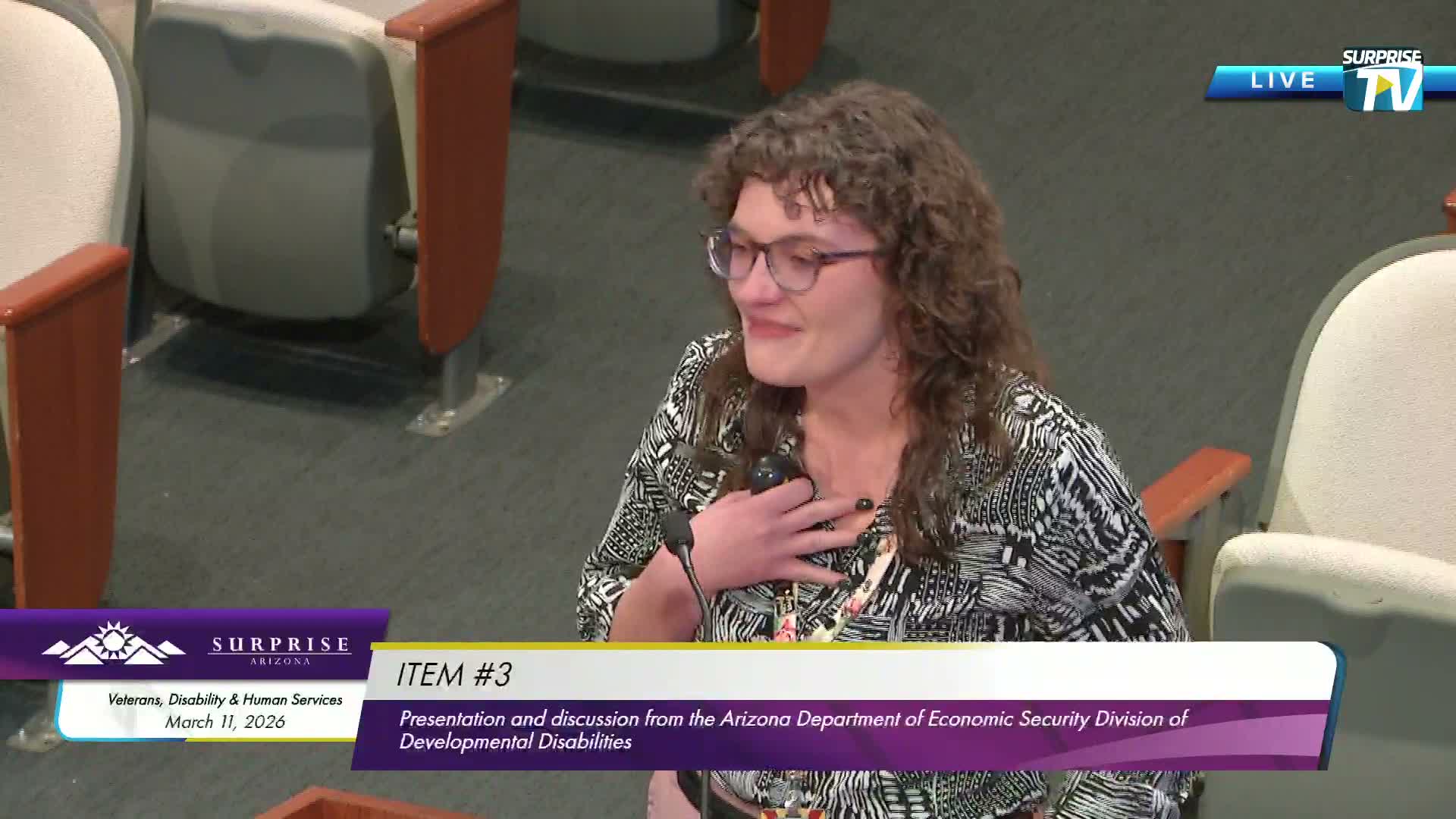
Mickie Barnhart, community engagement coordinator for the Arizona Department of Economic Security’s Division of Developmental Disabilities (DDD), briefed the Surprise Veterans Disability & Human Services Commission March 11 on DDD eligibility rules, services and how residents apply for supports.
Barnhart said DDD’s mission is to empower individuals with developmental disabilities to lead self‑directed lives and explained the Arizona Early Intervention Program (AzEIP) for children birth through 36 months. She listed the five qualifying diagnoses used by DDD — autism spectrum disorder, cerebral palsy, epilepsy, intellectual/cognitive disabilities and Down syndrome — and said diagnostic evidence must show the condition manifested before age 18 and is likely to continue.
Barnhart described how eligibility changes with age: children under 6 can qualify by diagnosis or by being at risk (50% delay in one developmental area or 25% delay in two); after age 6 a formal diagnosis plus serious functional limitations in at least three of seven categories (self‑care, communication, learning, self‑direction, mobility, capacity for independent living, economic self‑sufficiency) is required. She said some diagnoses (for example, autism) must come from specific licensed professionals — psychiatrists, neurologists, licensed psychologists or developmental pediatricians — and cannot be established only by a school psychologist.
On the application process, Barnhart said applicants must provide proof of Arizona residency, documentation of disability and functional limitations, identification (birth certificate, passport or immigration paperwork), and insurance information if applicable. Applications can be emailed to the DDD application address or dropped off in person; applicants should receive a mailed eligibility letter within 60 days. If denied, Barnhart said applicants may submit additional documentation, reapply at any time, or file an appeal per the instructions in the denial letter.
Barnhart also explained three DDD eligibility/payment categories: DD‑only (private/commercial insurance pays services), Access (financial eligibility for AHCCCS Access), and ALTCS (Arizona Long Term Care System) which covers medical and behavioral services through contracted plans. She emphasized DDD and ALTCS are separate agencies with different application and eligibility processes.
Barnhart described support coordination (DDD’s case management), the person‑centered service plan (PCSP), the role of planning teams (which can include family, guardians, and other service providers) and a range of services such as attendant care, day programs, employment supports, home modifications, in‑home nursing, therapies, respite and transportation. She invited local partners to request presentations and said DDD has volunteer opportunities for oversight and advocacy.
Commissioners asked about school records and IEPs: Barnhart said school documentation can be helpful evidence for functional limitations and recommended coordination between DDD and local schools and provider relations teams for more technical questions.
What’s next: Barnhart offered follow‑up contact information and said DDD team members can provide more detailed provider relations or vendor‑specific information on group homes and other services.