Get Full Government Meeting Transcripts, Videos, & Alerts Forever!
Get email alerts on the Nature Based Flood Mitigation topic
No spam. Unsubscribe anytime.
Panelists urge scaling nature-based flood projects, cite Washington program's $359 million investment
Summary
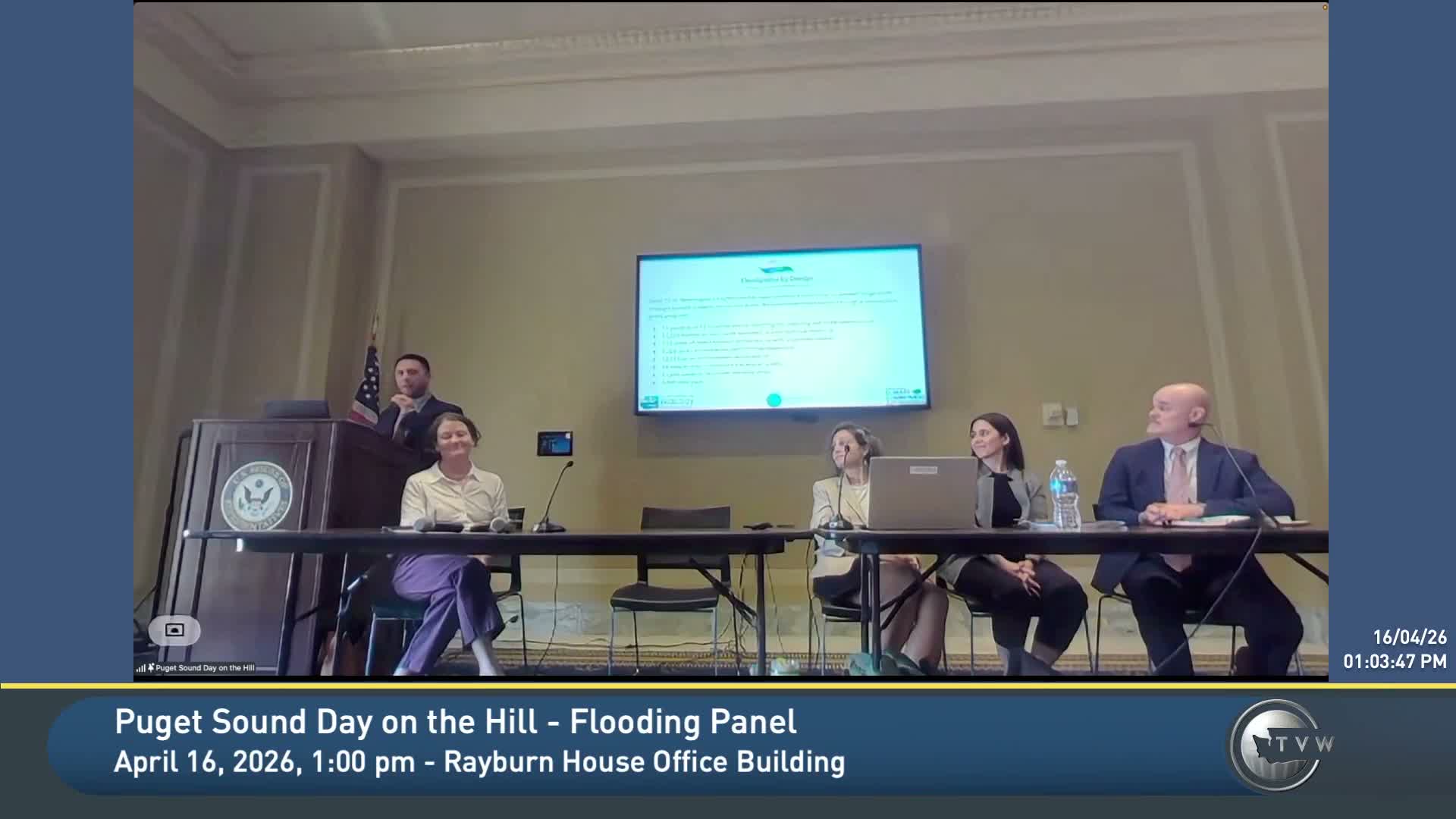
Panelists at a resilience session said multi-benefit, nature-based flood projects reduce risk and deliver environmental benefits but require larger, diversified funding; speakers cited roughly $359,000,000 invested in Washington and described voluntary buyouts, setbacks and side-channel projects as examples.
Panelists at a presentation on nature-based flood mitigation urged greater investment and streamlined permitting to scale projects that both reduce flood risk and restore habitat.
Tazio Bey, who opened the session and identified himself as a watershed codings director at a Portland-based health foundation partnering with the Washington State Department of Ecology, said locally available dollars are insufficient to meet the scale of need and that the "cost of inaction is so much higher than the cost of doing the solutions." He framed the discussion around multi-benefit, landscape-scale projects that combine flood-risk reduction with habitat gains.
Bob, who introduced himself as the Southwest director for the Washington State Department of Ecology, described Washington’s program (named in the transcript as a ‘‘Place/Club … by Design’’ program) as a public–private partnership that the state has used to leverage federal and private funds. "We've already seen investment of $359,000,000 in these projects," Bob said, and he listed measured outcomes including fewer flood damages, better emergency response and improved water quality.
Panelists gave examples: in King County a Riverbend acquisition relocated "over 10 homes" from high-risk areas, which the panelists said improved emergency response and reduced channel erosion and debris; other projects mentioned include setback levees and side-channel refugia that slow flood velocities and create aquatic habitat. Bey said voluntary buyouts, when paired with careful community engagement and land‑trust partnerships, can preserve community ties while moving households out of harm’s way and argued that "buyouts save money," a claim he encouraged attendees to view alongside the cited research.
Speakers also described regulatory and procedural barriers. Several panelists argued restoration-focused projects are often slowed by permitting systems that were not designed with active restoration in mind, and they urged reforms such as consolidating steps, removing unnecessary permits and providing stronger applicant support so projects can proceed more quickly when hazards create opportunities.
During audience Q&A, an attendee asked which climate horizon panelists used in planning. Panelists said they run climate-adjusted analyses across emission scenarios and commonly phase planning from nearer-term benchmarks (examples given included 2030 and 2050) out to 2100, using conservative, moderate and high scenarios to design phased actions. On data and tools, panelists noted interest in AI and startup work for sediment mapping and sediment-use planning, but also emphasized that data-management gaps and resource constraints limit how quickly projects can scale.
The session closed with an invitation to continue questions after the panel and with a reminder that the US National Nature Assessment (noted in the transcript) is open for public comment, including a chapter on "Nature, risk, resilience, and security."