Lifetime Citizen Portal Access — AI Briefings, Alerts & Unlimited Follows
Tempe preservation commission and foundation outline duties, projects and outreach plans
Loading...
Summary
At a joint meeting, city staff reviewed the Historic Preservation Commission's advisory duties under City Code Chapter 14A and the Tempe Historic Preservation Foundation described ongoing projects including a POW barracks rehabilitation, Double Butte Cemetery work and a preservation bond.
The Tempe Historic Preservation Commission met jointly with the Tempe Historic Preservation Foundation to review the commission's advisory role and to hear the foundation's recent projects and outreach plans.
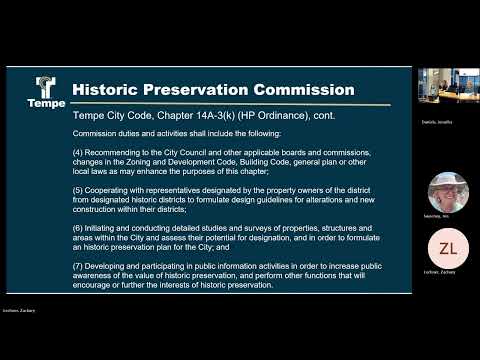
Dr. Lechner, staff to the commission, read the ordinance language that frames the commission's work, saying, "The Commission shall act in an advisory capacity to the City Council and all matters concerning historic preservation." He summarized the commission's duties under City Code Chapter 14A: recommending landmark and district designations, reviewing applications for alterations and demolition, advising on use of federal, state and city funds and promoting public outreach and surveys of potentially historic resources.
Rob Moore, speaking for the Tempe Historic Preservation Foundation, gave an overview of the foundation's mission and recent activity. He said the nonprofit, formed in 2005, focuses on advocacy, education and fundraising for at-risk historic properties and cultural resources. "One of our focal points is the Camp Papago Park POW barracks rehabilitation and interpretive installation," Moore said, and he noted the foundation's role in supporting Double Butte Cemetery and Eisendrath House efforts. He also cited a recent bond that included preservation funding, describing it as a "$2,000,000 community investment" meant to support local preservation work.
Foundation and commission members described specific projects and engagement efforts. Foundation co-founder Darlene Justice recounted research and community outreach around the Eisendrath House, saying they had unearthed physical evidence of past residents, "they had found a concrete slab ... and there were the handprints of four children," which helped galvanize local support. Peggy Maroney and other volunteers were credited for cemetery programming and tours.
Commissioners and foundation members discussed how to encourage owners of historic-eligible properties to register them, stressing property-owner consent is required for listing and recommending user-friendly materials. Staff said the city has previously sent letters to eligible owners and agreed to explore more direct outreach, neighborhood presentations, printed handouts and partnerships with Arizona State University and the Tempe History Museum to reach broader audiences.
On funding and technical support, staff noted the city will consider applying for Certified Local Government grant funding for planning projects and said more than $300,000 is available for short-term stabilization work on specific buildings if needed while longer-term development agreements are negotiated.
The commission said it will compile the meeting's outreach ideas into an implementable public-engagement plan to guide collaboration with the foundation, ASU and neighborhood groups. The HPC's next regular meeting was announced for May 13, and staff said the consultant presentation for the downtown core plan outreach could be rescheduled to allow more stakeholder input.
The commission approved the March 11 minutes at the start of the meeting and then adjourned after the joint session.
What happens next: staff will work with the foundation to document outreach proposals, explore a GIS layer for designated properties and bring program ideas back to the commission for inclusion in a preservation outreach plan.