Lifetime Citizen Portal Access — AI Briefings, Alerts & Unlimited Follows
Milwaukie council reviews three-tier water rate to fund PFAS treatment, protect low-income customers
Loading...
Summary
At an April 14 study session, Milwaukie City staff and a consultant outlined a proposed three-tier water rate design intended to fund PFAS treatment and better align cost recovery; council asked staff to deliver consumption data for Utility Assistance Program participants ahead of a June 2 vote to ensure low-income households are not inadvertently burdened.
Milwaukie City Council on April 14 received a presentation on a proposed three-tier water-rate structure intended to raise revenue for required PFAS treatment and to move residential rates closer to cost-of-service. Public Works Director Peter Passerone said the city must meet federal PFAS-treatment rules and that staff are planning to fund the work in part with state revolving loan funds.
"We have a deadline of needing to be compliant fully compliant by 2031. But to be fully compliant, we need to have that true operation by 2030," Passerone said, summarizing the compliance timetable and the need to begin construction and operations well in advance.
The presentation from the city's consultant laid out three volume tiers for residential usage: a lower block for 0–3 CCF billed at $3.65 per CCF, a middle block for 4–10 CCF at $5.48 per CCF, and a discretionary block for usage above 10 CCF at $7.31 per CCF. Consultant John Guillerdewki said the structure is designed so many low-use customers would see lower bills while higher users would make up needed revenue: "That third tier really kicks in" to recover revenue from heavy users, he said.
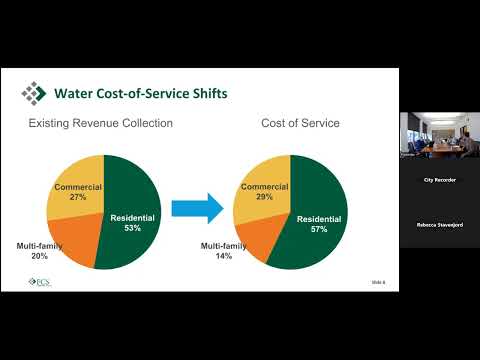
Why it matters: staff say the three-tier design both raises the revenue needed to pay for treatment and reduces a cross-subsidy that has been borne in part by multifamily customers. The cost-of-service analysis presented at the session showed single-family residential currently carries roughly 53% of water cost recovery and would move toward 57% under cost-aligned rates; commercial and multifamily allocations would be adjusted accordingly.
Council members probed distributional effects. One councilor raised a household-size example to illustrate potential hardship: "Her bill is gonna go up 28% just by the fact that they 8 people live in there," the councilor said, pressing staff to confirm whether larger households are disproportionately affected. Staff replied that meter-level billing data exist but households are not tracked by occupancy, and that the city can produce a consumption-distribution analysis for customers enrolled in the Utility Assistance Program (UAP).
Staff noted offsetting assistance: in the modeled bills, the city would keep an existing $5 monthly low-usage discount for accounts billed at 3 CCF or less and maintain other low-income fixed-charge reductions. Passerone emphasized trade-offs in program design: expanding or deepening discounts reduces revenue that must be recovered elsewhere in the rate structure, and staff favor a design that is simple enough to implement in the city's billing system.
Council direction and next steps: members asked staff to generate a distribution curve showing UAP-enrolled customers’ usage so the council can assess whether the tier design would unfairly affect low-income households. Staff said they could produce that targeted distribution within a week, and the council discussed taking direction at the second meeting in May so that rates could be adopted (a formal vote on rates is scheduled for June 2). No formal rate ordinance was adopted at the study session.
The council closed the water-rate discussion after agreeing on the data request and moved to the fee-schedule review.
Source: Milwaukie City Council study session transcript (April 14) — presentation and Q&A led by Public Works Director Peter Passerone and consultant John Guillerdewki.