Lifetime Citizen Portal Access — AI Briefings, Alerts & Unlimited Follows
Hood County debate over data centers intensifies as residents press court to require unified master plans
Loading...
Summary
Residents, engineers and lawyers urged Hood County commissioners to deny or return concept plans for Project Lion and Project Panther, arguing they are segmented parts of a larger Comanche Circle industrial complex and lack verified water sources, drainage studies and cumulative impact analysis. Commissioners instructed staff to pursue drafting regulatory updates and a procedural review.
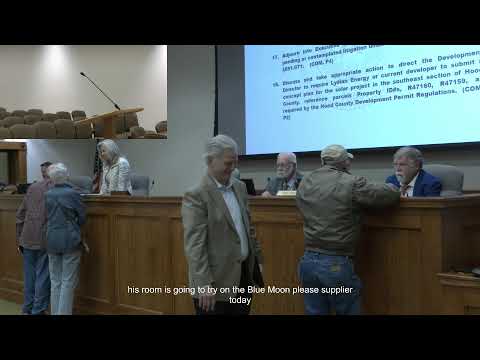
Hood County’s commissioners spent a substantial portion of their April 14 meeting hearing from residents, engineers and outside counsel who argued the filings for Project Lion and Project Panther are pieces of a larger industrial buildout and should be treated in the aggregate.
Multiple speakers — including neighborhood residents, retired engineers and water‑resource experts — said the concept plans lack required, verifiable information on water supply, drainage and grid impacts and that the developer’s use of separate LLCs creates a segmentation strategy that bypasses comprehensive review. “These are not standalone projects,” said one speaker; others showed conceptual maps and raised the prospect of downstream impacts to the Paluxy/Brazos watershed and nearby Dinosaur Valley State Park.
County staff and development‑commission representatives described a planned, phased approach to rewrite portions of the development permit regulations (subchapter K) and said the development commission is working on a triage package to produce enforceable non‑residential regulations within months. The court directed staff to bring back a proposed procedural review and to ensure that precinct commissioners are copied on project communications.
The commissioners considered, then failed, a resolution to categorically oppose tax abatements and other incentives for high‑water‑use industrial projects; the resolution resulted in a tie vote on the floor (two ayes, two nays) and therefore did not pass. Residents had urged the court to adopt a moratorium or require comprehensive third‑party impact studies before any abatement or contract.
Several technical issues were repeatedly flagged in public testimony: an apparent mismatch between claimed well coordinates and the state well registry (a speaker said a well’s coordinates matched a site in Wise County), inconsistent or incomplete stormwater and detention‑pond calculations, and missing unified master‑plan documents connecting adjacent filings. Speakers urged the court to deny or return the concept plans until a single master plan, cumulative hydrology and grid studies, and independent third‑party reviews are submitted.
What happens next: The court approved a motion to advance a phase‑1 scope to prepare updated development permit regulations and to present a proposed submittal calendar/process for review. Commissioners also asked staff to compile project filings and permit documents so precinct commissioners and the public can confirm what has been submitted.
Ending: The public hearing closed after dozens of speakers; commissioners asked county counsel and staff to return with a procedural recommendation and to schedule follow‑up items for future meetings.